I don't want a power transmission supplier who can sell me everything. I want one who tells me what they're really good at—and what they're not. After six years of managing a $180,000-plus MRO budget, I've learned that 'we do it all' is not a strength. It's a warning flag.
When I first started managing vendor relationships, I assumed the biggest catalog meant the smartest supplier. I was wrong. The supplier with the broadest list often has the shallowest technical answers. And in power transmission, a shallow answer is expensive. I'm not saying every generalist is bad. I'm saying that when a plant depends on uptime, I need application engineering, not just order entry.
The 'We Do It All' Trap
It's tempting to think one distributor can be great at chains, bearings, actuators, and couplings all at once. But nobody can be excellent at every product category. A generalist can stock them; a specialist can select them. The difference shows up when something goes wrong.
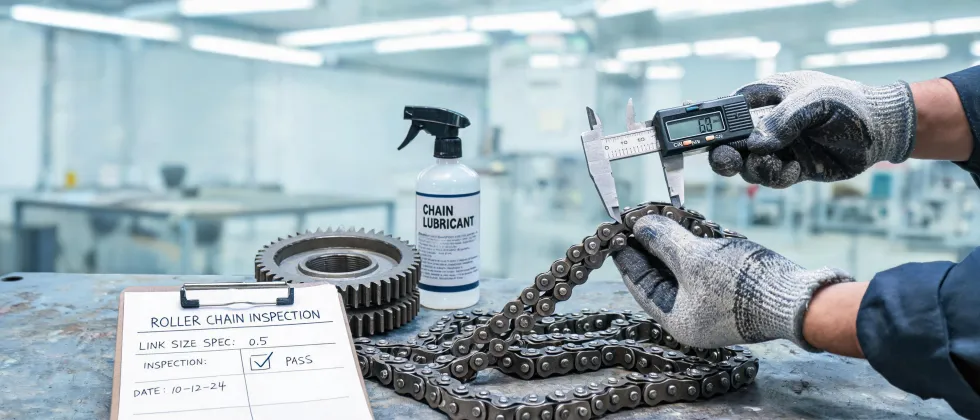
Take something as specific as a Tsubaki Titan chain. If a salesperson quotes you a part number without asking about the application, they're not actually selecting a chain—they're reading from a spreadsheet. The Tsubaki roller chain catalog has load tables, service factors, and lubrication requirements for a reason. I use the online tsubaki-chain catalog almost every time I price a conveyor. The engineering pages matter more than the price list. I downloaded the current edition in January 2025, and I still find myself checking the notes on sprocket tooth form and chain elongation before I approve a substitute.
I buy precision roller bearings several times a year. I don't just want a generic 6204. I want the internal clearance class, the cage design, and the sealing arrangement specified. If a supplier can't tell me whether the bearing has a pressed steel cage or a machined cage, they can't help me predict reliability. That's not a catalog failure—it's a boundary problem. They're better at other things, and I'd rather they tell me. It sounds counterintuitive, but a vendor who says 'I don't stock that class regularly' is more useful than one who says 'they're all basically the same.'
The same test applies to rotary actuators electric. Ask what torque you can get at a specified duty cycle, not just the max torque in the brochure. If the supplier can't explain duty cycle in plain terms, they won't be much help when the actuator stalls in production. A specialist will tell you the limits; a generalist will tell you it's fine. I've also started asking for the controller specification at the same time, because a rotary actuator is only as reliable as the drive behind it.
The Linear Actuator Question
If you want to see how a power transmission supplier actually thinks, ask them this: what happens when a linear actuator fails?
Most buyers focus on load capacity and speed. The better question is: what happens when the actuator fails? Does it stall and overheat? Does the load drift? Does the limit switch stop it, or just tell a PLC that it should stop?
That question has saved me more money than any quote comparison. In 2024 I almost approved a prototype purchase for a packaging line. The actuator looked right on paper. Then the supplier asked what would happen if the power dropped at mid-stroke. I hadn't thought about back-driving, so I tested it. That test cost $450 and avoided a much larger failure after installation.
The supplier who asks that question is the one who knows their product's limits. The one who says 'it'll just stop' is guessing. The same logic applies to screw-driven actuators, belt-driven units, and rotary actuators electric: if the product stalls, what protects the process and the people nearby? Those are application engineering questions, not price sheet questions.
Price Is Not Total Cost
I used to think the lowest quote was always the best choice. Three budget overruns later, I learned about total cost of ownership.
In Q1 2025 I compared six suppliers for a repeat order of precision roller bearings. One specialist quoted $12,400, including freight and certificates. A general distributor quoted $11,050. I almost went with the cheaper one until I added the line items: freight on three split shipments, a $600 expedite fee, and my engineer's time chasing missing test reports. Total: $12,900. The specialist was effectively $500 cheaper, even though their quote was $1,350 higher.
That's the oversimplified advice people give: get three quotes. The advice ignores the transaction cost of evaluating a new vendor and the value of a supplier who already knows our specs. After comparing six suppliers using our TCO spreadsheet, I built a shortlist of vendors who can actually answer application questions. Since then, I've cut the number of suppliers I use for critical components from eight to three. That consistency has done more for my budget than any single discount.
Maybe that sounds like a lot of effort for one bearing order. But when you multiply that effort across 30 active part numbers, the ROI is obvious. I track every purchase in the same spreadsheet, so I can see which suppliers cause follow-up work and which ones don't.
Most buyers focus on per-unit pricing and completely miss the documentation and failure-mode analysis that keep a line running. The question everyone asks is 'what's your best price?' The question they should ask is 'what's included in that price?'
We didn't have a formal process for reviewing failure-mode documentation. That cost us when a prototype actuator stalled and cooked its controller. After that, I built a simple checklist: ask about failure mode, ask about replacement part lead time, ask who to call when it breaks. I should have done it after the first problem, not the third. Now that checklist is part of every PO over $1,000.
Why I Trust a Supplier Who Says 'I Don't Do That'
Here's the part that might sound backwards: a supplier who admits a product isn't their strength earns my trust for everything else. I'd rather work with a specialist who knows their limits than a generalist who overpromises.
That doesn't mean I only buy from one manufacturer. I keep a local distributor for commodity parts and use specialists for anything with real engineering behind it. For critical applications, I go to the people who make engineering catalogs that are actually useful—the kind that include selection procedures and failure-mode notes, not just dimensions.
The vendors who make my shortlist share two habits. First, they ask about the application before they quote. Second, they tell me when another supplier is a better fit. The second habit is rare, and it's worth more than a small price difference.
Bottom line: I don't need a supplier to be the biggest. I need them to be the best fit for the part in front of me. If that means sending me to another vendor, I'll remember it. I'll also remember the vendors who pretended to know everything and left a line down for a day.