-
Step 1: Confirm the old part number before you open a browser
-
Step 2: Get the current Tsubaki chain catalogue PDF
-
Step 3: Use the part-number structure, not a picture
-
Step 4: Know what's a ball bearing before you order one
-
Step 5: Separate off-the-shelf parts from engineered parts
-
Step 6: Confirm stock and lead time before you send the PO
-
Common Mistakes I Still Watch For
If you're the one who gets 'get a chain' on a work order, you already know this: a chain is not just a chain. It has pitch, width, strand count, link count, and sometimes an attachment layout. Getting any of those wrong means the machine stays down, and the downtime lands on you.
I'm an office administrator for a 180-person manufacturing plant. I manage all maintenance and MRO ordering—about 70 orders a year, roughly $80,000, across 8 vendors. I report to both operations and finance. When I took over purchasing in 2020, I learned the hard way that 'looks like the old one' is not a specification.
This checklist is for replacement buying and routine stock orders, not for new machine design. It comes from years of ordering Tsubaki chain and related motion parts. Here are six steps I check on every order.
Step 1: Confirm the old part number before you open a browser
The first thing I do is ask maintenance for the old part. Not the old invoice, not the description in the spreadsheet—the actual part or a photo of it. If it's a roller chain, look for a stamping on the sideplate. If it's a Tsubaki ZIP Chain actuator, find the model plate. If it's a linear guide rail, look for a part number on the rail or carriage.
Here's the thing: the old order history can be wrong. We had a machine where a chain had been swapped for an 'equivalent' years ago. When I looked at the old order, it said the standard part number. The chain that was actually on the machine was a stronger series with different attachments. So the old order looked right, but it was wrong.
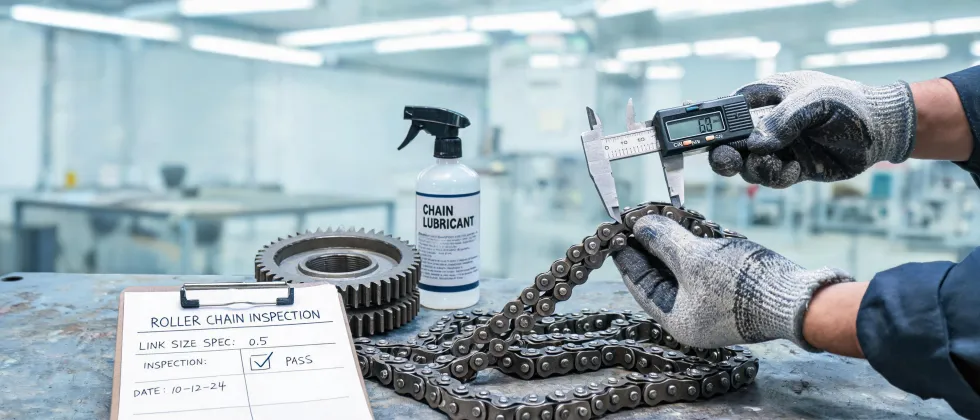
Take a photo. Write down what's printed on the part, plus what maintenance calls it. If the part is too worn, use a caliper to measure pitch and roller width. Most chain types have standard sizes once you measure them. Not ideal, but workable.
So glad I took that photo last month. I almost ordered the same number as the last invoice—which was wrong. The photo caught it before I sent the PO.
Step 2: Get the current Tsubaki chain catalogue PDF
I don't call a supplier until I've looked at the Tsubaki chain catalogue PDF. The official catalogue is the reference for chain sizes, dimensions, attachments, and part numbers. It's free, and it avoids a lot of back-and-forth.
Some distributor sites write the brand as 'tsubaki-chain' and others as 'Tsubaki chain'. Same brand, same catalogue. I search for 'tsubaki chain catalogue pdf' and check that I'm on an official page or at least looking at the current publication.
If you're not sure what a Tsubaki ZIP Chain actuator is, the catalogue will show it: it's an electric linear actuator that uses a special chain to form a rigid push/pull column. The chain coils inside a storage housing when not in use, so the unit takes less space than a rod cylinder. If you're ordering one, you'll need the model number and stroke length. If you're selecting one for a new machine, you probably need an applications engineer.
Step 3: Use the part-number structure, not a picture
Pictures are good for context, not for ordering. According to the Tsubaki chain catalogue PDF, a part number is built from identifiers for series, size, strand count, link count, and attachments. Use that structure instead of relying on a photo.
For example, don't assume the attachment layout doesn't matter. A conveyor chain with extended pins can look identical to one without them until you try to install it. If the catalogue page has a dimensional drawing, compare it to what you have. That step costs five minutes and saves a week.
A linear guide rail is the same. It might look identical in a photo but have different preload or rail profile. If you send a photo and ask for 'same thing', the supplier will probably ask a question you don't expect. I've had to go back to maintenance more than once.
Step 4: Know what's a ball bearing before you order one
I'll be honest: I'm not an engineer. But I know enough to ask the right questions. So let's answer the basic one: what's a ball bearing? It's a component with steel balls between an inner race and an outer race. The balls let one part rotate inside another with low friction while carrying a load. That's all it is.
Ball bearings show up in a lot of the parts we buy. Conveyor rollers, motor pulleys, and V-belt tensioners all use them. If a V-belt tensioner starts squealing or wobbling, the bearing in the pulley is often the first thing to check.
Here's where a lot of buyers trip up. They replace the bearing in the tensioner pulley and put it back. But if the tensioner arm is worn or the spring is weak, the new bearing won't last. If you ask me, replace the whole V-belt tensioner assembly when the bearing fails—unless you've checked the arm and spring and they're fine. I think replacing the bearing alone is usually false economy.
If you need the bearing itself, get the number off the old bearing, the dimensions, and the type. A deep-groove ball bearing won't do much good where you need a thrust bearing.
Step 5: Separate off-the-shelf parts from engineered parts
Standard roller chain can be a stock item. A Tsubaki ZIP Chain actuator is not. A linear guide rail might be a precision item with a lead time. They need different kinds of information.
For a Tsubaki ZIP Chain actuator, you need stroke, load, speed, mounting orientation, and installation space. For a linear guide rail, you need the rail length, rail width and height, number of carriages or blocks, and preload class. If the requisition doesn't have all of that, I write 'unknown' and ask. It's better to ask than to guess.
This is the point where I have to be honest about what this checklist can't do. It works well for direct replacements. If you're designing a new machine or upgrading an automated station, you're in the other 20%. The catalogue PDF will point you to the right product, but an application engineer should do the sizing. I'm not going to pretend a buyer's checklist replaces that.
Step 6: Confirm stock and lead time before you send the PO
Just because a part is in the catalogue doesn't mean it's in stock. I always ask two questions: 'What's the current stock status?' and 'What's the actual lead time?'
The Tsubaki chain catalogue PDF is a reference document, not a warehouse inventory list. If the supplier tells me five days, I write five days in the note. If the part has to come from another distribution center, I tell operations so nobody is surprised.
In our 2024 vendor consolidation project, I started asking my main suppliers for a simple stock report on the parts we order most. It cut a lot of small surprises and gave us something to talk about when setting minimum stock. There's something satisfying about seeing a shelf list that matches what's actually in the cabinet.
Common Mistakes I Still Watch For
- Ordering by the word 'chain' alone. You need pitch, width, strand count, link count, and attachments. Even if maintenance tells you 'it's just a chain', get more.
- Trusting old order history without checking the machine. The part number on the last purchase order might have been wrong.
- Ignoring attachment spacing. A conveyor chain with extended pins can look exactly like one without until you install it.
- Replacing only the bearing in a V-belt tensioner. If the arm or spring is worn, you're doing the same job twice.
- Forgetting that a ball bearing type depends on load direction. Radial loads and thrust loads use different bearings.
And if you're not sure, ask. There is no shame in saying 'what's a ball bearing?' or 'I don't know what the attachment code means.' It's cheaper than ordering the wrong part.
This checklist is based on what works for our plant. We're mid-size, with mostly predictable maintenance schedules. If you're in a job shop with constant changeovers, you might need more safety stock than we carry. The steps still apply, but your stock levels and lead-time expectations will be different.