It started with a three-line RFQ on a Tuesday morning. A buyer in Ohio wanted a compact indexing station for a small packaging line. The parts list included a small linear actuator, a stepper motor, shaft couplings, and a Tsubaki chain for the auxiliary transfer. The only technical question in the email was:
“How fast can a stepper motor turn?”
I've reviewed component orders for four years as a quality/compliance manager. I'm not a motion-control engineer, but I've seen enough first-run failures to know where shortcuts go. That stepper motor question changed how we bought the rest of the machine. It also explains why the work order had the phrase “tsubaki chain scythe” on it.
The project: unglamorous but unforgiving
The station was a lift-and-index unit. A small linear actuator pushed the carrier forward 150 mm, stopped it within ±0.2 mm, and released it while a pin located the pallet. The same actuator pulled the slider back. The stepper motor drove the actuator through a lead screw and two shaft couplings. Operators had nicknamed the chain loop “the scythe” because the slack side whipped sideways when a guard was removed. That's where “tsubaki chain scythe” comes from. Not a product type. A nickname.
At first, the easiest path would have been to buy the lowest-cost stepper, the smallest linear actuator that fits the stroke, and any shaft coupling that matches bore sizes. For a one-off free-standing prototype, that can be the right call. This machine wasn't a prototype. It was going into a production line running at 18 cycles per minute, 16 hours a day.
How fast can a stepper motor turn?
The short answer: a typical 1.8° stepping motor moves 200 full steps per revolution. At 1,000 pulses per second, that's 5 revolutions per second, or 300 RPM. In full-step mode, many NEMA 17 and NEMA 23 motors are near the edge of their torque curve at 300 RPM. With 16× microstepping, the drive must send 16,000 pulses per second for the same 300 RPM. The motor doesn't care about pulses per se; it cares about exact steps, current, and load inertia.
RPM = (pulses per second × 60) / (steps per revolution × microstep factor)
So for a 1.8° motor, RPM = (PPS × 60) / (200 × microstep factor).
But the buyer's real question was whether the stepper could drive a 12 kg payload through a 150 mm stroke at the required cycle time. We reflected the screw inertia back to the motor and found the torque at 300 RPM was right at the edge. If the motor couldn't accelerate fast enough, the cycle would drift. If we overspent on a bigger motor, we'd blow the budget.
The coupling trap
I'm a quality person, not a salesman. I don't care whether we save $30 on a coupling. I care about the cost of the next failure. Our rule: total component cost = purchase price + installation + downtime + risk of losing a customer. That rule got tested on the shaft couplings.
Original spec called for a jaw coupling with an elastomer spider. Fine, but the first quote from an off-brand catalog was 35% cheaper. It was rated for the same torque and had matching bore sizes. So why hesitate?
I called the vendor to ask about misalignment ratings. The cheap coupling had no published misalignment data. The sales engineer said, “It's the same basic elastomer material.” That was red flag number one. Our frame sees about 1.2 degrees of angular misalignment because the motor mount is drilled on a fixture that isn't perfect. Couplings are where that error gets absorbed. We had previously rejected a batch from another low-cost supplier whose bore tolerance was visibly off—0.04 mm interference against our standard spec. The vendor said it was “within industry standard.” We rejected the batch. The redo cost them money, and it cost us time.
In this project, the buyer wanted to shave $50 off two couplings. I pushed back. Our last three coupling failures cost:
- one cracked hub: $45 part
- machine downtime: $780
- expedited replacement shipping: $114
- night-shift labor rework: $230
Total: around $1,170 per incident. If a cheap coupling saves $50 and fails once, it's not a bargain. It's a gamble with a 23:1 payoff ratio, except the odds are unknown.
The Tsubaki roller chain catalog is a spec tool, not a parts list
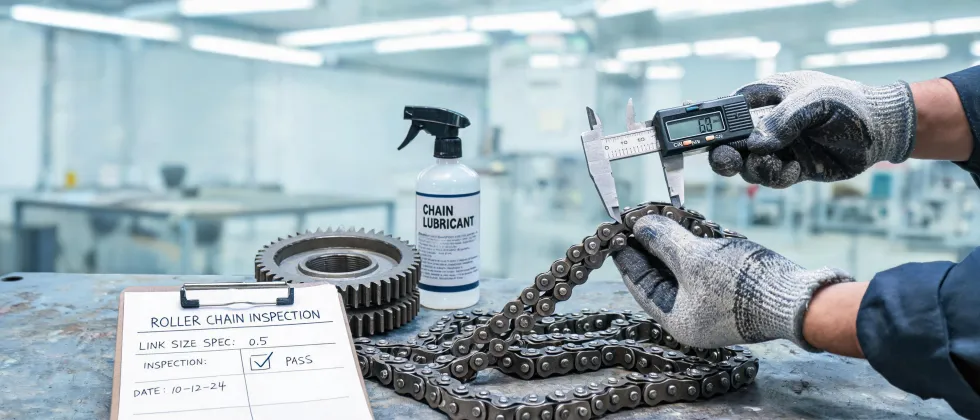
For the auxiliary transfer, we used a #40 ANSI Tsubaki roller chain. The original machine had a cheaper imported chain that wore out in nine months. The chain elongated enough that the indexing star started clocking wrong and jammed a carton. We had to replace the sprockets too. The replacement cost was about 1.4 times the price of a Tsubaki roller chain catalog order would have been if we'd bought the right chain up front.
The catalog is one of those resources I keep a printed copy of. It lists pitch, roller diameter, pin diameter, minimum ultimate tensile strength, and recommended sprocket bore range for each chain number. It also includes the ANSI/ASME B29.1 dimension standard, so you can cross-check sprockets without guessing. For a #40 chain, the useful working load is well below the breaking load. I see engineers look at ultimate strength and then run the chain at 70% of it. That's a rookie mistake. The catalog's working-load tables exist for a reason.
If your spec sheet says “tsubaki-chain” with a hyphen and no space, this is the same place to start. The catalog is the reference document that tells you what you're actually ordering.
The small linear actuator decision
The actuator was another value-over-price argument. We compared a ball-screw and a lead-screw version. The lead-screw was cheaper and quieter, and it would have let the buyer save a few hundred dollars. The ball-screw had higher efficiency, so it needed less torque from the stepper. That meant we could use a smaller motor and still move the carrier faster than the required 0.8 seconds.
The final small linear actuator moved the carrier in 0.55 seconds. The design margin was about 20% on torque. That margin is the thing you buy when you choose value over price. It's not extra cost. It's insurance.
The “tsubaki chain scythe” that wasn't
Let me explain the odd phrase. During our Q1 2024 audit I received a work order with “tsubaki chain scythe” typed into the spare parts system. The maintenance supervisor had used a Tsubaki chain drive on a trim line. The chain wasn't the failure. The shaft coupling behind the motor had loosened because the set screw was installed without thread locker. The chain, free of load, flicked sideways like a scythe when the sprocket jumped a tooth. The incident cost about $9,000 in repairs and two weeks of paperwork.
We could have blamed the chain. We didn't. The chain did its job; the coupling had not been torqued to spec. But the phrase stuck in the system. Every few months someone searches “tsubaki chain scythe” and lands on one of our case files. If that's you, this is the article.
Lessons we keep using
- Stepper speed is a torque curve, not a top number. A motor can spin fast with no load, but acceleration torque falls as speed rises. If you need 300 RPM under load, check the pull-out torque curve.
- Buy the actuator, coupling, and chain as a system. A high-lead small linear actuator can reduce the motor speed you need. The shaft couplings absorb the misalignment that the actuator can't.
- Use the Tsubaki roller chain catalog for engineering data, not just ordering. The working-load tables and ANSI dimensions will prevent both over-specifying and under-sizing.
- Don't save money on the part between the motor and the load. Couplings fail in ways that create downtime, not just a dead part.
This approach isn't universal. A one-off lab rig that runs for a week and gets torn down can use the cheapest components. I can only speak to production machines that have to run at 18 cycles a minute with a plant manager waiting. If your uptime requirements are different, the math changes.
Bottom line
The next time someone asks “how fast can a stepper motor turn?” don't just give them the formula. Ask what it's driving, what the load inertia is, and what happens if the coupling slips. Then open the Tsubaki catalog, check the chain data, and remember that the total cost of a component includes the cost of the next failure.
We installed that system with a standard Tsubaki roller chain, a ball-screw small linear actuator, properly rated shaft couplings, and a stepper motor running at 280 RPM with 20% torque margin. It's been running since April 2024 with no failures. The buyer originally wanted to save $600 on lower-price parts. That $600 would have cost about $3,000 if the coupling had cracked in the first month. Value over price isn't a slogan. It's a spreadsheet.