The Most Expensive Components Are the Ones Bought From the Wrong Supplier
I don't buy power transmission components from generalists. Not anymore.
Quick background: I'm a procurement manager at a 220-person food processing plant. I've owned the MRO budget for six years—roughly $720,000 a year—and I've logged every one of those orders in our ERP. I'm not an engineer. I don't design machines. I just know what things should cost and what they end up costing when they fail.
Here's my opinion: when a rep says “we can do it all,” what I hear is “we don't know our own limits.” And in power transmission, limits are everything.
A Needle Roller Bearing Lesson That Cost Us a Week
In 2023, one of our positive displacement pumps started vibrating. Our maintenance lead suspected the bearing. I got two quotes: one from a full-line distributor and one from a bearing specialist.
The full-line quote for needle roller bearings came in about 28% cheaper. The rep said it was a direct replacement. I went back and forth for a week. Stay with the incumbent supplier, or save $180 on paper?
Then I asked a simple question: “What's the dynamic load rating of that bearing?” The answer was “should be the same.” That's when I called a peer at another plant, and he told me to ask a different question—what was the original part number.
Now, I'm not a tribologist. I can't explain raceway angles or lubricant film thickness. What I can tell you as a buyer is that “should be” isn't a specification. The original part, if I remember correctly, was a 6205 deep-groove ball bearing. The needle roller bearing would physically fit in the housing, and it can handle high radial loads in a compact envelope. But it has a lower speed limit and almost no tolerance for misalignment. In our skid, misalignment happens. The cheaper part would have failed—and probably taken the pump with it.
Search for “which is better ball bearing or roller bearing” and you'll get forum threads full of opinions. The practical answer is: it depends on the application. A ball bearing handles higher speeds and some axial load; a roller bearing handles more radial load at lower speeds. You can't swap one for the other just because the outer diameter matches.
We verified the original spec against ISO 15 and used ISO 492 tolerance classes to match the replacement. That sounds like overkill, but it's how we stopped guessing. Reference standards are free. Downtime is not.
Reference standards we used to verify these parts: ISO 15 (rolling bearing dimensions), ISO 492 (bearing tolerances), ISO 606 (roller chain), ISO 4347 (leaf chain), ISO 5211 (part-turn actuator attachments).
Oh, and shipping. We almost forgot freight. The specialist charged $40 more for freight, but the part arrived certifiable and traceable. When the generalist's invoice later showed up with a line-item setup fee, I stopped feeling bad about our choice. That's the hidden cost nobody quotes.
The Valve Electric Actuator That Nobody Could Explain
Another example. We needed a valve electric actuator for a CIP skid. The quote from a general industrial supplier looked fine on price. Then I asked about ISO 5211 mounting dimensions and the torque rating at the control signal. The rep said “this one should fit.” That's not a specification.
A different vendor—one that only does fluid control—said this: “Actuators aren't really our specialty. Based on your valve stem and torque requirements, you'd be better off talking to someone who makes them.” I should add that we'd never bought from that vendor before. They could have taken the order. Instead, they handed us a competitor's number.
That honesty caught me off guard. Honestly, my first thought was: they're just trying to get rid of me. But when I called their referral, I got a specialist who asked about fail-safe position, duty cycle, and whether our control system needed a 4–20 mA positioner. The quote took two days and included the mounting diagram. It wasn't the cheapest. It was the one we installed without rework.
That first vendor who admitted they weren't the right fit? We still buy hose fittings and gaskets from them every month. The best sales move was saying “this isn't what we do best.”
Why a Tsubaki Leaf Chain Made Me a Believer
Now, the chains. We standardize on Tsubaki chain for conveyor drives. Not because a marketing rep took us to lunch—nobody has—but because their catalog makes it easy to calculate total cost.
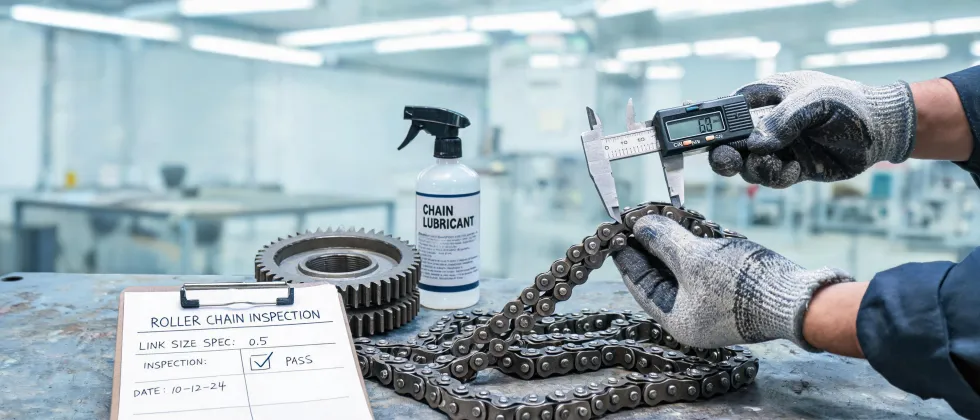
Last year, we needed a chain for a lift table. A distributor tried to sell us a roller chain “the same size.” Our maintenance lead said no—it needed a leaf chain. A Tsubaki leaf chain is a different animal. It's built for lifting applications with flat plate links, not rollers. The pins and plates handle bending loads differently, and they don't articulate over sprockets the way roller chain does.
The generalist's price was lower. But they couldn't tell me the working load limit of their equivalent. The Tsubaki rep pulled a spec sheet in ten seconds and pointed to the minimum breaking load. That's not sales. That's engineering confidence. We later used their online configurator to find the exact part number and used it as the baseline for all other quotes.
My experience here is based on roughly 300 MRO orders, mostly in food processing. If you're in mining or aerospace, your risk math might come out different. But the principle still holds: a supplier who knows their limits will tell you when something isn't their strength.
What About One-Stop Shops?
I hear the counterargument every time I tell this story: consolidating vendors reduces paperwork, freight, and lead times. That's true. I've trimmed our supplier list from 47 to 19 over the past four years. Vendor consolidation works.
But there's a difference between consolidation and replacing expertise. I'd rather buy multiple lines from a distributor with actual application engineers than one billing specialist who sells everything from wire mesh to gearboxes.
I'm not saying every generalist is worthless. Some of the best reps I've worked with admit when they're outside their lane. That's exactly the behavior I want from a supplier. If they know their limits, they'll compensate with honesty—and they'll route me to the right specialist instead of letting me learn the hard way.
Buy the Knowledge, Not Just the Part
So which is better: ball bearing or roller bearing? The question is wrong. The better question is whether your supplier can tell you the difference before your machine fails.
I'm not a specialist. I'm the person who pays when a specialist isn't involved. That's why I now ask every power transmission vendor one question before adding them to our list:
“What's this product's weak point?”
If they answer honestly, they get the order. If they say “nothing,” I walk. Because there is no part that does everything—and no supplier that should pretend otherwise.
That's cost control with a mind of its own. Simple.