Line 3 stopped at 2:47 on a Tuesday.
"The conveyor chain is stretching again," he said.
I know the time because the maintenance lead called before I finished my coffee. In my head I wrote down: order conveyor chain. I did not write down: check chain stretch. I had never used a chain stretch gauge—didn't even know it existed.
I knew what a chain was, obviously. I just didn't understand that a roller chain wears out in a way you can measure before it breaks. That gap in my knowledge ended up costing us more than the chain itself.
I'm the office administrator for a 350-person plant. I manage all the MRO ordering—roughly $180,000 a year across 15 vendors. I report to operations and finance, so I'm the person who hears about it when a $300 chain causes a $5,000 line stoppage. That Tuesday was the second time in two months for the same line.
The Same Chain, the Same Failure
When I took over purchasing in 2020, I made a classic assumption. I thought the product description told me everything I needed. If the part was a 40B-1 roller chain, then that was it. The part number was the product. It took me about 90 MRO orders and one annoyed maintenance lead to understand that the part number is only half the story.
The first time the conveyor failed, I ordered a standard roller chain from an established vendor. The price was good, and the invoice was clean—two things I value because I once lost $2,400 in a rejected expense report over a vendor who couldn't send a proper invoice. So I placed the order without asking details. I didn't ask about washdown, load, or sprocket condition. In my defense, nobody asked me to. But I should have asked anyway.
The chain arrived, maintenance installed it, and the line ran.
For a while.
It lasted about six weeks—or rather, it ran for six weeks, then spent the next two behaving inconsistently before it broke the line. The maintenance lead said the chain was stretching. I assumed he meant it was defective. I was wrong.
What I didn't understand is that roller chains don't "stretch" in the rubber-band sense. What really happens is that pin and bushing wear, over time, creates extra pitch length. The chain gets effectively longer. A worn chain can skip teeth, sag, and transfer stress in ways a new chain isn't designed to handle. The chain I'd ordered wasn't bad. What I mean is: it was the right generic chain for a generic conveyor, but not the right chain for this conveyor's real condition.
Before I ordered a third replacement, the maintenance lead asked if I had a chain stretch gauge. I said "is that a thing?" He sent me a photo and a link to the Tsubaki chain catalog page. That was the moment I realized there is a whole measuring tool I'd never needed to know about. Once you know, you can't leave it alone.
The Gauge That Changed How I Buy Parts
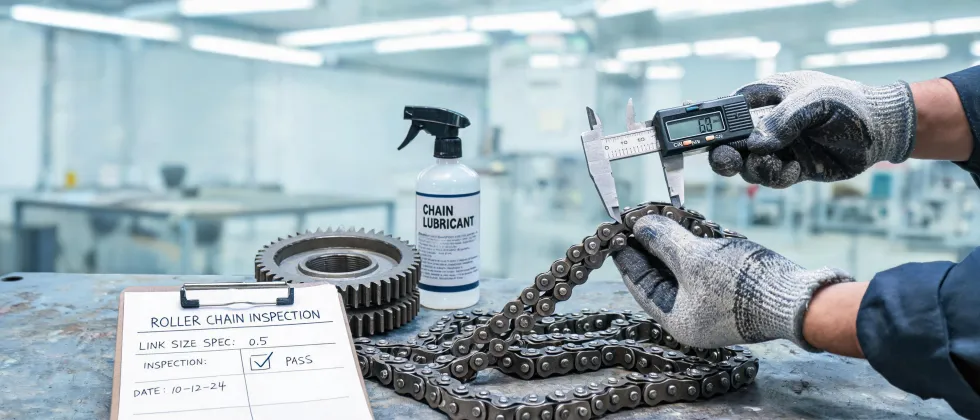
The Tsubaki chain stretch gauge is one of those tools that's almost embarrassingly simple. It has two contact points at a fixed distance. You place it across a set number of links, following the same measuring procedure every time. If the gauge sits in the "worn" slot, the chain has reached the elongation limit and it's time to replace it. No math, no calipers, no guesswork. The Tsubaki catalog page also referenced ANSI/ASME B29.1, so I knew the measuring method wasn't a distributor's invention.
At first I thought the gauge was overkill. Then we checked the conveyor line. The result was not subtle. Half the chain was past the wear limit on the Tsubaki gauge, and the other half wasn't far behind. We measured every strand, not just the section that looked bad. It took about twenty minutes. The old process—waiting for the line to fail—took two months.
The reason it kept failing was not bad parts. It was late replacement. We'd let the chain run past its useful life because nobody had measured it. The gauge didn't fix the chain; it fixed the process.
I'm not an engineer, so I'm not going to pretend the gauge can diagnose every problem. It can't. But for 80% of the "chain keeps stretching" calls I get, it's the fastest way to separate a real wear problem from a tension or alignment problem. If the gauge says the chain is good, you start looking at sprockets, shafts, and lubrication. If the gauge says it's worn, you already have your answer.
Neptune Chain and the Honest Price Question
Once we knew the chain was worn, the maintenance lead asked for a different product: Tsubaki Neptune chain. Our line runs through a washdown area, and the old chain was corroding around the same time it was wearing. The lead told me the Neptune series was designed for tough, corrosive environments and would hold up better there. We also replaced the sprockets, because putting a new chain on worn sprockets is just another way to throw money away.
At first, I balked at the premium. I had to ask twice whether it was necessary. The answer I got was pretty practical: if we kept buying standard chain, we'd keep replacing it more often, and the labor to replace it would cost more than the chain. I've learned to trust that math. Total cost matters more than the line item.
I won't tell you Neptune is the best chain ever made. That would overpromise, and I've been burned by overpromising vendors. What I will say is that for our washdown conveyor, Neptune made sense. If you run a dry, clean conveyor with light loads, a standard roller chain might be the right call. The honest answer is not "Neptune for everyone." It's "Neptune for the environment where it fits."
Same Lesson, Different Part: Timing Belt Kit and Pulley
A few weeks later, another line had a timing belt that kept jumping. I was about to order just a timing belt, based on the old part number. Then the maintenance lead asked for a timing belt kit, as well as the timing belt pulley. The kit included the tensioner and idler, which I would never have remembered. The pulley was the exact component I had already quoted wrong in my head.
That is when it clicked. The problem wasn't that I didn't care. The problem was that I was buying components without understanding what the component sits next to. A timing belt and a timing belt pulley work together; a kit exists because a worn tensioner can kill a new belt. The previous failure had stretched a belt, but the actual cause was a bad tensioner. If I had only ordered the belt, we'd be doing the same repair in two months.
While maintenance was replacing the belt, a new apprentice asked me, "What's a servo motor?" He was looking at the motor label on the drive. I gave him the non-engineer definition: it's a motor with feedback. It knows where the shaft is, and it corrects itself under load. He said, "So it's not just a motor?" I said, "Right. It's a closed-loop system." It reminded me that most of my purchasing problems happen when I treat components like standalone items. A servo motor is not a standalone motor. A timing belt is not a standalone belt. A chain is not a standalone chain.
What I'd Do Differently
If I could go back to 2020, I'd buy a Tsubaki chain stretch gauge before I needed it. It would have saved us downtime, labor, and a lot of pressure on my relationship with the maintenance team. But I'd also verify the application, not just the part number. For every replacement, I now ask: What's the environment? What's the load? Is there washdown? Are sprockets or tensioners part of this system?
I also started asking about lead times and stock availability earlier. A part that saves $20 isn't worth it if it takes three weeks to arrive. The Neptune chain, the timing belt kit, and the pulley all came through a vendor who could tell me exactly when they'd show up. That certainty was worth as much as the product itself.
To be fair, I'm not saying every plant needs a drawer full of gauges. If you work in a small facility and your maintenance lead has been doing this for decades, you might already have the expertise. Buy the gauge if you're the one making ordering decisions and you can't tell a worn chain from a new one just by looking. I couldn't.
The bigger lesson was about process. I used to think my job ended with the right PO number and the right price. It doesn't. The job ends when the parts work long enough to be considered a success. That means asking questions before I order, not after a line goes down.
Bottom Line
The best purchase I made wasn't the Neptune chain or the timing belt kit, though both were the right call. It was the chain stretch gauge, because it gave us a repeatable way to know when a chain is actually done. If your maintenance team is telling you "the chain keeps stretching," get a gauge, check the full strand, and then decide whether you need a different chain for the environment.
And if you ever hear the phrase "what's a servo motor?"—that's a reasonable question. I ask my own version of it about bearings, sprockets, and pulleys all the time. The trick is to keep asking until the part number makes sense in the system, not just on the page.