Last March, I was standing on the production floor in my office shoes, staring at a conveyor line that hadn't moved in three hours. Boxes were stacking up in places they weren't supposed to be. The maintenance tech, a guy named Chris who'd been here for 17 years, said the chain had stretched enough that the sprockets were slipping.
"Can't we just adjust it?" I asked.
"Not this time," he said. "It's worn. Look."
It didn't look worn to me. A little rusty, sure. Squeaky in places. But worn? This is a machine, not an old pair of running shoes. I'm the office administrator. I order printer toner, safety gloves, and ergonomic chairs. This is not my world.
But our purchasing manager had quit the week before, and the VP of operations had handed me his company card with a very specific instruction: "You're organized. Figure it out."
So I had to figure out the chain. Without knowing anything about chains.
"What's a Servo Motor?"
My first move was to call the equipment manufacturer. I explained what Chris had told me. The receptionist transferred me to a technician, who asked, "Is the servo motor on the infeed section still holding position?"
I said, "What's a servo motor?"
Silence. A long one. I'm pretty sure I heard him exhale before he said, "It's the motor that controls the feed mechanism."
Okay. That cleared up nothing.
To be fair, if you're reading this and you're not an engineer, here's the simple version: a servo motor is a motor with closed-loop feedback that determines its own position, speed, and torque. It checks where it is, corrects for errors, and keeps doing that along the way. That's what I eventually learned, anyway. At the time, I just heard "blah blah precise motor."
The technician started listing everything that could be wrong with our line. He mentioned the Gates timing belt a few times. "Check the teeth for wear or cracking."
I added "Gates timing belt" to my list of things to Google, right under "servo motor, what is."
The Rabbit Hole That Actually Helped
That evening, I dove into the world of power transmission. I found the chain part number embossed on the conveyor frame—it was a Tsubaki roller chain, RS60 series or something similar. I searched "tsubaki-chain" and landed right on their catalog.
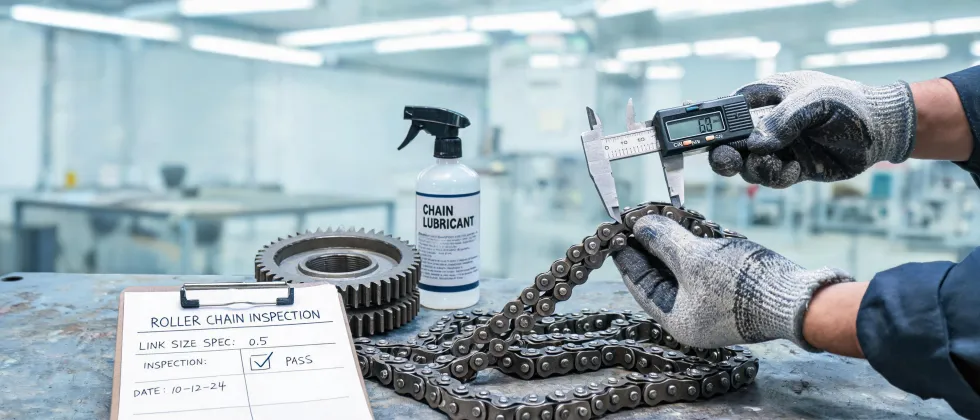
Here's what surprised me: the site wasn't just a product list. It had technical guides, charts, and even a Tsubaki chain wear indicator product page that explained how elongation works. I learned things I didn't know I needed to learn. Like how to measure chain pitch. Like why a chain "stretches" (it's the pins and bushings wearing, not actually stretching). Like how to tell if a chain is truly done or just thirsty for grease.
Then I found the ZIP Chain Actuator page. I had no idea a chain could replace a piston or a screw in a linear actuator. But apparently, that's a thing. The concept is simple: the actuator uses a compact chain drive to extend and retract a load. For space-constrained applications, it's a neat alternative.
I was still in over my head. But for the first time, I felt like I was asking better questions.
A Phone Call With a Guy Who Didn't Dismiss Me
I called the local Tsubaki distributor the next morning. I braced myself for condescension. Instead, I got a guy named Rick.
"You have a chain number? Great. Is it a straight conveyor or an inclined one?"
I told him it was straight, with a slight elevation around the discharge point. He asked about lubrication. I said, honestly, I had no idea.
He didn't sigh. He explained the difference between a chain that's dirty and a chain that's worn. "If the roller chain has less than 2% elongation, you might be able to clean it and run it for a while longer. If it's past 2%, replace it before it starts beating the sprockets."
Then he asked, "Do you have a chain wear indicator?"
"A what?"
He told me it's a small gauge that hooks onto the chain and reads the elongation. "Tsubaki makes one," he said. "It's cheaper than replacing a chain you don't need to replace."
I added it to the order without hesitation. That $75 tool turned me into a slightly dangerous buyer—dangerous in the sense that I could actually verify something now.
And Then There Was the Actuator
While I was on the phone, the production manager appeared at my desk. "The label applicator's height adjustment is done," he said. "We're holding it up with a chunk of scrap wood. We need a new actuator."
Good. Fantastic. Another thing I know nothing about.
I walked over with a tape measure and a flashlight. The nameplate on the old unit read: 12 volt linear actuator, 6 inch stroke. I took a photo of it and brought it back to Rick.
He asked about the mounting style and the space around it. I described it. Then he said, "The Tsubaki ZIP Chain Actuator could work there. It uses a chain drive instead of a ball screw, so it's more compact. But check the stroke, because we need to match the movement."
He emailed me a spec sheet. I printed it out. There were terms like "dynamic load" and "duty cycle" that made my head spin. I did some quiet YouTube research on chain actuators that night. By the end of the evening, I had enough confidence to compare the numbers—not to fully understand them.
The mounting fit. The stroke matched. The numbers said go.
My gut said, "You are absolutely over your head." But the production manager was hovering, the line was down, and I had to make a call. I placed the order. The 12 volt linear actuator arrived two days later. Chris mounted it in an afternoon. It's been working with zero problems since.
My Gut Was Wrong. The Wear Indicator Was Right.
Here's the part that got me.
Before we installed the new chain, we used the wear indicator on the old one. Chris had already told me it was finished. I had already ordered a replacement. The chain looked terrible—dry, noisy, rusty on the outside, stiff links. Everything about it screamed "replace me."
From the outside, it looked like a classic worn-out chain.
The reality? The gauge read 1.2% elongation at the worst link. Under the 2% threshold. The chain was dirty, not dead.
I stood there staring at the gauge. So did Chris. We'd both been ready to spend a few hundred dollars on a part we didn't need. Instead, we spent $15 on chain lube and about thirty minutes cleaning. The old chain is still on that conveyor today.
That's when I internalized the lesson: industrial parts don't always fail visibly. A chain can look terrible and still be within spec. Or look perfectly fine and be stretched past its service life. If you don't measure, you're guessing. And guessing is how you buy parts you don't need—or miss the parts you do.
Since then, I've used that gauge on every conveyor in our facility. It paid for itself in one afternoon.
Also, the Gates timing belt the OEM tech had warned me about? Chris checked it while the line was down. Clean teeth, no cracks, no glazing. The belt was fine. We didn't touch it. Sometimes the most expensive-looking thing isn't the actual problem.
Lessons From a Nervous Office Buyer
If you're in a similar spot—maybe you're the one who gets handed the company card and told to "figure it out" for something you've never bought before—here's what I learned.
- Ask the dumb question. Seriously. Saying "What's a servo motor?" is better than pretending. A vendor who explains without making you feel small is worth their weight in gold.
- Get the measurement tool in your hands. The Tsubaki chain wear indicator saved us. It's a simple piece of hardware, probably less than $75, and it acts like a lie detector for "I think this is worn out." Buy it. Use it.
- Look for suppliers who care about small orders. My first order with that distributor was maybe $600, including the gauge. They could have pushed me through the process like a number and sent whatever chain was closest. Instead, they spent real time with me, asked about my actual application, and recommended a tool that saved me money. Small doesn't mean insignificant. It means early.
- Take promotional claims with a grain of salt. The more absolute the claim, the more you should push for data. Per FTC guidelines, advertising claims need to be truthful and substantiated with evidence. A conversation with a knowledgeable human beats a glossy brochure every time.
I still buy the printer paper. But now I also buy chain wear indicators, ZIP Chain Actuators, and replacement roller chains. The VP calls me the "supply chain coordinator" in his Monday emails. It's generous. I still remember being the person who didn't know what a servo motor was.
What changed is the vendors I work with. The ones who took a small order seriously have earned a bigger one. That's the real story here: treating small buyers like people isn't charity—it's good business. And it pays off when we grow.