Last April, I was two hours into a quality audit when my phone rang. It was a purchasing manager from Visalia, California. His voice had that tight, trying-to-stay-calm tone that I've learned means someone's production line is down.
"What happens when a linear actuator fails?" he asked.
That question is broader than it sounds. And by the end of that week, acting on it cost them about $2,800 more than the cheapest repair quote. I think it was worth every dollar.
Quick context: I'm the quality and brand compliance manager at a power transmission distributor. I review roughly 200 unique product requests a year—maybe 180, I'd have to check the system—and I've rejected 7% of first-time vendor samples in 2025 for spec mismatches. I don't design equipment. I just make sure what ships matches what was promised.
The phone call that changed the repair plan
The Visalia plant runs a packaging line that uses a ball-screw linear actuator to position cartons before sealing. The actuator had seized up after a weekend shutdown. The maintenance techs thought it was a motor issue. Turned out the screw was bound from side load. And the side load came from a motor shaft coupling that had been slowly destroying the alignment for years.
They asked if we could quote a replacement actuator and also handle the "Visalia timing belt replacement" they had been postponing on the infeed conveyor. Since the line was already down, it made sense to do it in the same call.
We quoted a Tsubaki electric linear actuator, a new motor shaft coupling with a spider insert, and a Tsubaki timing belt. The total was around $845—maybe $850, I'd have to check the final invoice. Their other machine parts supplier had quoted an off-brand actuator for $380 and "something close" for the coupling.
The spreadsheet said save $465. My gut said no.
So what actually happens when a linear actuator fails?
People assume a linear actuator fails like a light switch: it either moves or it doesn't. That's not how it happens in real packaging lines. When a ball-screw actuator stalls mid-cycle, you can get a few different things:
- the motor keeps pushing, current spikes, and the overload trips;
- the screw loses lubrication and starts to gall; or
- the load can shift or slam back when the drive releases.
In their case, the coupling acted as the sacrificial component. It wore out, added backlash, and let the actuator hammer itself against the end of stroke until the screw bound completely.
So "what happens when a linear actuator fails" is rarely just an actuator problem. The rest of the drive train—especially the motor shaft coupling—will tell you the real story.
The coupling was the real problem
When they sent photos, the surprise wasn't the failed actuator. It was the coupling. I could see set screw marks scored into the motor shaft. The old coupling was a rigid clamp style. That works if two shafts are perfectly aligned. In practice, they almost never are.
Honestly, I'm not sure why the original integrator chose a rigid coupling. My best guess is it was a design shortcut. A motor shaft coupling should have some compliance. With a rigid one, every little misalignment transmits straight into the actuator's bearing block.
We spec'd a jaw coupling with a soft spider insert. It costs a bit more, but it tolerates small angular and parallel misalignment. That's the difference between a line running for five years and a line that becomes a recurring service call.
The upcharge that saved the week
The off-brand actuator had a nice price tag, but it had two red flags. First, the mounting flange was 7mm shorter than the original. Second, the output shaft was 4mm smaller. That means a different motor shaft coupling, a custom bracket, a longer alignment process, and another day of downtime. The $465 savings evaporated.
I also couldn't get a straight answer on lead time. "Usually ships same day" is not a commitment. In an emergency, that's the biggest risk of all.
I went back to them with a simple position: the Tsubaki actuator was in stock and could be on a truck by noon. The motor shaft coupling and timing belt were also in our warehouse. We would guarantee delivery by Tuesday morning. The expedite fee was $480—not $400, I keep mixing it up with our standard rush charge—but it bought a fixed date.
That's the part a lot of buyers miss. In an emergency, you're not paying for speed. You're paying for certainty. An uncertain cheap option is way more expensive than a confirmed premium one.
Check the chain while you're at it
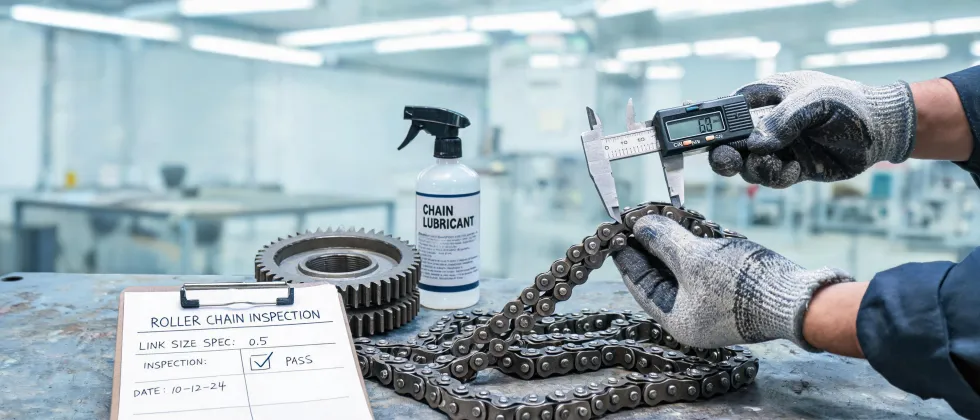
While the maintenance team had the line open, they noticed the conveyor chain had almost an inch of slack at the take-up—way more than the quarter-inch I'm comfortable with. The old chain had no brand marking, which is a red flag. Generic roller chain can work, but you're rolling the dice on pin hardness and pitch accuracy.
I recommended replacing it with a Tsubaki roller chain. The Tsubaki catalog—the tsubaki-chain product family, as it's labeled in our system—gives you exact dimensional specs for pin diameter, bushing width, and preload. The pitch dimensions follow ISO 606, which is the standard I use for every chain spec I approve. When I type "roller chain tsubaki" into our parts search, I get a clear part number. The same goes for a "chain Tsubaki" search—you get a family of part numbers, not a vague picture.
The original chain didn't fail outright. It just stretched unevenly, which put extra side force on the same motor shaft coupling we were trying to protect. Replacing it wasn't exciting, but it was the kind of thing that prevents the next phone call.
Lessons I keep coming back to
The line was back up Wednesday morning. It ran a full shift without a single fault. The plant manager later told me the three-day downtime cost about $14,000. So an extra $465 for the right actuator and coupling was a no-brainer in hindsight.
I've walked away with four rules:
- When a linear actuator fails, don't just replace it. Check the motor shaft coupling and the chain.
- A motor shaft coupling is not a commodity part. The cheap one can destroy a $600 actuator.
- In an emergency, buy the delivery date, not the price tag. Uncertainty is the real premium.
- If you're arranging a Visalia timing belt replacement or any urgent drive component, ask for the part number, the mounting dimensions, and the stock status before you approve anything.
This was accurate as of Q1 2025. Component prices and stock levels change fast, so verify current rates before budgeting. At least, that's been my experience with packaging and material-handling lines under normal duty cycles.