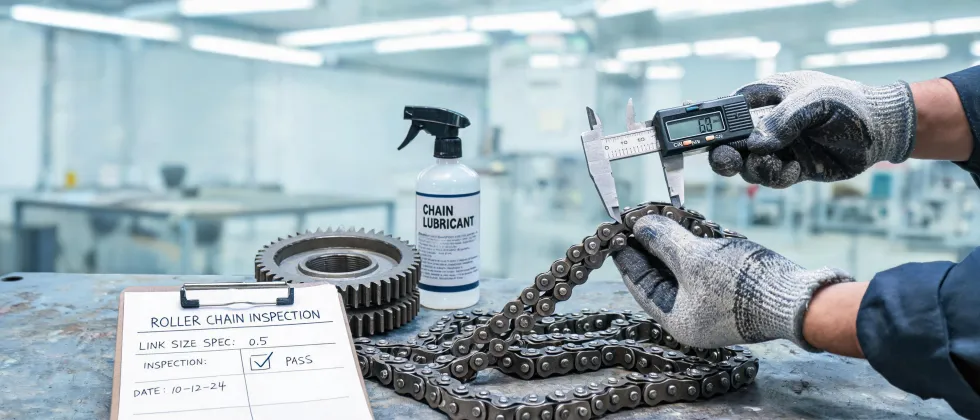
Let me start with a confession: when I first started managing procurement, I assumed an off-brand roller chain was functionally identical to a Tsubaki chain, just cheaper. That assumption lasted about three months. Since 2020, I've managed a $1.2M annual MRO and capital budget for a 220-person material handling company, and I've tracked every quote, rework hour, and downtime event in our cost system. The numbers changed how I buy.
This is not a 'premium is always worth it' argument. I'm a cost controller, and I care about total cost of ownership, not the pretty logo on the box. But when I compare Tsubaki engineered components against unbranded 'equivalent' parts, the comparison consistently runs along four dimensions: total cost, engineering data, real-world performance, and procurement risk. I'll walk through each one using the products we actually order: tsubaki chain, tsubaki attachment chain, tsubaki zip chain actuator, ball bearing rollers, jaw couplings, and one linear bearing I get asked about constantly.
1. Total cost of ownership (TCO)
In Q2 2024, I quoted a conveyor upgrade that called for two tsubaki attachment chains, 34 ball bearing rollers, and six jaw couplings. The unbranded quote came in 16% lower. That looked like a no-brainer until I totaled the actual costs. The generic parts arrived in four shipments instead of one. Two attachment links needed filing before they would slide onto the pins. The jaw coupling hubs had to be reamed to fit the shaft. One ball bearing roller failed after 60 days. By the time I added labor, downtime, and shipping, the generic option was 22% more expensive than the Tsubaki order. (This was back in Q2 2024, so those percentages are the ones I recorded, not a universal truth.)
That 22% number is the part I wish I'd known earlier. When I started, I assumed Tsubaki components cost two or three times as much. In my experience, the upfront premium is usually 10-20%, and it disappears once you include rework and failure. To be fair, a generic part can be perfectly fine in low-duty applications. But a 10% discount is not worth a 50% chance of measuring the wrong bore.
2. Engineering data and compatibility
The second dimension matters more than the first, at least for me. For a Tsubaki chain, the catalog gives you ANSI/ASME B29.1 dimensions, tensile strength, attachment spacing, and allowable speeds. A tsubaki attachment chain is not just a chain with a bent tab; the tab position, hole size, and pin length are defined in the drawing. An unbranded attachment chain might come with nothing more than a pitch number. That makes the rest of my job guesswork.
The same issue appears in actuators. I compared the tsubaki zip chain actuator with a pneumatic cylinder for a compact lift table in 2022. The cylinder supplier gave me bore and stroke; the Tsubaki selection tool gave me thrust, stroke, mounting dimensions, and duty-cycle ratings. The zip chain cost more upfront, but it was the only option with enough data to calculate real performance. To be fair, the pneumatic cylinder would have been fine for a simple open/close gate. For repeatable vertical positioning, I did not want to guess.
Linear bearings are where people get burned. The most common question I get in procurement is 'what size is lm8luu linear bearing'? The '8' tells you the bore is 8 mm, but it says nothing about the outside diameter or length. In the standard catalog, the LM8LUU is the long version of the LM8UU, so the overall length is larger than the standard bushing. I still kick myself for ordering a batch of LM8LUU bearings in Q2 2023 without checking the drawing; the bore was right, but the housing fit was wrong. Mental note to self: always download the dimensional print, even for a 'standard' part.
3. Performance under real conditions
Engineering data only matters if the component holds up. In our Q3 2024 inspection, I compared plain bushings and ball bearing rollers on the same pallet conveyor section. The plain bushings had 0.022 inches of wear on the pin after four months; the ball bearing rollers on the adjacent section had 0.004 inches. Same load, same speed, same dust. The ball bearing rollers cost more, but they also made the maintenance schedule boring, which is exactly what I want.
Jaw couplings provided a similar lesson. We had a motor-driven fan with a set-screw rigid coupling. The motor bearing temperature was running 76°C in March 2023. I switched the motor to a jaw coupling with a spider insert—same motor, same driven shaft—and the temperature dropped to 62°C. The spider absorbs the slight misalignment that was cooking the bearing. That's one data point, but it's a data point from our CMMS, not from a sales brochure.
The Tsubaki Zip Chain Actuator is the least intuitive. I assumed a chain-based actuator would be clunky and imprecise. In the 2022 lift table project, it actually gave more controllable speed and held position better than the pneumatic cylinder option. The upfront cost was about $1,100 higher, but the air leak and solenoid costs from the pneumatic setup disappeared. Surprise, surprise, the 'complicated' option was operationally simpler.
4. Procurement experience and support
The last dimension is the one that rarely gets put in a quote. When I source from Tsubaki's catalog, I do not need to call five suppliers for datasheets and chase drawings. I can go to tsubaki-chain.com, find the product line, and pull the dimensional table, load rating, and part number in one session. For a tsubaki attachment chain, I can see the attachment spacing options immediately. For jaw couplings, I can check bore and keyway availability before asking for a price. That cuts our sourcing cycle by roughly 30%, and it is a major reason I keep the brand in our approved list.
The unbranded path usually works differently: first quote, then a drawing that shows up in three days, then a phone call to confirm the drawing is final, then a test order. That is not always a disaster. But when I need a documented replacement during a planned shutdown, I cannot wait a week for a datasheet. Since 2021, I have made 'documentation available before payment' a standard condition in our procurement policy.
When to choose Tsubaki vs. generic
If you are asking which one is 'better', the answer is: it depends on the application and your ability to verify engineering data. Choose Tsubaki engineered components when the equipment runs continuously, when failure causes safety issues, or when you do not have an in-house engineer to verify a generic equivalent. Choose generic parts for one-off prototypes, non-critical bench builds, or cases where the generic supplier provides a full dimensional drawing and load rating.
I also think the industry has shifted. What was best practice in 2020 may not apply in 2025. The fundamentals haven't changed—chain is still rated by pitch and breaking load, and a bearing is still a bearing—but the way we select parts has transformed. The Tsubaki configurator, downloadable CAD models, and catalog data let a small procurement team act like a much bigger one. That shift is why I now use a TCO spreadsheet instead of just a quote spreadsheet.
If I left you with one rule, it would be this: compare the gap between the quote and the running cost, not just the quote. For the products I manage, that gap is where Tsubaki wins on paper and in the field.