-
What happens when a linear actuator fails?
-
The micro actuator trap
-
The failure I caused in 2018
-
What a chain manufacturer taught me about actuators
-
Small customers deserve real answers
-
The five-line checklist I didn't create until after the third failure
-
Granted, sometimes the actuator really is the problem
Sometimes the most useful question isn't 'what happens when a linear actuator fails?' It's 'what was happening around it while it failed?'
I've been specifying power transmission parts since 2017. I've sold them, installed them, repaired them, and—if I'm being honest—broken enough of them to stop blaming the parts. When a customer tells me an actuator 'just died,' I ask eleven questions before I suggest a replacement. That habit came from my own mistakes.
Here's my blunt opinion: linear actuators are usually not the first component to fail. They're selected, mounted, powered, or ignored into failure.
What happens when a linear actuator fails?
The common-sense answer is: it stops moving. The more useful answer is: the visible symptom depends on the application. Here are the patterns I've seen most often.
- Motor overload or thermal trip. The actuator stalls at the end of stroke and overheats. It can look like an electrical failure, but the root cause is often a mis-adjusted limit switch or a controller without stall protection.
- Drift or backlash. The load slowly sags when power is off. Worn threads, a stretched internal belt, or a loose coupling all produce the same symptom for different reasons.
- Mechanical jam. A bent rod, a seized pivot, or something as simple as a bolt that fell into the mechanism. The motor pushes, nothing moves, and eventually something burns out.
- Environmental death. Water ingress, dust, or cold grease. A unit that works for years on a bench can fail in one season when it's mounted outdoors. The actuator didn't get worse; the environment got real.
The list matters because it explains why the replacement part often fails again. If you don't know which pattern killed the first one, you're probably going to ship the second one to the same funeral.
The micro actuator trap
Micro linear actuators are easy to like: they're compact, affordable, and simple to wire. They also get misused in predictable ways. A micro linear actuator rated for intermittent duty isn't defective when it overheats after continuous use—it's being used outside its spec. The same goes for an IP54 unit in a washdown line or a cold storage door. The spec is the limit, not a suggestion.
Choosing a heavy duty linear actuator has the opposite problem. The load capacity looks reassuring, but load capacity doesn't protect against side loads, shock loads, or a bracket that flexes under force. I've seen a heavy actuator break its own mount because the mount was stiff enough on paper but not in practice. Force travels through the whole structure, not just the datasheet.
The failure I caused in 2018
In 2018, I specified a 24 V micro linear actuator for a damper. Load? 300 N. Stroke? 150 mm. I checked both. What I didn't check was the linkage: the rod wasn't moving in a straight line. On day two, the actuator stalled against a damper that had shifted sideways, and the internal guide wore out fast. The result: $180 actuator, $320 in emergency shipping, and one very patient customer.
The replacement supplier asked a question I hadn't asked: 'How is the rod end mounted?' That's when I started drawing the whole linkage before choosing any component. It's also when I stopped calling actuator failures 'actuator failures.'
What a chain manufacturer taught me about actuators
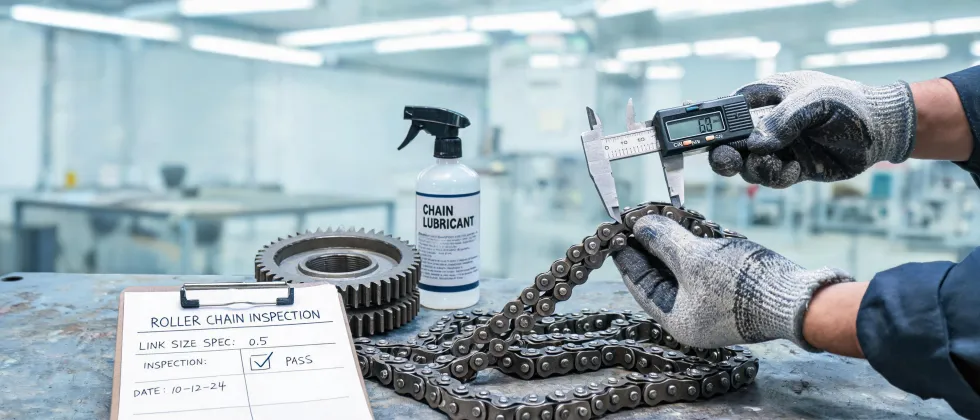
Sometimes the best way to understand a linear actuator is to step into the power transmission aisle. Chains are brutally honest about wear: they stretch, they need measuring, and they need replacing on evidence, not opinion. That's why the name Tsubaki shows up in both chain and actuator conversations. The Tsubaki Zip Chain Actuator, for example, is a linear actuator built around chain. It doesn't work like a rod-style cylinder or a ball screw, and it doesn't behave like one.
I also keep a Tsubaki chain stretch gauge in my toolbox. It's not a glamorous tool. But it settles arguments: is that chain worn, or just dirty? One measurement ends the debate. The same approach works for actuators. When a unit fails, measure the motor current at stall. Check the temperature. Look at the mounting. Measure the backlash. The data will point to the cause faster than a part swap will.
Small customers deserve real answers
This is the part that may sound like an opinion, so I'll say it plainly: I'm tired of seeing small customers treated like a nuisance. A one-person shop ordering one micro linear actuator isn't buying a cheap part; they're buying the next year of uptime for a custom machine. They deserve a real answer, not a link to a datasheet.
To be fair, some suppliers are excellent at this. I've learned more from a few patient distributors than from any certification course. But the industry as a whole still confuses 'small order' with 'simple problem.' Those are not the same thing. A $120 actuator can be part of a very complex failure.
Small customers are also the most loyal customers. One of my first orders, back in 2017, was $180. In 2024, I placed a $6,000 order with the same supplier. Small doesn't mean unimportant. It means potential.
The five-line checklist I didn't create until after the third failure
After enough mistakes, I made a checklist. It's short. Between mid-2023 and January 2025, it caught 40+ potential errors before orders went out, and each one would have been another 'mystery failure.' Here it is:
- Write down the duty cycle, not just the load. How far does it move, how fast, how many times per hour?
- Draw the linkage. Is the rod in straight compression or tension, or is there a side load?
- Define the environment. Temperature, humidity, dust, washdown, direct sunlight.
- Check the control scheme. Does the actuator stop by limit switch, by timer, or by controller logic? What happens at end of stroke?
- Plan the inspection. What will wear first, and how will you measure it?
The list doesn't make me sound like a genius. It makes me sound like someone who learned the expensive way.
Granted, sometimes the actuator really is the problem
I don't want to overcorrect. I've found bad units straight from the factory—a damaged thread, a miswired switch, a cracked weld. Replacement is the right fix, and I've done it. If you have an obvious failure and a spare part on the shelf, swap it.
But if the replacement fails again, or if the first failure didn't leave any evidence, pause before ordering another one. Record the symptoms, the load, the current draw, and the mounting. That's not over-engineering a small problem; that's avoiding a recurring one.
If someone asks me what happens when a linear actuator fails, my honest answer is: first, something else should be inspected. In my experience, the order is selection mistakes, control mistakes, mounting mistakes, environmental mistakes—and only then the part itself.
Measure first. Ask the awkward questions. And give the actuator a fair trial before you blame it for the crime.