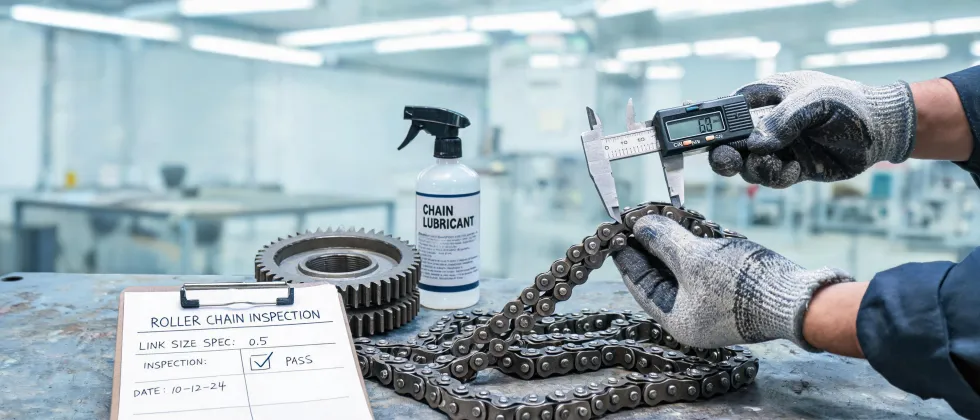
I've been handling MRO orders for a food processing plant for eight years. I've personally made—and documented—fourteen significant buying mistakes, totaling roughly $26,000 in wasted budget. This is not a review. It's a confession with a checklist at the end.
The comparison I wish I'd read before mistake number three isn't "Tsubaki vs. generic" in the usual sense. It's Tsubaki versus the total cost of a replacement part over its service life. I compare three things: specification fit, coupling alignment tolerance, and real-world speed and thrust behavior. Look, I'm not saying every budget part is bad. I'm saying the comparison has to be honest.
1. Tsubaki Roller Chain vs. Generic Roller Chain: Fit Is Not Optional
Back in 2019, I ordered 200 feet of an "equivalent" roller chain for a conveyor. It looked identical to the Tsubaki roller chain it was replacing. Pitch was right, width was right, price was 35% lower. I checked it myself, approved it, and processed it. The result came back with a stretch problem: the chain had elongated 3% in one month. That's not acceptable for a conveyor that has to index to within a quarter inch.
We caught it just before it jumped a sprocket. The replacement cost, including labor and the new order, was about $1,800. And the original $700 in savings? Gone. A lesson learned the hard way.
When I compared the Tsubaki roller chain spec sheet side by side with the generic sheet, I finally understood why the details matter so much. Tsubaki lists pin diameter, plate thickness, tensile strength, and preload. The generic sheet listed only pitch and width. Same "size," different product.
Roller chain dimensions are standardized under ASME B29.1, but the standard gives you a common language, not a guarantee of quality. A chain can meet the size standard and still fail because the pins are undersized or the plates are annealed to save cost. (Source: ASME B29.1. Verify specific dimensions against your manufacturer's catalog.)
Preload is another difference. Preload is the force applied to the chain pins during assembly to seat the pins and bushings. Without it, the chain "beds in" during the first few hundred hours and stretches. The cheap chain in that 2019 order wasn't preloaded. The Tsubaki chains we've installed since then were. That's one reason the data log looks the way it does.
Now I use the tsubaki-chain catalog as my reference. I start every selection there, search by chain number, and verify the dimensions that actually matter. I also keep a tension log. The cheap chain needed re-tensioning almost every week. The Tsubaki chain on the same conveyor hasn't been adjusted in fourteen months. That's not marketing. That's a data point.
2. Tsubaki Chain Coupling vs. Budget Coupling: The $65 Coupling That Cost $1,400
Chain couplings are where the price gap gets dangerous. A chain coupling connects two shafts with a double-strand chain loop. It's a forgiving design, but not infinitely forgiving. The Tsubaki chain coupling and the budget coupling we tested were nominally the same size. The difference was in the tooth engagement and the chain material.
In January 2022, I bought a budget coupling because the Tsubaki chain coupling was $110 and the budget version was $45. Prices from our regular vendor as of that date; verify current pricing. I saved $65. I didn't realize how much the interior tolerance and chain hardness mattered.
The coupling failed at four months. It didn't just wear out—it hammered itself loose, wore into the keyway, and took out the reducer seal. Repair cost: $1,400 plus two days of downtime. That $65 savings turned into a $1,400 problem. I still kick myself for not following our own replacement checklist.
Here's something vendors won't tell you: the first quote is almost never the final cost. The $45 quote didn't include the cost of the repair it caused.
Alignment tolerance is the spec you have to probe. A chain coupling can usually handle angular misalignment of around 1 degree and a parallel offset of 0.010 inch, depending on the size. But if the tooth profile is sloppy, the effective tolerance shrinks. I started measuring backlash before installation. The budget coupling had roughly twice the backlash of the Tsubaki chain coupling. On something that's supposed to dampen shock, that isn't a small difference.
Now, I'm not saying every budget coupling is trash. But when I compared them side by side, the Tsubaki chain coupling had cleaner tooth engagement and a harder chain. The budget one rattled before it was even installed. On a coupling, that rattle is impact load. Impact load shortens the life of every bearing and seal around it.
3. Linear Electric Actuators and Ball Bearing Rollers: Compare at the Operating Point
The same logic applies to linear electric actuators. The question I hear most is: how fast can a linear actuator move? The honest answer: it depends on load. Buyers compare no-load speed, but no-load speed doesn't move your machine.
In 2023, I compared two linear electric actuators for a gate valve conversion. One was cheaper and 15% faster at no load. At our actual load—800 pounds—the cheaper unit stalled. The Tsubaki linear electric actuator was slower on the spec sheet, but at the required thrust it moved the valve. We bought both before we figured that out. Bad process, good lesson.
For a screw-driven actuator, speed depends on motor RPM and screw lead. At the same motor speed, a 5mm lead moves slower but generates more thrust; a 20mm lead moves faster but needs more torque. That's the trade-off. If you need both high speed and high thrust, you need a bigger motor, a different screw, or a different drive.
Everyone told me to check the speed-thrust curve at the operating point. I didn't listen. The cheaper actuator stalled on the first test. Speed and thrust are a trade-off, and the vendor's "max speed" number is usually measured with no load. The only useful number is the speed at the thrust you need.
Ball bearing rollers are a quieter version of the same lesson. A roller with unsealed bearings spins easier when it's new. Once dust or wash-down water gets in, rolling resistance climbs fast. Tsubaki's ball bearing rollers use sealed bearings and tighter tolerances. In our plant, replacing generic rollers with Tsubaki ball bearing rollers cut conveyor drag by about 18%. The bigger win was fewer bearing failures.
What I'd Buy Now
Here's the framework I use now, after 14 documented mistakes and roughly $26,000 in wasted budget:
- Roller chain: Compare tensile strength, preload, and plate thickness—not just pitch and width. Tsubaki roller chain is my benchmark. If the alternative doesn't publish the same data, it's not equivalent.
- Chain couplings: Check tooth engagement, backlash, and chain hardness. If the coupling rattles on the bench, it will hammer on the machine.
- Linear electric actuators: Ask for the speed-thrust curve at your operating load. If the vendor can't provide one, that's a red flag. If they quote "max speed" without a load condition, that's a red flag.
- Ball bearing rollers: Use sealed bearings in any environment with dust, moisture, or wash-down. The extra cost is less than the first replacement.
In my experience managing MRO buying for eight years, the lowest quote has cost us more in about six out of ten cases. Some of those cases were small. Some were like the coupling. All of them were avoidable if I'd compared total cost instead of invoice price.
Bottom line: I don't buy "most expensive," and I do not buy "cheapest." I calculate total cost: part price + labor + expected lifespan + downtime risk. If a Tsubaki roller chain costs twice as much but lasts three times as long, then the cheap one is the expensive one. That's not a slogan. It's the math I wish I'd done earlier.
So, what should you choose? If a part is load-bearing, safety-related, or hard to reach, buy the reference part. If it's a low-risk position and you want to experiment, do it with a documented trial and a clear data log. Just don't tell yourself you're saving money while the maintenance backlog grows. That's the mistake I kept making. Now it's on the checklist.