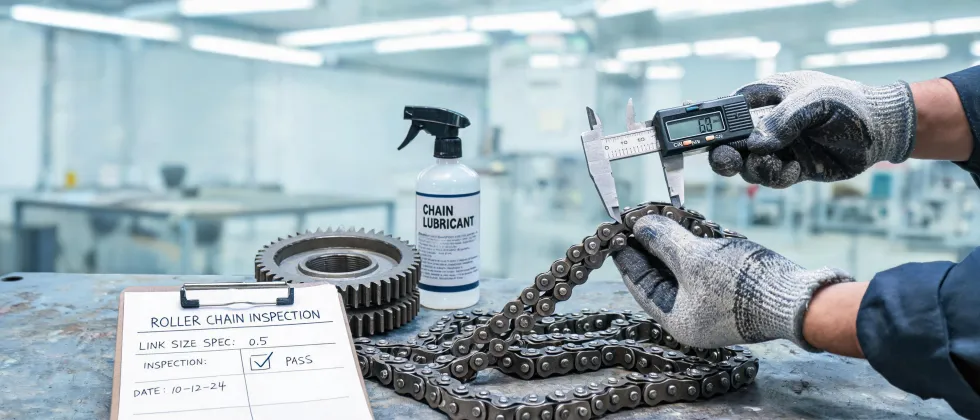
Our packaging line went down on a Tuesday morning in November 2023. I remember the time because I was supposed to be in a budget review at 10:00, and instead I was standing on the plant floor watching our maintenance lead pull a drive chain off a conveyor like it was overcooked spaghetti.
Context: I'm the procurement manager at a 140-person contract packaging company in Ohio. I've managed our maintenance and replacement parts budget—roughly $380,000 per year—for six years. I track every purchase, every quote, and every failure in a spreadsheet that has caught more hidden costs than I can count. This time, it caught me.
The failed chain was a roller drive chain we'd bought in February 2023. It had stretched so badly it was jumping teeth on the sprocket. The vendor's quote was 22% below market rate, and I wrote "seems suspiciously cheap" in my notes. Then I bought it anyway.
Total cost of that decision: $16,400. I'll break that number down because it's the reason I'm writing this.
The $340 "Bargain" Chain
When the chain let go, I quoted replacements from three vendors. The original supplier came in at $1,240 for a 20-foot run of ANSI B29.1 roller chain. The Tsubaki chain quote, through a local distributor, was $1,580. My boss looked at the two numbers and asked why we'd pay $340 more for the same thing.
It wasn't the same thing, though. The Tsubaki chain had a published tensile rating, fatigue data, and a documented service life under cyclic loads. The cheap chain had a picture and a price. At the time, I couldn't articulate why that mattered, so I defaulted to the lower number. Classic rookie mistake—except I've been doing this job for six years, which makes it worse.
In January 2024, the line failed twice in one week. The first time, a seized pin from worn bushings. The second time, the sprocket had eaten itself because chain elongation threw the drive geometry out of spec. Here's the breakdown I promised:
- $1,850 — maintenance labor for both failures and the emergency rebuild
- $420 — overnight shipping for replacement parts (the original vendor couldn't deliver in less than five days)
- $14,130 — lost production while the case-sealer ran at half capacity for four days
I could've bought three Tsubaki chains for that. The lesson cost me $16,400, and I'll never need to learn it again.
What the Stepper Motor Question Taught Me
While we were still patching up the conveyor, we were also retrofitting a bottle-filling line. That's where the phrase "how fast can a stepper motor turn" entered my life permanently.
Our automation engineer, Dan, was sizing a positioning axis for a labeling station. The original design specified a servo motor. A distributor rep suggested a stepper instead to cut costs. Dan looked at me and asked, "Do you know how fast can a stepper motor turn?"
I didn't. I spent an afternoon on the internet, where opinions outnumbered datasheets. The short answer, as I eventually learned from talking to a real applications engineer: most stepper motors handle 300–600 RPM with reasonable torque, but usable speed depends on drive voltage, winding inductance, and how much holding torque you need at standstill. The honest answer is that you need the torque curve for the specific motor, not a number from a forum.
We specified a NEMA 23 stepper paired with a linear electric actuator from Tsubaki's actuator line. The assembly worked cleanly—but only because we got the duty cycle rating and acceleration limits from a manufacturer's engineer, not from a guess. I still remember the relief on Dan's face when he found out the actuator's IP-rated housing could handle the washdown environment on that line.
The Shaft Coupling Near-Miss
Same retrofit, same lesson, different component.
We needed a shaft coupling between the gearmotor and the drive shaft. Two quotes: a generic jaw-type coupling at $68, and a Tsubaki shaft coupling at $94. A 38% difference. On paper, the generic one looked identical.
But Dan read the datasheets—something I now do religiously. The generic coupling allowed a maximum misalignment of 0.010 inches. Our measured misalignment was 0.014 inches. The Tsubaki coupling allowed 0.020 inches. The generic coupling wouldn't fail immediately. It would just transfer vibration into the gearbox bearings and quietly kill a $1,700 gearbox a year later.
I didn't catch that. Dan did. And at that moment, I realized my job was not to find the cheapest part—it was to find the part that didn't create a more expensive problem downstream.
Why Transparent Quotes Win
Here's the part of this story I wish I'd understood earlier. The Tsubaki quotes were easier to evaluate, not harder. They listed product numbers, ANSI/ASME compliance, lubrication intervals, expected service life, even allowable misalignment ranges. The cheaper quotes had none of that.
Everyone tells you to check specifications before approving. I only believed it after skipping that step once and eating a $16,400 mistake.
I now have a simple procurement rule: if a vendor can't show me the specification, I don't buy. That rule has saved us more money than any discount negotiation ever did.
The Full Comparison, With Real Numbers
In Q1 2024, we bid the complete drive train replacement for that line: roller chain, sprockets, shaft coupling, and a linear electric actuator for the tensioner. The lowest bid was $6,240. The Tsubaki package—sourced through US Tsubaki's distribution network—was $7,310. The difference was $1,070, or about 17%.
But over a 24-month total cost of ownership model, the Tsubaki package was $3,200 cheaper. The chain had more than double the fatigue life at our operating load. The coupling was rated for the misalignment we actually had. The actuator survived washdowns where the old one corroded. And the application engineer who came out to walk the line told us we didn't need the oversized frame we'd budgeted for—that visit saved us $800 outright.
I placed that order on a Friday afternoon at 4:47 PM and spent the weekend second-guessing it. Had I overcorrected based on one bad experience? It took six months of uninterrupted production to quiet that voice.
What I'd Tell My Past Self
If I could go back to February 2023, I'd change one thing: I'd ask the vendor for the chain's fatigue resistance data at our operating load. No data, no order. The missing information is what killed us, not the price.
That's the advice I'd give any procurement person reading this. Don't start with "What's the price?" Start with "What's the specification?" A cheap part you can't spec is just expensive in slow motion.
And if someone tells you a stepper motor turns "however fast you need it to," run. Call the manufacturer. Get the torque curve. And make sure your linear electric actuator's duty cycle matches your actual cycle time.
I've got the invoices to prove all of this. The Tsubaki chain guide is on my shelf now, and it's the first thing I pull out when specing a drive. You don't need to make my mistakes to learn the lesson—but if you do, at least you'll know what the numbers really look like.