-
Where can I find a Tsubaki chain catalogue PDF?
-
What does a Tsubaki chain guide actually include?
-
When do timing belt pulley flanges matter?
-
What is a ball screw actuator, and when do you need one?
-
Which is better: ball bearing or roller bearing?
-
What one checklist item would have saved me the most money?
I started this guide from my own "oops" stack. I've been specifying power transmission components for about 12 years, and I've personally made (and documented) 14 significant mistakes, totaling roughly $28,000 in wasted budget. I now keep a pre-order checklist that has caught 47 potential errors in the past 18 months. This guide is built around six questions engineers, maintenance leads, and procurement people still ask me. Some answers will save money. A couple might save a shutdown.
Where can I find a Tsubaki chain catalogue PDF?
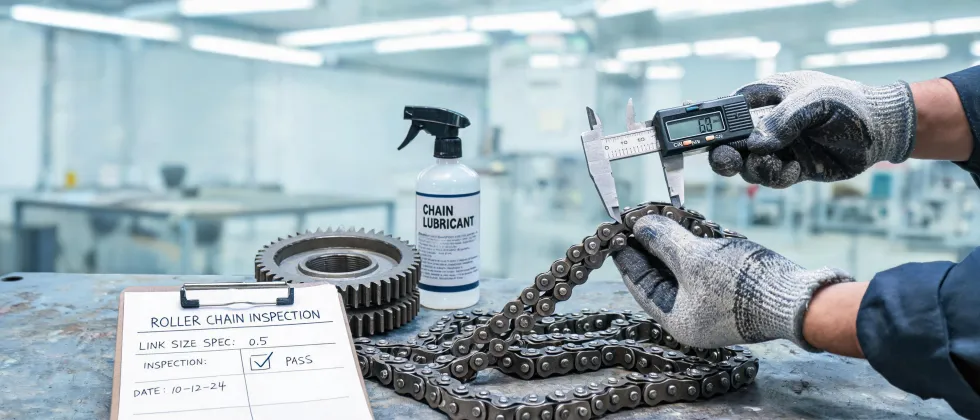
The direct answer is Tsubaki's website. The catalogue is usually split by product family: roller chain, conveyor chain, engineering chain, and drive components. Look for the current edition and save it with the date in the file name. I know that sounds overly tidy. I learned that after I used a 2019 PDF to order a "current" part number. The part existed. It had been replaced by a different series. The replacement wasn't backward compatible. $620 down the drain.
Why does the catalogue edition matter? Because the chain catalogue is not a brochure. It contains chain number, pitch, breaking load, sprocket tooth form, even lubrication guidance. If the edition is outdated, every downstream calculation is suspect. If you can't find a current PDF on Tsubaki's site, ask a Tsubaki distributor for one instead of trusting an old upload.
What does a Tsubaki chain guide actually include?
"Chain guide" can mean two things: a guide-rail component that keeps chain running straight, or a technical guide document. Both are important.
As a component, chain guides are used in conveyor and transfer applications where the chain can lift or drift sideways. They need the correct clearance. Too tight creates drag and wear. Too loose means the guide is just along for the ride.
As a document, the chain guide is the installation and maintenance section of Tsubaki's technical literature. In 2017 I skipped the lubrication table and installed a new chain with too little oil. At 4,000 hours the pins were grooved. The expected life had been 15,000 hours. The answer was right there in the guide.
So if someone asks for "Tsubaki chain guide," ask what they're selecting. A part and a PDF are not interchangeable.
When do timing belt pulley flanges matter?
Timing belt pulley flanges keep the belt from sliding off the side of the pulley. They look simple. They are not.
For most horizontal drives, at least one pair of flanges is enough. Put flanges on every pulley and the belt can grind against the edges until it frays. In 2016 I ordered a custom timing belt pulley with flanges on both sides because I figured "more is safer." The belt tracked perfectly—straight into the flange faces. Within weeks the edges started fraying.
Before you specify timing belt pulley flanges, check the drive center distance, shaft orientation, and speed. And remember: flanges will not fix misalignment. They just rub against the belt until you notice the smoke. (mental note: I really should publish that photo.)
What is a ball screw actuator, and when do you need one?
A ball screw actuator converts rotary motion into linear motion using a screw and recirculating balls. The rolling contact means lower friction and higher efficiency than a sliding lead screw. That is why it shows up in precision positioning, higher speeds, and applications with many cycles.
But precision has a price. If your application is a slow push every few minutes, a ball screw actuator may be overkill. A lead screw actuator can do the job at a lower total cost. I'm not an electromechanical design engineer, so I won't spec one from memory. From field experience, though, I've seen a packing station where the old lead screw lasted years. Someone swapped in a ball screw actuator because they assumed "ball is better." It worked, but it added cost without fixing the real issue—a worn motor coupling. The coupling, not the screw, had been the problem.
Use a ball screw actuator when the application needs the efficiency or accuracy. If not, keep the simpler design and spend the savings on alignment or guarding.
Which is better: ball bearing or roller bearing?
I get asked this at least once a month. The honest answer is: it depends on what "better" means for your load.
Ball bearings have point contact. They handle moderate radial loads, some axial load, and they run well at higher speeds. Roller bearings have line contact, so they handle heavier radial loads and shock loads, but they are generally less tolerant of misalignment and may have lower speed limits.
A few years ago (2021), a maintenance supervisor asked whether he could replace a roller bearing with a ball bearing that had the same bore size. It was $180 cheaper. The equipment was a conveyor idler, not a high-speed spindle. But the load was above the ball bearing's dynamic rating. Three weeks later the bearing failed. The machine was down for a day. The $180 saving turned into an $890 repair plus lost production.
The question shouldn't be "ball vs roller" in a vacuum. It should be "which bearing matches this load, speed, and housing?" I'm not a tribologist, so I always send the load calculations to a bearing engineer before changing types. Total cost of ownership is more than the unit price.
What one checklist item would have saved me the most money?
Verify the part number against the physical component, not just the drawing. That sounds obvious. In 2022, I ordered a replacement chain from a catalogue PDF that was one revision old. The drawing number looked right. The sprocket said otherwise. The chain had the right pitch but the wrong link plate width. We caught it during the changeover, not before. That was a three-day delay and a $1,150 reorder.
The part number check belongs on every pre-order list, but so do these:
- Is the catalogue edition current?
- Is the component size based on a measurement or a guess?
- Does the load rating cover the starting torque, not just running load?
Price is one line in the total cost. "Oops, it doesn't fit" is the line after it.
My experience is built on a few hundred line starts and rebuilds, mostly in medium-size packaging and material handling. If you're designing a high-speed spindle or a crane derrick, treat this as a starting point, not the last word.