-
Is “Tsubaki-Chain” a product, a brand, or a whole family?
-
How do I use the Tsubaki chain configurator without creating a mess?
-
What are precision roller bearings actually for?
-
What makes a heavy duty linear actuator different from a regular one?
-
What’s a ball bearing, in plain terms?
-
Does the Tsubaki chain configurator cover roller chain, leaf chain, and conveyor chain?
You probably got here by searching “tsubaki-chain,” so let’s start with what that term actually points to. I’m a quality/compliance manager at a power transmission manufacturer. I review roughly 200 unique specs a year before they go to customers. In 2024, I rejected about 8% of first deliveries because of missing lubrication details or tolerance mismatches. These are the questions I answer most often.
Is “Tsubaki-Chain” a product, a brand, or a whole family?
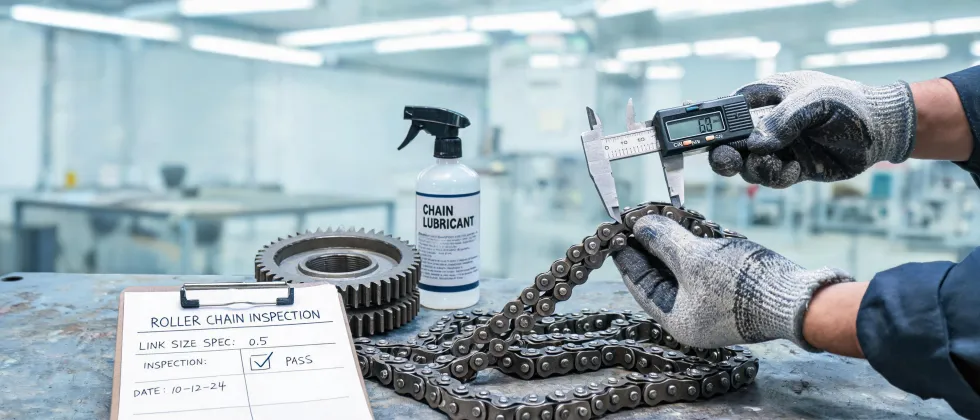
Tsubaki is the brand. Chain is the core product line. You’ll see “tsubaki-chain” in URLs, part numbers, and distributor filters because it’s a quick way to isolate Tsubaki’s chain products from their actuators, bearings, and couplings. That distinction matters. A “Tsubaki chain” can be a roller chain, leaf chain, conveyor chain, timing chain, or motorcycle chain. They are not interchangeable, and the design calculations are different. For roller chain, dimensions follow ANSI B29.1 and ISO 606. But the standard only defines the chain, not the application. That’s where quality issues begin.
How do I use the Tsubaki chain configurator without creating a mess?
Actually, the configurator is where I see the most avoidable mistakes. It’s an efficient way to narrow down a chain—no question. But you need to feed it the whole system, not just a couple of numbers. Enter the shaft center distance, pitch, chain speed, expected load, sprocket arrangement, lubrication method, and service factor. If you skip lubrication or ignore the drive layout, the tool can either oversize the chain or return something marginal.
In Q1 2024, I reviewed a configurator output where someone selected “idler sprocket” but never added it to the layout. On paper it looked fine. In the real assembly, the chain would have run against a housing. We caught it only because I print the PDF and red-flag anything that doesn’t match the actual machine. (Should mention: the configurator also rejected an impossible combination that a rushed human would have accepted. That’s a genuine benefit.)
What are precision roller bearings actually for?
Precision roller bearings are for applications where standard bearing tolerance isn’t enough—high-speed spindles, gearboxes, rotary indexing tables, and some linear motion assemblies. “Precision” means defined size and running accuracy grades, usually per ISO 492. It does not mean “always better.” The mistake I see is treating precision like a no-brainer upgrade. It isn’t. A tighter bearing can be more sensitive to misalignment and housing tolerances. So you can spend more and still shorten life if the surrounding bores aren’t accurate.
I can only speak to my context: most chain and conveyor applications don’t need that level of precision. The ones that do tend to be positioning or high-speed equipment. If you’re looking at a heavy duty linear actuator, the bearing grade should match the actuator’s rail and carriage, not your guess. One recurring problem is C3 clearance specified because “everyone knows C3 is premium.” No—it’s a specific internal clearance, not a blanket upgrade.
What makes a heavy duty linear actuator different from a regular one?
Load capacity, duty cycle, and stiffness. A regular actuator is often sized for occasional movement. A heavy duty linear actuator is designed for continuous or high-cycle operation, higher thrust, and repeated positioning without losing accuracy.
I had a vendor once quote a “heavy duty” actuator that was actually a standard unit with a bigger motor. So glad I checked torsional rigidity and frame deflection before approving—the frame flexed at about 60% of rated load. That kind of miss can turn into a $22,000 redo and a missed launch. Tsubaki’s linear actuator line? Honestly, I know less about it than Tsubaki’s chain and bearing products. But the spec discipline is the same: verify rated force, duty cycle, ambient temperature, and stroke length under real conditions.
What’s a ball bearing, in plain terms?
A ball bearing is a machine element that reduces friction between two moving parts by placing balls between two rings, or races. The balls roll, so the surfaces don’t have to slide against each other. Ball bearings show up in motors, conveyor idlers, fans—and in Tsubaki’s product range, they’re common in mounted bearing units on conveyor systems.
But if you’re asking because you saw the phrase on a drawing, the practical question is: what’s it doing here? A ball bearing handles light-to-moderate radial and axial loads with low friction. Roller bearings handle heavier radial loads and shock better. Honestly, I’m not sure why some legacy drawings keep ball bearings in belt drives where a cylindrical roller would survive longer. My best guess is the original design predated the load calculation. So don’t copy a bearing designation from an old file without checking the load spectrum. A bearing that worked in a low-duty prototype may not live through production.
Does the Tsubaki chain configurator cover roller chain, leaf chain, and conveyor chain?
It covers more than roller chain, but not every product line accepts the same inputs. Leaf chain, for example, doesn’t use a sprocket pitch circle in the same sense—you’re designing lift and mast systems with pins and links under tension. Conveyor chain introduces attachments, side-bend, and carrying surfaces. Timing chain needs a different calculation again. The configurator is great for standardized products.
I have mixed feelings about using it as a one-stop design authority. On one hand, it eliminates data entry errors and speeds up selection. On the other, it can tempt you to treat different applications as if they were the same. My rule is simple: use the tool to narrow options, then send the output to someone who understands the machine’s duty cycle. That’s not old-school; that’s the review process I sign off on.