I'm the office administrator for a 52-person manufacturing company. I've been ordering power transmission and machine components since 2020, and I manage roughly $300k in annual spend across eight vendors. I'm not a mechanical engineer. I'm the person who has to get the product code right, because if I don't, everybody downstream pays for it.
One phrase I hear all the time is 'we need a Tsubaki part' or 'look up the tsubaki-chain catalogue.' That's a bit like walking into a hardware store and asking for 'a screw.' Before I can order anything, I need to know which problem you're solving. The good news is that most requests fall into one of three scenarios.
Three Scenarios, Three Different Answers
I use a simple decision frame for almost every component request: is this a replacement, is this linear motion, or is this rotating power? The answer changes the product family completely.
- Scenario A: The part already exists on a machine and needs to be replaced.
- Scenario B: Something needs to move in a straight line.
- Scenario C: You're connecting rotating shafts or supporting heavy loads.
Scenario A: You're Replacing Something on an Existing Machine
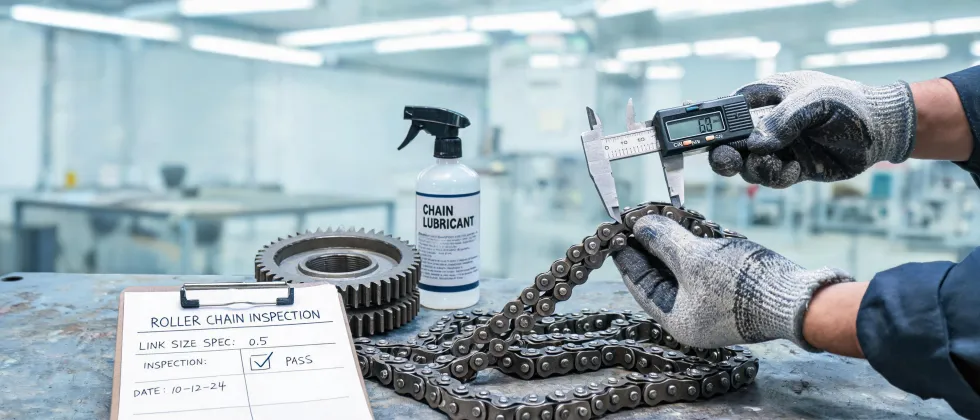
If the machine already has the part, don't guess. Get the old part number, the chain number stamped on the metal, or at least a clear photo with a ruler beside it.
This is where the tsubaki chain catalogue PDF becomes your friend. Searching for 'tsubaki chain catalogue pdf' will bring up the official downloadable version. It includes chain numbers, coupling dimensions, bearing diameters, and more. For example, a standard roller chain number like #40 means 4/8-inch pitch under ANSI/ASME B29.1. That's the kind of detail that separates a correct order from a return.
If you're replacing a chain coupling, the catalogue shows the usable bore range for each coupling size. Don't assume the outside size tells you what's inside.
From the outside, it looks like you can just match the overall dimensions. The reality is that a taper roller bearing has a cone and a cup that have to stay matched. If you order by bore size alone, you're only getting half the bearing.
I only started downloading the catalogue PDF after I ignored it once and paid for the lesson. I ordered a 'same-looking' roller chain without checking the pitch, and it didn't fit. The return shipping plus downtime cost us about $180. Now I keep a folder of tsubaki-chain catalogue PDFs on my desktop, and I use it at least twice a month.
Scenario B: You're Building or Upgrading a Linear Motion Axis
If the request is about something sliding, moving, pushing, or extending, ask whether the job needs a bearing or an actuator. These get mixed up more than you'd think.
Linear bearing: if it just needs to slide
A linear bearing supports the moving part on a shaft. A common part number is LM8LUU. If someone asks 'what size is LM8LUU linear bearing?', the short answer is: it's a metric linear bearing with an 8 mm bore, a 15 mm outside diameter, and a 35 mm overall length in the long version. That 'L' means long—the standard LM8UU is 24 mm long. The extra length spreads the load, so it's generally a better choice for a longer or heavier carriage.
When I compared LM8UU and LM8LUU side by side, I finally understood why one costs more than the other. It's not just a longer body. It's a different load capacity and a different stiffness behavior on the rail.
Micro linear actuator: if it needs to move by itself
Micro linear actuators are one of those categories where the name sounds more complicated than the part. In short, if the part has to push, lift, or position without someone turning a handle, a linear bearing alone won't do it. You need a micro linear actuator.
'Micro' usually means a compact motor with a lead screw, often 12V or 24V, with a stroke under 300 mm. Before ordering one, I need to know voltage, stroke, force, speed, and mounting style.
Honest limitation: a micro linear actuator is not a replacement for a ball screw in high-precision positioning, and it's not a replacement for a pneumatic cylinder in high-speed cycling. It's best when you need compact, repeatable motion in a small envelope.
Scenario C: You're Connecting Rotating Shafts or Supporting Heavy Loads
This is where couplings and bearings come in. It's a completely different question from linear motion.
Chain coupling: if you're connecting two shafts
A tsubaki chain coupling uses a length of roller chain to connect two sprockets. It's simple, durable, and relatively easy to spec once you know the chain number and bore size. When someone asks specifically for a tsubaki chain coupling, I look up the coupling series in the catalogue, then confirm the bore range and keyway details.
Honest limitation: a chain coupling allows some misalignment, but not a lot. If your shafts are visibly off, no coupling will fix that. Fix the alignment first, or you'll be replacing the chain far too often.
Taper roller bearing: if one shaft carries both radial and axial loads
A taper roller bearing is designed for heavy combined radial and axial loads. You'll find them in gearboxes, wheel hubs, conveyors, and similar equipment. When I order one, I don't just ask for 'a taper roller bearing.' I need the exact bore, outside diameter, width, and taper series.
Most buyers focus on the bore and completely miss the cup. That's a classic blind spot. The cup and cone are a matched pair. Mixing different series changes the preload and shortens the bearing's life.
How to Tell Which Scenario You're In
Here's how I walk a request through to the right order:
- Is the part already mounted on a machine? Go to Scenario A. Get the old part number, check the stamping, and use the Tsubaki chain catalogue PDF to confirm dimensions.
- Does something need to slide or extend in a straight line? Go to Scenario B. Use an LM8LUU-style linear bearing if it only needs support, or a micro linear actuator if it needs powered motion.
- Does the task involve rotating shafts or heavy support loads? Go to Scenario C. A chain coupling is for torque transfer between shafts; a taper roller bearing is for heavy radial and axial load support.
If you're still stuck, the smartest thing I do is send a photo and any part numbers to the supplier. A good supplier would rather answer one question than deal with a return. And there is no universal 'best' Tsubaki product that covers every request. The right choice depends on the machine, the load, and the motion. That's not frustrating—it's just how mechanical design works.