Thursday, 2:17 p.m. I remember the exact time because I was about to close a purchase order when the maintenance supervisor appeared at my desk. He didn't say, “we might have a problem.” He said, “line's down. I need a Tsubaki chain stretch gauge before tomorrow morning.”
I'm the office administrator for a 180-person manufacturing plant. I handle all the MRO ordering—roughly $600,000 a year spread across eight vendors. I report to operations and finance. I'm not an engineer. But when you're the person who signs the purchase orders, you become the de facto translator between the plant floor and the supply chain.
When I took over purchasing in 2020, I thought a chain was a chain. That afternoon, I searched tsubaki-chain online and learned more about chain wear than I had in the previous five years.
The first thing I learned: a chain doesn't stretch like you think
My first instinct was to order the longest chain I could find. The maintenance supervisor looked at me the way you'd look at someone who just offered you a printer to fix a printer. “No,” he said. “We need the gauge. The chain itself is already installed.”
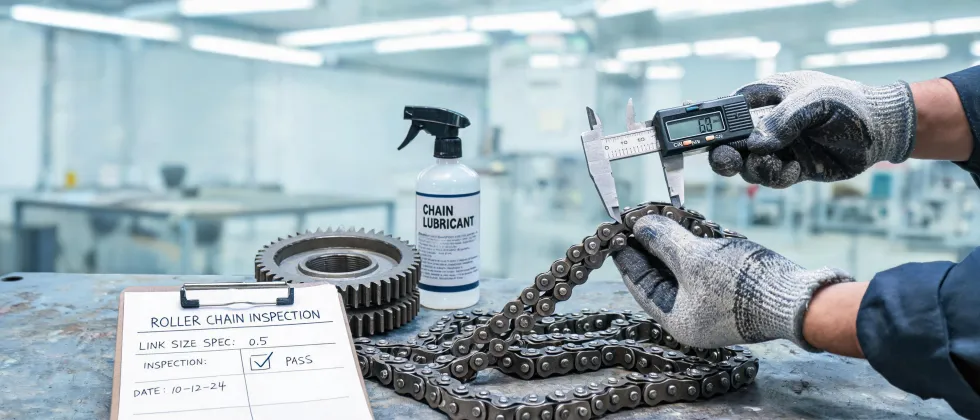
So I looked up tsubaki chain stretch gauge. In plain terms, it's a tool that measures chain elongation. A roller chain gets longer as pins and bushings wear. If the elongation gets past a certain point, the chain stops engaging with the sprocket properly. It can skip, jump teeth, or snap—usually at the worst possible moment.
According to Tsubaki's published maintenance guidelines, a chain at 2% elongation is generally considered worn for most drive applications. Some slow-speed conveyors can go further, but 2% is the number that stuck in my head. I don't have hard data on how many failures that one rule prevented, but based on what happened later that week, my sense is it was the difference between a scheduled repair and a surprise rebuild.
Here's where the simplification trap comes in. It's tempting to think any chain gauge will do, or that you can eyeball a chain and tell if it's worn. You can't. We measured 2.4% on the main conveyor chain. It looked fine from the floor. The gauge showed it was done.
Tsubaki leaf chain: the part that made me question everything
The conveyor chain was the obvious problem. The hidden one was on the vertical lift—a Tsubaki leaf chain. I'd never heard of leaf chain. There's a reason it's called that: it's made of stacked leaves or plates, not roller links. It's used where you need strength without a lot of articulation—like lifting a platform or a counterweight.
When maintenance said they needed a Tsubaki leaf chain, I typed the keyword and got a part number. Great. But then came the question I wasn't ready for: “Which one?”
From the outside, a chain looks like a chain. The reality is there are pitch sizes, pin diameters, lacing patterns, and attachment spacing. The old part number was buried in grease. I had to send maintenance back with calipers to measure pitch and pin diameter before I could order. That delay cost us half a day—not because the supplier was slow, but because I didn't know what to ask. (note to self: always ask for the part number before the part is installed.)
To be fair, our regular supplier was responsive once I gave them the measurements. But “responsive” doesn't mean “in stock.” The leaf chain had to come from a regional warehouse. Standard ground would take four days. The plant was already down. Every hour counted.
The rest of the train: spherical roller bearings and electric linear actuators
While we waited, I started digging into the rest of the assembly because I didn't want to be caught unprepared again. I typed what's a ball bearing late that night—I'm not ashamed to admit it. That led me to a deeper rabbit hole: spherical roller bearings, which are not the same thing as ball bearings, despite the word “ball” not being in the name. A ball bearing uses balls. A spherical roller bearing uses barrel-shaped rollers and handles misalignment. If you order the wrong one, the machine will tell you quickly.
I also learned about electric linear actuators. We had a pneumatic actuator on a diverter gate that kept failing because of air-quality issues. Maintenance had been recommending a switch to an electric linear actuator for months. I'd approved the quote without thinking about it. Now I understood why: no compressed air lines to maintain, more precise positioning, and fewer moving parts exposed to contamination. We ended up ordering one that week. That decision was another case of paying a little more upfront to avoid a recurring hidden cost.
Why I paid $480 for overnight delivery—and why I'd do it again
In March 2024, the leaf chain quote was $842. Overnight shipping was $480. Finance asked me if there was a cheaper option. I explained that the line was producing about $3,800 of margin per hour. If the part arrived in four days, the shutdown would cost roughly $60,000 in lost production. The overnight fee wasn't a luxury. It was insurance against an unstated risk.
People think rush shipping is about impatience. It's not. It's about certainty. In my opinion, uncertain cheap shipping is more expensive than certain expensive shipping. I'd been burned before by a vendor who promised a two-day delivery and delivered in five. That time, it wasn't a chain; it was a replacement motor, and the delay cost us a customer deadline. Since then, I've been willing to pay for guaranteed delivery when the cost of being wrong is higher than the shipping charge.
What I'd do differently now
I wish I had tracked downtime more carefully over the years. What I can say anecdotally is that most of the urgent orders I've placed could have been predicted if someone had measured the chain earlier. A $40 chain stretch gauge is a small price to avoid a $60,000 shutdown.
My experience is based on one plant's MRO buying. If you're managing a large multi-site operation, your process will differ. But I'd bet the principle holds: know your critical components, measure them, and don't let a part-number shortage become an emergency.
So, what's the takeaway? Three things, from someone who orders parts instead of installing them:
- Buy a Tsubaki chain stretch gauge before you need one. It's not a “nice to have” tool. It's a cheap early-warning system.
- Don't assume “leaf chain” is one part. There are many variations, and the difference between them matters.
- If a machine is critical, pay for delivery certainty when you order. In the 2024 outage, the $480 rush fee looked excessive on the invoice. Compared to the $60,000 production loss, it was almost free.
I won't pretend I'm a mechanical engineer now. But the next time someone asks me “what's a ball bearing?” I won't have to look it up. And if a maintenance supervisor ever says “Tsubaki chain stretch gauge” again, I'll already know what to order.