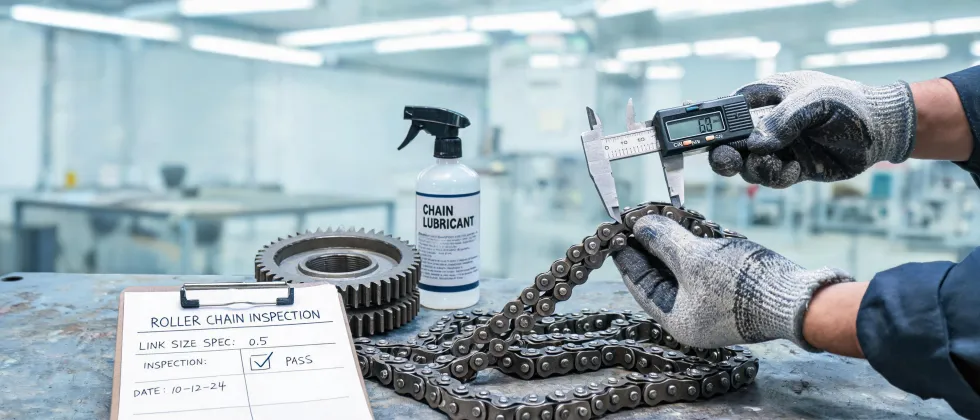
Most Tsubaki Chain purchases go sideways for one reason: spec mismatch buried inside a low-looking quote, not the price of the chain itself. In the last 18 months I've compared quotes from four distributors for the same industrial Tsubaki stock parts and found a 31% spread on identical part numbers. The lowest base price would have cost us about $2,300 more once substitutions, freight, and expedite fees appeared. The fix isn't negotiating harder. It's getting the full spec written down before anyone talks price.
Here's the thing: I'm a procurement manager at a 50-person material handling systems integrator. I manage roughly $180,000 a year in power-transmission purchases, and I've been logging every quote and PO in our ERP for six years. I'm not an engineer. I'm the person who calls engineers after a bad part arrives and says 'you were right.' That's why I'm annoying about part numbers.
The quote that taught me to write the full spec
Last year I emailed a supplier. I said 'We need a Tsubaki ZIP Chain actuator with a linear actuator control kit.' They heard 'send the current standard package.' Both sides said 'standard package' but meant different things. We found out when the machine faulted on startup: the chain module was right, but the control kit was 24V and our run was 48V.
I still kick myself for not sending the product page and electrical spec in the same email. If I'd done that, the supplier would have caught the discrepancy before the PO. Instead we paid a $180 expedite fee, waited two extra days, and I built a rule: no quote goes out without a full part number and a line item for the control kit.
Three Tsubaki-specific traps in a quote
The expensive error isn't the chain. It's the check you didn't do earlier. Here are the three I see in orders.
1. 'Tsubaki' is not a full spec
If someone asks for 'Tsubaki chain' and nothing else, that's a red flag. A 100 chain has a long list of variants: standard ANSI roller chain, RS types, stainless, attachment-chain layouts, and different lubrication options for high-speed operation. The part number tells you what's actually included. '100 chain' does not. We got a batch of attachment chains where the attachment spacing was five pitches instead of four. It didn't look wrong until we tried to bolt on the carriers.
Ask for the manufacturer's complete part number. If it isn't on the quote, ask again.
2. The linear actuator control kit is where the hidden cost lives
Searching for 'tsubaki zip chain' gets you to the actuator page faster than searching for 'electric cylinder.' Tsubaki's ZIP Chain actuator is a good replacement for a pneumatic cylinder because the chain retracts into a compact body. But the mechanical part is only half the system. When somebody searches for a 'linear actuator control kit,' the search usually lands on a page of vague controller options. The controller has to match voltage, stroke timing, and sometimes the brake relay.
On a recent 'high speed linear actuator' request, two quotes looked identical. One included a basic relay controller. The other included a PLC-style interface with the programming hardware. The second quote was $600 higher upfront, but it was the real solution. The cheap quote would have needed a $470 interface board after award. The summary page didn't show that.
Last time I checked, Tsubaki's website (tsubaki.com) has a configurator for ZIP Chain actuators; it lists the actuator, motor, and control kit separately. Use it even if you buy through a distributor.
3. Timing chain orders are a game of exact numbers
If you're replacing a 'tsubaki timing chain' in an engine, you don't want a chain that's 'close enough.' The pitch, width, and matched sprocket kit are part of the system. If the OEM part number or manufacturer's kit number isn't in front of me, I don't approve the purchase.
My rule came from conveyor chains, but it applies to engine timing chains: if the part number isn't printed on the email, assume someone is guessing.
What happened to Pete Jackson Gear Drives?
Real talk: if you searched that, you're probably not looking for Tsubaki. But it's in the search logs, so I'll give you the honest procurement version.
Pete Jackson gear drives are the old-school aftermarket cam drive setup that used a gear drive instead of a timing chain. They were popular on small-block and big-block V8 builds, partly because of the distinctive whine and partly because removing the chain from the equation sounded like a good idea at the time. The original branded sets have not had mainstream factory-direct distribution in years. What you find today is mostly used parts and new old stock, plus some later versions under other names.
If you're building an engine around one of these, verify the crank and cam numbers, check the installation instructions, and don't assume a shiny box means current quality control. That's the same part-number discipline I use for Tsubaki timing chains: brand matters, but application fit matters more.
Asking what's not included first
Once I got better at writing the spec, I got better at asking price questions. I now ask every vendor, before they sharpen the pencil, 'What's not included?' That question has surfaced setup charges, software licenses, communication cables, and a $250 returned-material authorization policy that no one mentions on the first call.
I have mixed feelings about this. Part of me hates that transparency has to be demanded. Another part knows most vendors are responding to the same pressure: if they show every fee, the total number looks scarier. I reconcile it by adding a line to every RFQ: 'Include all one-time and monthly fees. Missing items will be rejected after award.'
A supplier who lists all fees upfront, even when the total looks higher, usually costs less in the end. That's not optimism. That's the difference between invoice price and total cost.
When this advice doesn't apply
Before you get a lecture from people like me, here's the other side:
- If the component is already in service and you have the old part number from the tag, use that number. You don't need a quote comparison.
- If the duty cycle is low, a basic control kit is fine. A gate that opens twice a day doesn't need servo-level position control.
- If your local distributor has the part on the shelf and can get it to you tomorrow, that's worth money. A 3% price break from a distant warehouse doesn't help when downtime is burning.
Prices I cite here came from Q4 2024 distributor quotes for common stock items. They're not a current price list. Verify before you budget.