-
My Position: Price Is the Last Thing I Look At
-
The 2% Rule: How a Tsubaki Chain Stretch Gauge Changed My PM Checklists
-
Neptune Chain: The 'Expensive' Part That Saved Us Three Rebuilds
-
Jaw Couplings, 'Roller Ball Bearings', and the Art of Asking the Right Question
-
How Fast Can a Stepper Motor Turn? The Answer Is Not a Number
-
But What About the Boss Who Wants the Lowest Bid?
-
Bottom Line: Trust the Spec, Not the Slide Deck
The cheapest component in the catalog is never the cheapest component in the machine.
That may sound like a slogan. It's not. I've been maintaining and specifying power transmission parts for 11 years, and I've personally made and documented 19 significant mistakes — roughly $43,000 in wasted budget, lost uptime, and re-engineering. I now maintain our team's pre-order checklist, and the first line is not 'price.' The first line is: What do we actually know?
If you've ever watched a chain jump a sprocket at 2:00 PM on a Friday, you know exactly what I mean.
My Position: Price Is the Last Thing I Look At
Here's the thing: in power transmission, every component carries a hidden fee. The fee is not in the quote. It's in the mismatch, the unplanned downtime, and the part that fails in exactly the way the spec sheet warned about. We can only see that fee if the supplier is transparent about the system, not just the price.
Transparent pricing is not only about seeing the total before you click. In B2B parts, transparency means the vendor gives you the load limits, the elongation limits, the misalignment tolerance, the torque curves, and the dimensions that make or break an installation. If they do that, the price is a real price. If they don't, you're buying a lottery ticket.
The 2% Rule: How a Tsubaki Chain Stretch Gauge Changed My PM Checklists
In my first year, I made the classic mistake. I looked at a roller chain, decided it was fine because it didn't look broken, and left it in service. I didn't know the difference between visual wear and actual elongation. The chain didn't snap. It stretched, jumped a sprocket, and destroyed the sprocket in the process. The repair cost $890 with labor, and we were down for a day and a half.
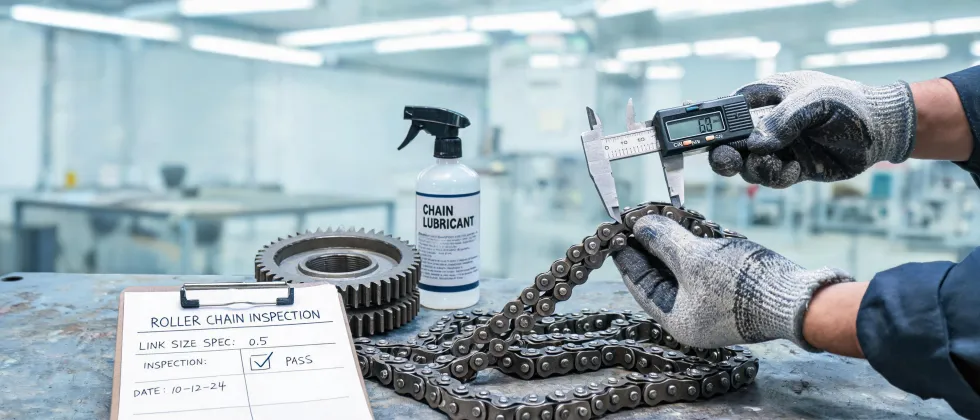
After that, I bought a Tsubaki chain stretch gauge. It's a small tool, and based on distributor quotes I've seen in January 2025, it costs somewhere around $60 to $80 — verify current pricing. It measures pin-to-pin elongation in seconds. According to Tsubaki's roller chain catalog (tsubaki.com), chain should be replaced when elongation reaches about 2% for ordinary drive and conveyor service. I treat 1.5% as the limit for anything that needs precision. That one gauge caught problems we couldn't see with a flashlight. We've caught 47 potential failures in the last four years using the same checklist. Last fall, the gauge flagged a 1.9% stretch on a chain that looked fine. So glad I measured before the PM deadline. One more month would have taken out a $380 sprocket. Not ideal that it took a disaster to convince me. But a lesson learned the hard way is still a lesson.
When I compared the PM records before and after the gauge — same lines, same components — I finally understood why detail matters. The 'before' records had dates and signatures. The 'after' records have numbers. One is a checkbox. The other is a history.
Neptune Chain: The 'Expensive' Part That Saved Us Three Rebuilds
One of my documented mistakes involves a washdown conveyor that was eating standard roller chain. In Q3 2022, we replaced the same drive chain twice in six months. The cheapest replacement was standard chain. I ordered it again. It failed again. Then we tried Tsubaki Neptune chain, which is designed for corrosion-resistant, washdown environments. The upfront cost was higher — not dramatically, but higher — and within a year the math was obvious: standard chain would have cost us more, because it would have failed again.
I have mixed feelings about premium component premiums. On one hand, the extra cost is easy to see on a purchase order. On the other hand, after you compute labor per failure, downtime, and damaged product, the premium becomes small. Part of me wants to call it profit-taking. Another part knows that corrosion-resistant engineering is real. I reconcile it this way: I don't object to paying for capability I need. I object to paying for capability I was never told I needed.
Jaw Couplings, 'Roller Ball Bearings', and the Art of Asking the Right Question
Every so often, someone searches for a 'roller ball bearing.' The phrase makes me flinch. There is no roller ball bearing. There are ball bearings and there are roller bearings. They have different contact geometry and different load capacity. A ball bearing uses point contact and handles moderate radial and thrust loads in many applications. A roller bearing uses line contact and is usually a better choice for higher radial loads. The internet will happily sell you a bearing using a phrase that does not match your application. The spec sheet is the only thing that stops the mismatch.
Most buyers focus on shaft diameter and price, and completely miss load direction, speed, temperature, lubrication, and misalignment. The question everyone asks is 'which size fits?' The question they should ask is 'what is the load doing to that fitting?'
The same principle applies to jaw couplings. They look simple: two hubs, an elastomeric insert, four bolts. But if you pick the insert by durometer without checking torque, temperature, and misalignment capacity, you'll get a coupling that is technically installed and still does not survive. The Tsubaki coupling selection section makes you answer these questions. Not to slow you down. Because the answers change the part number.
How Fast Can a Stepper Motor Turn? The Answer Is Not a Number
How fast can a stepper motor turn? I get this question from new engineers, and it's fair. It is also impossible to answer without context. Under no load, with the right high-voltage driver, a small stepper can spin a few thousand rpm. But that's the same as quoting a car's top speed while driving downhill. The moment you attach a lead screw, a belt, or any inertia, the usable speed drops fast. In most real applications, a stepper delivers useful torque between about 300 and 1,000 rpm. Some can go faster. But ask the application, not the brochure.
This is why I respect the tsubaki-chain resource. The catalog doesn't just list parts for chains, couplings, bearings, and linear actuators. It gives you the data and selection steps that force you to think in terms of load, speed, and duty cycle. A tsubaki-chain catalog entry is not a black box. That is the kind of transparency I want before I write a PO.
But What About the Boss Who Wants the Lowest Bid?
Look, I know the pressure. Somewhere in every supply chain, someone says 'can you find a cheaper version?' I've said it myself. It's how I ended up with three good quotes for a coupling and a flange that did not fit each other. The cheapest one was the most expensive because the extra time to fix the mistake was not in the quote.
Then again, I'm not saying ignore price. That would be irresponsible. I'm saying compare data sheets with the same eye you use on the bottom line. If one vendor sends torque curves and deflection ratings, and another sends a one-page price list, the second one is not cheaper. It's incomplete. Put another way: the hidden fees of power transmission are the equivalent of 'what's NOT included?' in a service quote.
Bottom Line: Trust the Spec, Not the Slide Deck
Transparent specs are transparent pricing. I trust the tsubaki-chain catalog because it gives me the limits and the selection tools before I make a mistake. It doesn't guarantee that I'll never miss an installation detail. It makes the check possible. That's the whole point.
Measure the chain. Read the elongation limit. Match the bearing to the load direction. Give the jaw coupling enough misalignment margin. Ask the stepper motor question with load attached. And remember that the part that fits on paper but fails on the floor is the kind of mistake I'm trying to stop — one documented $43,000 chunk at a time.
Measure it. Read it. Trust the data. That's it.