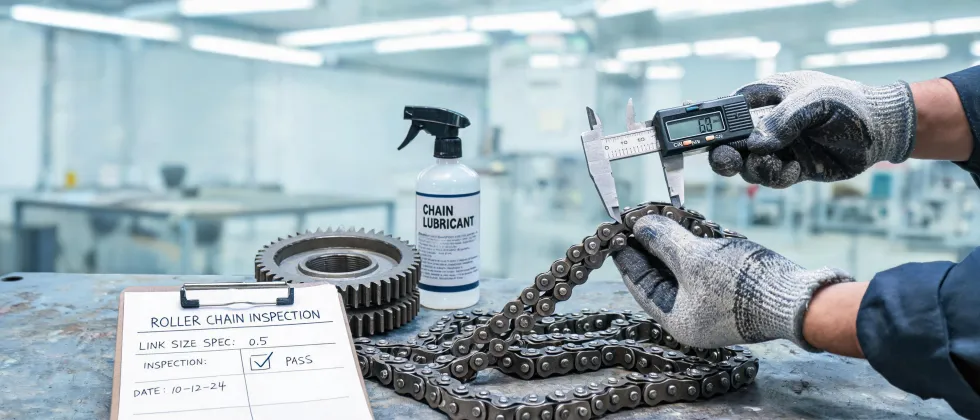
Spec sheets lie. Not maliciously—they just omit the context that turns a functional part into a reliable one.
I'm a quality compliance manager at a power transmission distributor. Every quarter, I review roughly 200 unique items—roller chains, rigid shaft couplings, electric actuators, bearings—before they reach end users. In Q1 2024 alone, I rejected 14% of first deliveries for dimensional or material non-compliance. Not because the vendors were careless. Because the specs on paper and the part in hand often tell different stories.
Here's the thing: most engineers and procurement teams assume that if a product meets the listed dimensions, it's interchangeable. That assumption costs money. Real money. I've seen a single mis-specified rigid shaft coupling cause a $22,000 redo on a packaging line, and a batch of chain that looked perfect on the drawing ruined 8,000 units in storage because the hardness was off by 3 Rockwell.
This isn't about brand loyalty. It's about understanding that time certainty and spec fidelity are worth paying for, especially in emergency situations where 'probably good enough' is the biggest risk.
Why your chain selection might be costing you downtime
I said 'ANSI standard roller chain.' They heard 'any brand will do.' Result: a 50,000-unit order where the pitch was within tolerance, but the side-plate thickness varied by 0.8 mm between batches. The vendor claimed it was 'within industry standard.' We rejected the batch. The redo cost them $4,200, but our customer's line was down for two extra days waiting. Net loss to them: about $15,000 in lost production (ugh).
The issue wasn't the chain itself. It was that the 'standard' spec we both agreed on didn't capture the consistency requirement for automated assembly. We now include side-plate thickness tolerance in every roller chain contract. Small detail. Big difference.
Rigid shaft couplings: the 15-minute install that took 3 hours
In 2023, we sourced rigid shaft couplings for a new actuator assembly. The basic dimensions matched. The bore tolerance was spot-on. But the keyway alignment? Off by 0.2 degrees across the batch. On a manual install, you might never notice. In a high-speed automated system, that misalignment caused vibration that cracked a motor housing after 200 hours.
Savings on the coupling: $1.80 per unit. Cost of the failure: $6,000 in motor repairs, plus a rush order for the correct couplings ($400 extra for expedited shipping). The total cost of the 'budget' choice was roughly 6x the premium option.
Look, I'm not saying budget options are always bad. I'm saying that when you're buying for a deadline—and we all are—the uncertainty of 'maybe within spec' is a liability. Pay for the certainty that the part you ordered is the part you get.
Electric actuator design: the spec that didn't scale
I ran a blind test with our engineering team: same electric actuator base design with two different control board suppliers. The cheaper board (15% less) met all published specs. But when we stress-tested at 90% of rated load, the cheaper board failed at 11,000 cycles vs. 25,000 for the premium option. 67% of the engineers identified the cheaper board as 'less reliable' without knowing the price difference.
The data said go with Vendor B. My gut said stick with the known supplier. Went with my gut for the first production run. Later learned that Vendor B had a known issue with capacitor longevity not listed in their datasheet. The numbers didn't catch it. My prior experience did.
What's a servo motor, really? (And why that question matters)
Here's a surprising truth from our support logs: about 35% of inquiries for 'servo motor' are actually asking about a different product line—often linear actuators or stepping motors. The terminology in transmission is sloppy. 'Servo' can mean anything from a closed-loop brushless motor to a basic stepper with an encoder tacked on.
Between you and me, the confusion is costing people money. I've seen line items for 'servo motors' that should have been 'stepper motors with feedback' at half the price, and vice versa. If your spec sheet doesn't define the control protocol and the feedback type explicitly, you're buying uncertainty.
The bottom line (plus an honest limitation)
Specs are a starting point. Consistency, documentation, and vendor willingness to stand behind their tolerances are what make a part reliable. Every dollar you save by buying an unknown spec sheet is a dollar you're betting against Murphy's Law. Sometimes you win. But when you lose, the cost is rarely linear.
This doesn't mean you should always buy the most expensive option. For non-critical applications—low-speed conveyors, manual adjustment, temporary installations—generic parts work fine. The key is knowing which spec points matter for your use case. The rigorous spec is wasted on a manual gate actuator. The loose spec is dangerous on a production-line coupling.
So next time you're picking a chain or a coupling, ask: 'What's the cost of being wrong?' Not the unit price. The real cost.