-
What is a Tsubaki Chain Stretch Gauge, and Do I Really Need One?
-
How Do I Pick the Right V-Belt Tensioner?
-
What's Included in a Linear Actuator Kit?
-
How Fast Can a Stepper Motor Turn?
-
Should I Buy Direct from Tsubaki or Through a Distributor?
-
How Do I Check Chain Quality on Delivery?
-
Are Bearings and Couplings Worth Ordering from Tsubaki?
-
Where Can I Find Tsubaki Part Numbers and Tech Specs?
I've been handling purchasing for a mid-sized manufacturing plant for about 6 years now. I don't have a mechanical engineering background—I'm the admin who processes the orders, reconciles the invoices, and tries to keep everyone on the operations floor happy. When I took over buying power transmission components in 2020, I learned a lot of things the hard way. So, if you're an admin, a junior buyer, or even a small business owner doing your own procurement, this FAQ covers the things I wish someone had told me upfront about ordering Tsubaki chain and related gear.
What is a Tsubaki Chain Stretch Gauge, and Do I Really Need One?
I didn't get this at first. I thought a chain was a chain—you buy it, install it, and it runs until it breaks. But our head maintenance guy, Tom, explained that roller chain doesn't just snap one day. It wears out by stretching. The pins and bushings wear down, the pitch gets longer, and suddenly you're getting a jerky motion or skipping teeth on the sprocket.
So the Tsubaki chain stretch gauge is a simple tool (they call it a wear limit gauge) that lets you check if the chain has stretched past a safe point. The twist I learned: different applications have different wear limits. On a conveyor running at slow speeds? You might let it go longer. On a timing drive running at high RPM? You replace it sooner. The gauge takes the guesswork out.
Do you need one? Honestly, if you're ordering a single replacement chain maybe once a year, probably not. But if you're managing 60-80 orders annually across multiple drives, it's worth the $30-50 investment. It turns maintenance into a measurable check instead of a vibes-based decision. We bought one after a $4,000 emergency shutdown in 2022 because we didn't notice a chain was stretched until it jumped the sprocket. Tom said the gauge would've caught it two weeks earlier.
How Do I Pick the Right V-Belt Tensioner?
This is one of those questions I get from new team members a lot. A v belt tensioner isn't just a spring on a pulley—it's about maintaining the right tension across the belt's life. Belts stretch, too (though differently than chain), and if they're loose, you lose power transmission and get squealing. Too tight, and you burn out bearings.
When selecting one, the main specs you need are: belt width, shaft center distance, and the load rating. Honestly, the best move I've made is just calling the supplier's tech line with those three numbers. They'll almost always know the right model in the Tsubaki range (if they stock Tsubaki). I've bought from a vendor who didn't ask and just sent me a generic unit. It didn't fit the bracket holes. That cost us 45 minutes of rework and a return label.
One thing I'd flag: tensioner brackets are not universal. Check the bolt pattern and slot dimensions against your mounting points before you order. I wish I had tracked that metric more carefully. What I can say anecdotally is that about 1 in every 8 tensioners I ordered in my first year had a mounting mismatch.
What's Included in a Linear Actuator Kit?
When our team asked me to source a linear actuator kit for a machine that pushes components into a packaging station, I assumed it was just the sliding mechanism. But a 'kit' from Tsubaki (or any reputable brand, really) usually includes:
- The actuator body (the slide rail and carriage)
- A motor mount or interface plate
- Couplings (if it's a screw-driven type)
- Mounting brackets
- Often, a cable or connection harness
But—and this is a big but—it does not usually include the motor or the controller. That's the part that tripped me up. I ordered a kit, thought I was done, and then the engineer asked, 'So, where's the stepper motor?' I had to place a separate order for a Tsubaki motor (or a compatible one, depending on the coupling spec).
Also, check the stroke length. Kits come in standard lengths (like 100mm, 200mm, 300mm, etc.). If your application needs 250mm, you might need a 300mm kit or a custom build. Custom builds add 3-4 weeks to lead time, so plan ahead.
How Fast Can a Stepper Motor Turn?
I overheard an intern ask this the other day, and it reminded me of my own confusion. The answer isn't just one number. A stepper motor's speed depends on the load, the driver, and the voltage. But generally speaking, a standard NEMA 23 stepper motor (which is common with Tsubaki linear actuators) can run at about 600-1200 RPM without a load.
But here's the thing: as speed goes up, torque goes down. A motor that gives you 1.5 Nm of torque at 200 RPM might only give you 0.3 Nm at 1000 RPM. So the real question isn't 'how fast can it turn?', it's 'what torque do I need at that speed?' If you need high torque at high speed, you probably need a servo motor, not a stepper. I don't have hard data on industry-wide torque curves, but based on our 6 years of ordering and replacements, my sense is that 80% of our stepper-driven applications run under 400 RPM.
If you're buying a linear actuator kit with a stepper, the kit specs will usually state the maximum speed for a given lead screw pitch. A 5mm lead screw at 400 RPM gives you 2000mm/min linear speed. Bump it to 800 RPM and you get 4000mm/min, but you lose torque. It's a trade-off.
Should I Buy Direct from Tsubaki or Through a Distributor?
This was a big question for me early on. For Tsubaki-chain products specifically, I've found that authorized distributors are often the better route for us. Here's why:
- Inventory: Distributors stock the common sizes (like RS40, RS60, RS80 roller chain). If Tsubaki is backordered on a specific item, a distributor might have it on the shelf.
- Support: My distributor has a tech line that actually picks up. They helped me figure out why a chain was wearing prematurely (it was a sprocket misalignment issue).
- Consolidation: I can order Tsubaki chain, a v belt tensioner, and a linear actuator kit in one PO instead of three.
The downside? You might pay a small markup (maybe 5-10%) over list price. But for me, the time saved and the support makes it worth it. Processing 60-80 orders annually means I can't afford to chase down each vendor for support.
How Do I Check Chain Quality on Delivery?
This is the 'quality is brand image' moment for me. When I first started, I just checked that the box said 'Tsubaki' and moved on. But after a batch of chain that had surface rust on pins within a week (ugh), I learned to do a quick check:
- Visual: Look for consistent pin finish and no deep rust spots on the plates.
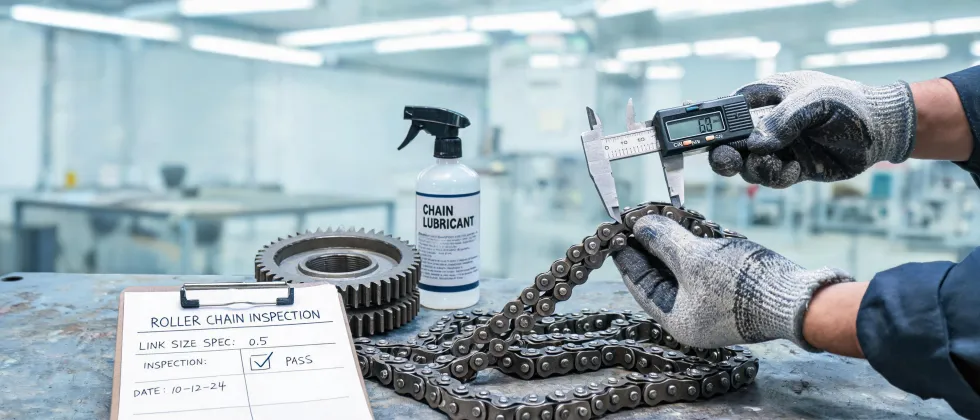
- Measure: Use a caliper to check the pitch over a 12-inch span. New chain should be dead on spec (e.g., 1/2 inch pitch on RS40).
- Flex: It should flex smoothly. If it feels stiff, it might have a bent pin or insufficient lubrication.
I started tracking these checks after a $1,200 order of leaf chain came in with one link that was clearly binding. The distributor replaced it, but the time wasted was on us. Now, I note on the receiving slip if the chain looks good or if I have any concerns. It's a simple step that's saved us a lot of hassle.
Are Bearings and Couplings Worth Ordering from Tsubaki?
I've ordered bearings and couplings from Tsubaki as part of a larger order to save on shipping. The quality is solid—especially their spherical roller bearings, which we use on conveyor drives. But I'll be honest: if I just need a generic ball bearing for a low-speed idler, I might source it from a bearing specialist for a lower price. The Tsubaki couplings (like jaw-type or rigid couplings) are excellent for their precision. We use them on a servo-driven indexing table where alignment is critical. For that application, the extra cost is justified because it's a brand perception thing internally—the machine builder trusts the name.
A rule of thumb I've developed: if the component is a 'brand-critical' part of the machine (like on a drive train that's hard to access), go with Tsubaki. If it's a non-critical support component, price shop.
Where Can I Find Tsubaki Part Numbers and Tech Specs?
The Tsubaki-chain.com website has a solid resource section. They have a chain catalog, a configurator tool for drives, and individual product sheets. I've printed out the chain catalog and keep it in my desk drawer. It has the wear limit specs, horsepower ratings, and sprocket data all in one place.
One thing I found useful is the 'chain selector' tool. You put in the load, speed, and service conditions, and it recommends a chain size and series. It's not perfect, but it's a good starting point before you talk to an engineer. Also, the part number system is logical once you decode it. For example, RS60-1-100L means a single-strand RS60 roller chain, 100 links. I didn't learn this until I ordered a 'RS60' chain with 100 pins instead of 100 links. The missing link (pun intended) cost us a day of down time.
This was accurate as of my last major order in Q4 2024. The market changes fast, so verify current pricing and lead times before budgeting.