-
The cheapest bearing on the quote is never the cheapest bearing in the plant
-
Mistake #1: The $720 'Saving' That Cost Me $2,280
-
Mistake #2: The Linear Ball Bearing Spec I Didn't Check
-
The Risk Nobody Prices In: Product Lines Go Quiet
-
The TCO Comparison That Changed My Mind
-
But Not Every Application Needs Premium
-
What I Actually Do Now
The cheapest bearing on the quote is never the cheapest bearing in the plant
I manage the bearings and power transmission category for an MRO distributor. I've been handling maintenance and OEM orders for 11 years. In that time I've personally made — and documented — six significant sourcing mistakes, totaling roughly $47,000 in wasted budget, rework, and unplanned downtime. Our catalog covers everything from INA needle roller bearings to linear actuators and roller chain, so I've watched this pattern repeat across product lines. Now I keep a pre-purchase checklist taped inside my desk drawer. This article is basically that checklist, plus the invoices that created it.
Here's my position: in bearing procurement, the lowest unit price is almost always the most expensive decision you'll make. Not sometimes. Almost always. And I can show you exactly where the math goes wrong.
Mistake #1: The $720 'Saving' That Cost Me $2,280
In my first year, 2014, I swapped a spec'd INA needle roller bearing for a generic equivalent. The savings looked like $6 per unit on a 120-piece order. $720 saved on paper. That felt like smart procurement — the kind of thing a new category manager wants to put in a quarterly review.
Six months later, 38 of those bearings had failed in a conveyor application. The supplier replaced them under warranty. The warranty did not cover the two shifts of downtime while we waited for replacements, the overtime to catch up, or the emergency freight to get a second batch in before the line backed up further.
$720 saved. $2,100 in overtime and lost output. $900 in expedited freight. Net loss: $2,280. That's a 3x penalty for shopping on price. I keep that spreadsheet. I pull it out every time someone in a meeting says we should "just get a quote from a cheaper source."
Why does this matter? Because the bearing is a $6 component inside a $15,000 machine, and the machine doesn't care what you paid for the bearing. It cares whether the bearing works on Tuesday at 2am.
Mistake #2: The Linear Ball Bearing Spec I Didn't Check
The next one was worse because it was entirely my own research failure. In Q3 2019, I specified a linear ball bearing by outside diameter and basic load rating without checking the dynamic load capacity curve on the INA bearings website. The application had side-loading the one-line spec didn't reflect. I approved 40 units. All 40 were rejected at installation.
$2,800 order. Two-week production delay while we re-sourced the correct profile. $1,900 in expediting and restocking fees. And a very uncomfortable conversation with our operations manager, who had already blocked a Saturday shift to install them.
Why do I bring up the manufacturer's technical portal specifically? Because five minutes with the load curves would have caught it. That's the entire cost of prevention. Five minutes. I've since built that five-minute check into our standard work instructions, and we've caught 23 spec errors before they turned into purchase orders in the last 18 months. The checklist doesn't make me look smart. It makes me look like someone who has been on fire enough times to buy a fire extinguisher.
The Risk Nobody Prices In: Product Lines Go Quiet
People still search for "what happened to Pete Jackson gear drives" years after that product line went quiet. I don't know the full story, and honestly it doesn't matter for this argument. What matters is the behavior behind the search: when a critical component's supply quietly disappears, you don't just lose a part. You lose the maintenance schedule built around it, the spare-parts bin assigned to it, and sometimes the machine itself when the retrofit cost exceeds the asset value.
And here's the uncomfortable part. Cheap bearings are often cheap because the supplier has no long-term plan for that product line. The premium you pay to a manufacturer with a documented catalog, a technical support channel, and a twenty-year product roadmap isn't a markup. It's an insurance policy on your own uptime. I'm not saying every premium brand is worth it. I am saying that when a product line vanishes, the invoice for that lesson never arrives with a discount attached.
The TCO Comparison That Changed My Mind
Here's the one that genuinely surprised me. In Q3 2022, we ran a total cost of ownership comparison between a budget bearing and a mid-tier branded option across three pump stations. I expected the budget option to win on first-year cost. It did win — slightly. But over three years, the branded bearing cost us $4,100 less per station. It cost 38% more per unit, but lasted roughly 2.4x longer in our duty cycle. The overage came almost entirely from labor and downtime, not from replacement parts.
I have mixed feelings about that spreadsheet. On one hand, it means several of my early sourcing decisions were predictably bad — I could have run this analysis in 2015 and saved everyone a lot of grief. On the other, it gave me a number I could take to finance. TCO stopped being an opinion and became a line item. Once you have the number, the conversation changes from "I think cheap bearings are risky" to "here is what our cheap bearings actually cost us per station per year." The second one gets budget approved.
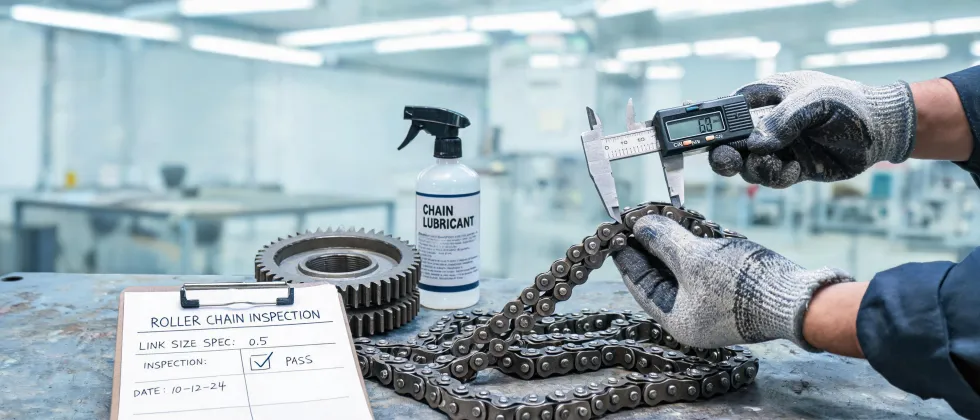
The same logic applies to adjacent components. Specify roller chain sizes wrong on a drive retrofit — or buy a chain with an undersized pin diameter to save $40 — and you'll be back in that machine within a year. The chain isn't the cost. The teardown is. The bearing isn't the cost. The downtime is.
But Not Every Application Needs Premium
Now, the obvious pushback: not every application needs a premium bearing. That's true. A hand-truck wheel, a low-speed display fixture, a garage hobby build — buy the budget option. I do. There's no shame in it, and I'm not gonna pretend otherwise.
But that pushback usually misses the actual question. The question isn't "premium or cheap?" It's "what does failure cost in this specific machine?" If the honest answer is "a $60 bearing and 20 minutes," buy cheap. If the answer is "a $3,000 production hit and a Saturday phone call," the unit price is noise. It's kinda like arguing about the price of a smoke detector while your kitchen is on fire.
Here's the test I use now: if this bearing fails on a Tuesday at 2am, what's the total cost before the line is running again? Add labor, freight, lost output, and the political cost of telling your operations manager the machine is down again. That number — not the quote — is the real price.
What I Actually Do Now
Before I approve any bearing order above a low-risk threshold, I check three things. First, the dynamic load rating and duty-cycle curve on the manufacturer's technical portal. Second, total replacement cost — parts plus estimated labor plus downtime, using our actual production numbers from the last twelve months. Third, whether the product line has a documented long-term availability plan or is likely to go quiet in three to five years.
None of this is sophisticated. It takes about fifteen minutes per order. And it has caught enough expensive mistakes that I now do it for roller chain sizes, linear guides, and pillow block bearings too — not just the high-value stuff.
So I'll say it plainly, one more time: the cheapest bearing on the quote is not the cheapest bearing in the plant. It's the one you'll pay for three times — once at purchase, once at replacement, and once in the downtime you didn't budget for. The spreadsheets in my drawer are the receipts.
Check the spec before you check the price. Know your failure-cost number cold. And when someone quotes you 40% below the branded option, ask what happens when that product line goes quiet.
Because it will. It always does. And the invoice never comes with a discount.