Why this choice matters more than most people think
When I took over ordering at our plant in 2021, I inherited a shelving unit full of bearings in unmarked boxes. Whatever the maintenance tech grabbed was what went in. That worked fine—right up until the day it didn't. A conveyor line went down for 11 hours, and the postmortem traced it back to one thing: someone had put a deep groove ball bearing where a tapered roller should have been.
We buy through an authorized SKF distributor now. That consolidation project I ran in 2022 helped—more on that later. But the bigger shift was learning to think about SKF bearings differently. This isn't a "which one is better" article. It's a comparison of two bearing types against the four things that actually matter when you're the one signing off on the order: load direction, speed and heat, installation precision, and what happens after failure.
I'll give you the framework upfront, then walk through each dimension. By the end, you'll know which one to order and—just as important—when the cheaper option is fine.
Load direction: what each type is built to handle
SKF deep groove ball bearings do one thing well and they do it reliably: radial loads. That's force perpendicular to the shaft—the weight of a conveyor roller, the pull of a belt, the torque on a fan shaft. The deep raceway grooves let the ball ride smoothly, and the design handles moderate axial loads in either direction, too—just not huge ones.
SKF tapered roller bearings play a different game. The cone-shaped rollers and matching raceways are engineered so the line of contact angles toward the shaft axis. That geometry lets them carry radial and axial loads simultaneously—often very heavy ones. When you've got a wheel hub taking the weight of a loaded cart and the side-thrust from turning, that's the bearing you want.
Here's where I see people get it wrong. Bigger load capacity doesn't automatically make tapered rollers "better." If your application is almost entirely radial—an electric motor driving a belt, a standard fan, a pillow block on a light conveyor—and you're not pushing high thrust loads, a tapered roller is overkill. It's more expensive, it requires more installation care, and it doesn't buy you anything the ball bearing wasn't already handling fine.
My rule: If the axial load is small relative to the radial load (or clearly zero), start with the deep groove ball bearing. If you can't articulate the axial load direction and magnitude, get an engineer to calculate it before you order. Guessing is how my 11-hour shutdown happened.
Speed, heat, and installation—where they diverge
Broadly speaking, deep groove ball bearings run cooler and tolerate higher speeds. The point contact between ball and raceway generates less friction, and that matters on a 3,600 RPM motor. If speed is in the application spec sheet, ball bearings usually win.
Tapered roller bearings are designed for lower speeds with heavier loads. They generate more heat, and the lubrication requirements are stricter. Put one in a high-speed application that should've had a ball bearing, and you'll see temperature climb and bearing life drop. According to ISO 281—the standard for calculating bearing rating life—load and life follow a roughly cubic relationship for ball bearings and a 10/3 power for roller bearings. A seemingly moderate increase in load doesn't reduce life by a little. It reduces it exponentially. That's not a detail I fully appreciated until our reliability engineer walked me through the math.
Installation is the other half of the argument. Deep groove ball bearings are forgiving. Press fit or heat fit, double-check alignment, done. Most maintenance techs can handle it with standard training.
Tapered roller bearings demand precision. Axial clearance has to be set correctly—too loose and you get impact loading; too tight and you get rapid heating and premature failure. If your maintenance team has high turnover or limited training, this is a real operational risk. I've seen a perfectly good tapered roller fail in weeks because the clearance was never set right. The bearing wasn't the problem. The installation was.
What actually happens when a bearing goes out
This is the part I wish more purchasing teams thought about before clicking "order." The failure mode and its downstream cost depend on everything above—load, speed, installation—but the timeline is usually similar.
Early warning: noise, vibration, temperature rise. If your maintenance team catches it here, you're looking at a bearing replacement plus a few hours of downtime. Bearable.
Late warning: the bearing seizes. The shaft gets scored. The housing bore wears oversized. Now you're replacing the shaft or the bearing seat, not just the bearing. I've seen a $40 bearing turn into a $2,400 repair because nobody caught the vibration trend early enough.
Catastrophic: the bearing fails under load. Debris spreads. Adjacent components get damaged. On a critical line, that's the 11-hour shutdown scenario.
So when someone asks what happens if a ball bearing goes out, the honest answer depends heavily on how quickly you find it. Early detection is an operational cost—an abnormal vibration reading and a planned replacement. Late detection is an incident cost—emergency labor, expedited shipping, production loss, and component damage that wouldn't have been necessary. The gap between those two numbers is large enough to justify a vibration monitoring program, even a basic one.
One more thing: if the same bearing position keeps failing on the same schedule, that's not a bearing quality problem. That's a sizing problem. Nine times out of ten, the original selection was wrong, not the replacement.
The cost math—and a note on other components
Standard accounting for a bearing order looks like this: unit price, quantity, freight, maybe a handling fee. That's incomplete.
Total cost of ownership for a bearing includes: unit cost, installation labor, downtime cost per hour, and the probability-weighted cost of premature failure. When you run those numbers, the "cheaper" bearing with a shorter service life usually loses. Not always—but usually. On non-critical, low-load applications, a lower-cost option can make sense. I'll say that plainly because it's true. If you're running a light-duty fan in a building that never shuts down for maintenance, the cheapest bearing that fits the spec will do the job.
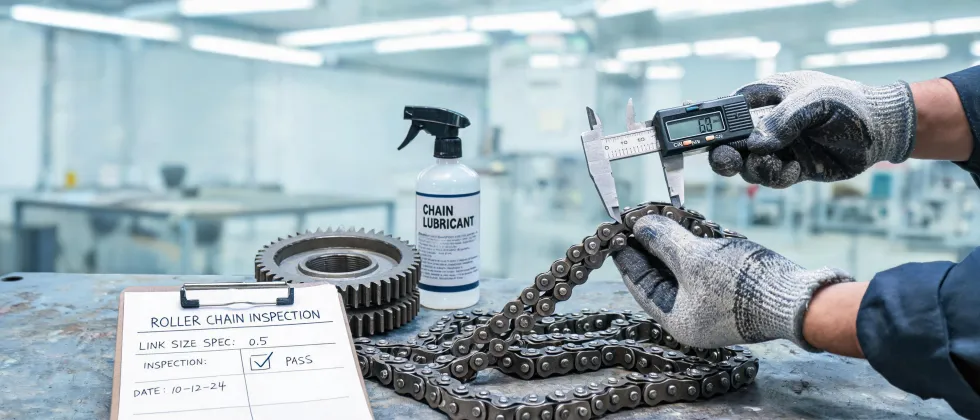
The same logic applies to linear bearings and rails and roller chain links. Our plant consumes a surprising amount of both—conveyor chain and linear guide systems across three assembly lines. The rail's precision grade and preload spec matter as much as the bearing type. The chain's pitch tolerance and maintenance schedule determine how long it runs before stretch becomes a problem. Both carry the same hidden cost: a poorly specified part fails early, and early failure is never as cheap as it looks on the quote.
Choosing between them—and knowing when not to
I don't think there's a "best" bearing. There's the one that fits. Here's how I decide:
- Deep groove ball bearing when the load is primarily radial, speed is moderate to high, axial loads are light, and your maintenance team's installation precision is standard. Motors, fans, light conveyors, small gearboxes.
- Tapered roller bearing when radial and axial loads act together, load is heavy, speed is moderate to low, and you can guarantee correct clearance setting. Heavy conveyors, wheel hubs, large gear reducers, winches.
Here's the limitation I'll state honestly: if you can't verify the axial load expectations and you can't verify your team's installation process, don't guess. Ordering a tapered roller "to be safe" isn't safe—it's a different kind of risk. Get the application reviewed first. The bearing is the cheapest part of that decision.
And if the logistics work better for you on some non-critical positions—standard ball bearings, simple linear rails, common chain—there's no prize for buying premium where the application doesn't require it. The goal is reliability at the right cost, not premium everything. That's the balance I've been running since 2022, and the shutdown count has reflected it.