-
The short answer is that there isn't one
- Scenario A: High torque, large shaft, zero-backlash, and a shutdown you can't afford to repeat
- Scenario B: Small shaft, light torque, misalignment you can't machine away, and a price ceiling
- Scenario C: Long center distance, dirty environment, low speed, and a maintenance team that owns a grease gun
- Scenario D: The equipment is legacy, the OEM is gone, and the drawing is all you have
-
How to figure out which scenario you're actually in
The short answer is that there isn't one
Three times in the last two years, someone has asked me to "just pick the right coupling" — once from our assembly floor, once from a customer's maintenance lead, once from our own engineering manager at 4:40pm on a Friday. All three times, the honest answer was: it depends on which failure mode you can afford.
That's not a dodge. It's the actual decision. I've managed our power transmission and MRO spend (roughly $1.6M a year) for six years across a 180-person industrial equipment builder, and the pattern I keep seeing is that people buy components to a spec sheet instead of buying them to a cost-of-failure model. Those are different purchases.
The cheapest component on the quote is rarely the cheapest component in the plant. The expensive one isn't automatically the safe one either.
What most people don't realize is that the quoted price of a coupling or a chain drive is maybe 40% of what it actually costs you over five years. The rest hides in machining, installation labor, lubrication schedules, downtime windows, and spares inventory. Vendors quote the part. You buy the system.
So here's how I'd break it down. Four scenarios. Find yours, then read only that section — the advice genuinely differs, and I'll tell you how to tell which one you're in at the end.
Scenario A: High torque, large shaft, zero-backlash, and a shutdown you can't afford to repeat
What this looks like
Main drive on a crusher, a mill, a heavy conveyor head shaft. Shaft diameters above 60mm. Torque that will happily shear a key. Duty cycle that runs 16+ hours a day. And a production line where a 6-hour unplanned stop costs more than the component will ever cost.
What I buy
Friction-based shaft connections — locking assemblies and shrink discs. In our catalog that's the Ringfeder Power Transmission GmbH range, and I'd be lying if I said the German engineering reputation didn't factor into the approvals conversation. It factors in because when I put a $4,800 locking assembly next to a $900 keyed hub on a capex request, I need something to point at other than my own judgment.
The real argument, though, is arithmetic. A keyed connection on a heavily reversing load develops fretting corrosion. When that shaft finally has to come apart during a rebuild, you're not removing a hub — you're cutting one off, and now you're re-machining a shaft that costs more than the coupling did. I've watched that happen. It added nine days to a scheduled outage in 2022 and something in the low five figures to the bill.
The cost nobody puts in the spreadsheet
Installation. A locking assembly needs the shaft and bore tolerances to be right — genuinely right, not "close enough." If your machine shop runs loose, you'll pay for that in hydraulic press time or in a part that slips under load. I now require a tolerance check on the drawing before the PO goes out. That's a 20-minute phone call that has saved us at least two reworks (that I know of).
Also: the s.r.o. entity — Ringfeder Power Transmission s.r.o. — is where a lot of our EU-bound paperwork routes through, and lead times quoted in Q1 2025 ran longer than what the German-side quote sheet suggested, because freight and customs don't appear on a datasheet. Verify current lead times directly. Mine may already be stale.
Scenario B: Small shaft, light torque, misalignment you can't machine away, and a price ceiling
What this looks like
Servo or stepper driven, shafts under 25mm, torque measured in single-digit Nm, and some honest angular or parallel misalignment that nobody wants to fix because the bracket is welded. This is the world of the oldham shaft coupling.
What I buy
An Oldham shaft coupling, usually the two-hub-plus-torque-disc type. It handles parallel misalignment better than most flexible designs, it's compact, and — critically for me — it's cheap enough that we stock four sizes as line-side spares instead of ordering per-breakdown.
Where people get this wrong
They buy it for the price and then forget the wear item. The insert is a consumable. In a reversing application with any real cycle count, that disc wears, backlash appears, and your positioning accuracy quietly degrades over months in a way nobody notices until a quality issue shows up downstream.
The upside of the Oldham design was a $60 replacement disc and 15 minutes of labor. The risk was that the wear went unnoticed for eight months. I kept asking myself: is saving $180 on a more robust coupling worth a scrap event we won't catch until the customer does? For a non-critical axis, yes. For the axis that sets our tolerance stack, no.
My rule: Oldham couplings on anything where a few tenths of a degree doesn't matter. Anything else, I'll spend the money.
Scenario C: Long center distance, dirty environment, low speed, and a maintenance team that owns a grease gun
What this looks like
Shafts three feet apart. Ambient grit. Maybe a 3:1 reduction needed anyway. Speed low enough that chain noise doesn't matter, and someone on the floor who actually greases things on schedule.
What I buy
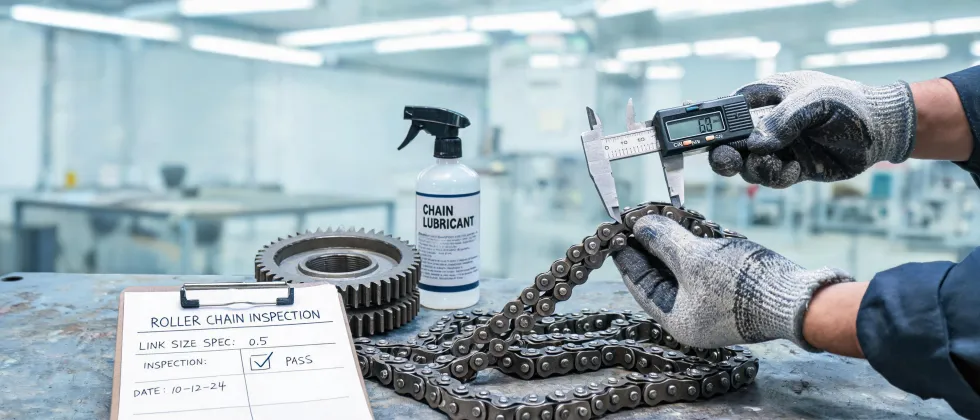
Roller chain. Unfashionable, but the TCO math is hard to beat when the center distance is large — a coupling plus a jackshaft plus two more bearing sets usually costs more than the chain drive it replaces, and the chain is repairable with hand tools.
Here's something vendors won't tell you: the "premium" chain and the commodity chain often come off similar lines, and the difference in life is usually lubrication and tension, not metallurgy. I've had commodity chain outlast branded chain in the same application because one got maintained and the other got forgotten. Buy mid-tier and spend the difference on a tension check schedule.
The part that bites
Stretch. Chain elongates, sprocket wear accelerates, and the whole assembly starts eating itself. In our 2023 spend audit, chain and sprocket replacement on four conveyor drives accounted for about $6,100 — and roughly a third of that traced back to two drives that hadn't had a tension check in over a year. That wasn't a component problem. It was a schedule problem.
Scenario D: The equipment is legacy, the OEM is gone, and the drawing is all you have
The Pete Jackson question
I get versions of this constantly — "what happened to Pete Jackson gear drives?" Being straight with you: I'm not 100% sure of the corporate history, and I'd rather admit that than invent a timeline. My understanding is the brand effectively stopped supplying new product, which puts every unit still in service in the same bucket: orphaned.
The specific product doesn't matter. The pattern does. Gear drives, discontinued coupling lines, a shrink disc size that left the catalog in 2016 — the decision tree is identical.
Your three options, ranked by total cost
Option 1 — Buy new old stock while it exists. Cheapest per unit, and the shortest-lived win. You're buying time, not a solution. Fine if the machine has two years left in its service life. Bad if it's a 20-year asset.
Option 2 — Reverse-engineer and have it made. I've done this twice. Both times the quote looked reasonable and both times the second order cost more, because the shop that made the first batch kept the tooling and we had no leverage. Budget for a two-vendor arrangement from day one or accept that you've just created a single source.
Option 3 — Change the technology. Highest upfront, and the only one that ends the problem. Had 90 minutes to make this call on a legacy drive in Q2 2024 — the machine was down, the CEO was asking, and I had one NOS unit available at a 3x markup. Normally I'd run a proper comparison, but there was no time. Went with the NOS unit to get the line running, then spent the next five weeks converting the drive properly. In hindsight that was the right sequence, though it cost more than doing both at once would have.
How to figure out which scenario you're actually in
Four questions. Answer them in this order, and stop at the first one that's a hard yes.
- What does an hour of downtime cost? If it's more than the component price, you're in Scenario A regardless of shaft size.
- Does misalignment exist and will anyone fix it? If yes and no, that's Scenario B — but only if the load is genuinely light.
- Is the center distance over about 500mm? Scenario C. The coupling-plus-jackshaft math almost never wins there.
- Can you still buy the original part from anyone? If no, you're in Scenario D and the only real question is how long you want to keep pretending otherwise.
One more thing, and this is the part I'd put on a sticky note. Whatever you pick, the quality of what you bolt onto that shaft is the first physical impression your customer gets of your machine. They don't see your engineering calculations. They see a coupling that wobbles, or a chain that slaps, or a hub that's been hammered on with a drift. The $50 you saved on the wrong part gets paid back in how the whole machine reads. Simple as that.