-
Who is Martin Sprocket & Gear, and where are they actually located?
-
How do I find a Martin Sprocket & Gear distributor near me?
-
What do I need to confirm before ordering roller chain sprockets?
-
What's a stepper motor, and when do I actually need one?
-
When are brushless DC motors worth the extra cost over brushed?
-
Why do two sprockets with the same tooth count sometimes not fit the same shaft?
-
What's the fastest way to get a Martin part when my lead time is tight?
I'm the office administrator for a 180-person fabrication shop. I handle MRO purchasing—roughly $340,000 a year across about 22 vendors—and I report to both the operations manager and the controller. Most weeks, I'm not the one specifying parts. The shop foreman tells me what he needs, and I figure out where to buy it, which version to buy, and how to keep finance happy while doing it.
These are the questions I actually get from coworkers, new hires, and the occasional frustrated email from accounting. I've answered most of them more than once. Here's what I cover below:
- Who Martin Sprocket & Gear is, and how to verify their locations
- Finding a distributor that actually stocks what you need
- The sprocket specs I confirm before any PO
- Stepper motors vs. standard motors: when each makes sense
- Brushless DC motor economics, from a purchasing seat
- The spec that gets skipped (and shouldn't)
- Getting a part fast when the line is down
Who is Martin Sprocket & Gear, and where are they actually located?
Martin Sprocket & Gear is a U.S. manufacturer founded in 1951, headquartered in Arlington, Texas. They make power transmission and material handling components—sprockets, gears, sheaves, bushings, bearings, conveyor pulleys, and related parts. If your shop runs conveyors or chain drives, you've probably handled a Martin part without knowing it.
As for locations, I don't have hard data on their exact facility count, and I'm not going to guess. When I checked their website locator in early 2025, it listed manufacturing and distribution points across several states. For a specific address, use the official locator tool or call their main line. My rule: never trust a third-party directory for a shipping address—the official site is the only source that doesn't go stale.
How do I find a Martin Sprocket & Gear distributor near me?
Most Martin product moves through authorized distributors, not direct from the factory. Their website has a distributor locator—enter your ZIP and it returns regional distributors. That's the fastest route, and it's more reliable than calling around.
One thing I learned the hard way: distributor coverage isn't the same as inventory. A listed distributor may carry common sizes but order non-stock items at full lead time. When I need something specific, I call first and ask three questions: Do you have it on the shelf, what's the freight cost to us, and can you invoice against a PO? The vendor who answered yes to the shelf question but couldn't produce a proper invoice once cost me a $2,400 expense rejection. Finance doesn't care how fast the part arrived if the paperwork doesn't match.
What do I need to confirm before ordering roller chain sprockets?
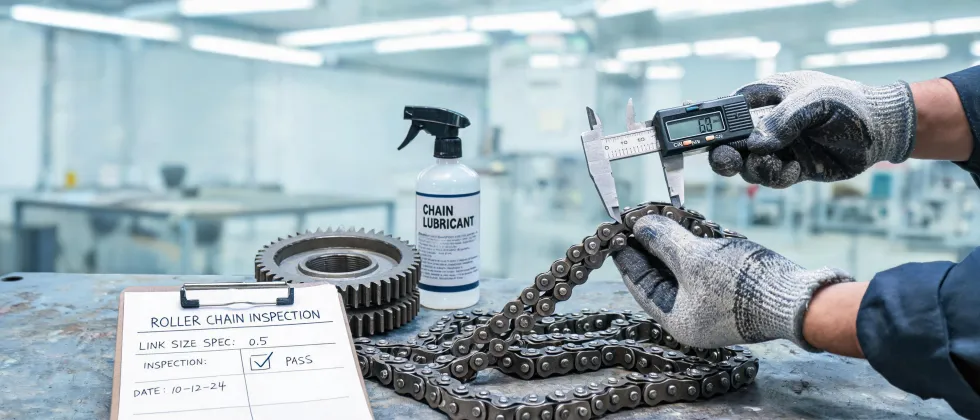
More than the tooth count. Roller chain sprockets are standardized under ANSI B29.1, so the chain size (also called pitch) has to match exactly. A #40 chain needs a #40 sprocket—0.500-inch pitch. A #50 is 0.625 inch. If someone orders a "40-tooth sprocket" without the chain number, that's not a spec, that's a guess.
The other items I confirm before the PO goes out: number of teeth, bore size (finished or stock?), keyway dimensions, hub type (A, B, or C), and material. The bore is where most reorders go wrong. I assumed "1-inch bore" meant the same thing across vendors. It didn't—one supplier shipped a stock bore that needed machining; another shipped finished with a keyway. Same description, different part.
What's a stepper motor, and when do I actually need one?
A stepper motor divides a full rotation into fixed increments—typically 1.8 degrees per step, or 200 steps per revolution. It moves in discrete steps rather than spinning continuously, and it holds position when it stops. That's why you see them in 3D printers, CNC fixtures, and anything that needs repeatable positioning without a feedback loop.
When to pick one over a standard AC motor: low speed, high holding torque, and precise position control matter more than raw power or efficiency. When not to: high-speed continuous duty, variable loads, or anything where losing steps would be dangerous. Steppers run open-loop—if the load overwhelms the torque, the motor doesn't know it missed a step. For safety-critical motion, that's a red flag.
When are brushless DC motors worth the extra cost over brushed?
Brushless DC motors swap mechanical brushes for electronic commutation. Fewer wear parts, longer service life, better efficiency—usually in the mid-80s to low-90s percent range versus the mid-70s for many brushed motors, depending on load. The tradeoff is the drive: BLDC motors need a controller, and that controller is a real line item in the budget.
In our shop, BLDC made sense for a conveyor retrofit where the motor runs eight hours a day and we were replacing brushes every few months. It would not make sense for a once-a-week pump. This worked for us, but our duty cycle is predictable. If your equipment runs intermittent or highly variable loads, the payback math changes.
Why do two sprockets with the same tooth count sometimes not fit the same shaft?
Because the tooth count is the only thing everyone agrees on. Bore diameter, keyway width, keyway depth, hub type, and set screw placement all vary—and "stock bore" means different things depending on whether the part ships as a finished or machinable item. I learned never to assume interchangeability after a reorder that matched every number on the old PO and still didn't mount.
Bottom line: pull the old part, measure the bore and keyway, and put those numbers on the PO. Not the part number alone. The part number is only as good as the revision it was printed from.
What's the fastest way to get a Martin part when my lead time is tight?
Call the distributor, not the website. Online catalogs are accurate for catalog numbers, not for stock status. In 2024 we had a line down and four hours to decide: pay a premium for next-day from a regional distributor, or wait three days for standard freight. Normally I'd get multiple quotes, but there was no time. We paid the premium. In hindsight, that was the right call—downtime cost more per hour than the freight surcharge.
The lesson I keep re-learning: know your distributor's cutoff time and stock depth before you have an emergency. A ten-minute call in a quiet week beats a four-hour scramble when the line is down.