-
Step 1: Confirm what actually failed
-
Step 2: Nail the exact chain number using the Tsubaki chain guide
-
Step 3: Don't guess when replacing a servo linear actuator
-
Step 4: Choose a rigid coupling only when alignment is understood
-
Step 5: Understand 'how fast can a stepper motor turn' before swapping motors
-
Final notes from the field
When a machine goes down, the first question I ask isn't about the part. It's about the clock. How many hours do we have?
In my role coordinating emergency replacements for power transmission components, I've handled 200+ rush orders in the last nine years. That includes same-day turnarounds for packaging plants, food processors, and small assembly shops. The difference between a costly outage and a manageable one usually comes down to how fast you can identify the right component and get it sourced.
This guide is for whoever has to spec and source a replacement under pressure. It's a checklist, not a textbook. Five steps. Do them in order and you'll avoid the mistakes I've made and the ones I've watched other people make.
My rule: never pick the cheapest part in an emergency. People think they're saving money. I've seen a $50 saving create a $4,000 new failure. Total cost matters more than the invoice.
Step 1: Confirm what actually failed
Before you open a Tsubaki chain guide or start checking prices, take 15 minutes to look at the failed part. That sounds super obvious, but I've done the opposite more times than I like to admit. When production is stopped, every minute feels like an emergency. But replacing the wrong component means the line runs for five minutes and then stops again.
A client called on a Sunday afternoon saying their conveyor chain snapped. They were sure. I showed up with a new chain, and it took me about ten minutes to see the chain was in good condition. The coupling on the motor had sheared. The chain only broke because the machine jammed. We ordered the wrong part and lost half a day because nobody spent ten minutes looking at the whole drive train.
Here's what I check first:
- Broken plates or pins on the chain, or just a stiff link?
- Score marks on shafts? That points to a coupling or bearing problem, not the chain.
- Does the motor sound normal? If it's noisy or skipping steps, the motor or its driver may be the real issue.
- Is the actuator position drifting? That can be a feedback or mechanical problem, not necessarily the linear actuator itself.
I'm not a design engineer, so I can't speak to root-cause fatigue calculations. What I can tell you from a replacement perspective is that the visible failure is often a symptom. If you only order the part you can see, you're gambling.
Step 2: Nail the exact chain number using the Tsubaki chain guide
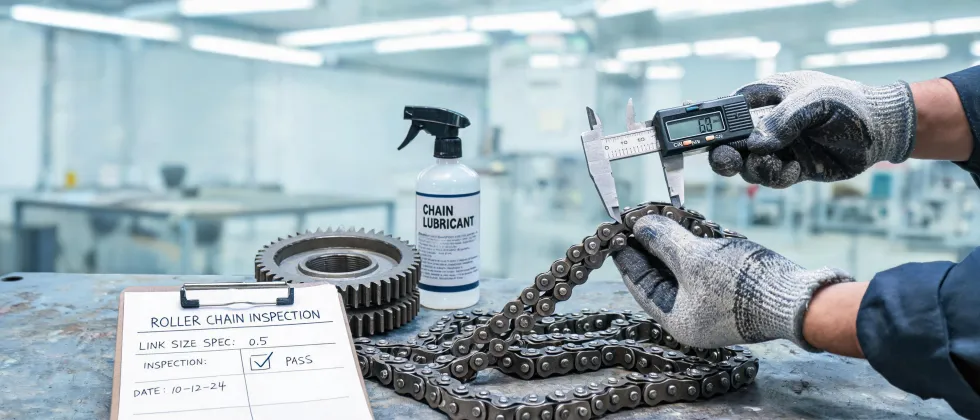
Once the failure is definitely the chain, the fastest path is the Tsubaki roller chain catalog. You need three numbers: chain size, pitch, and link count. Most Tsubaki chains have the size stamped on the side plate. Chain pitch is the distance between pin centers. Link count includes both outer and inner links. Count carefully, then count again. I've watched grown engineers count once and order one link too many. That's a full day of work lost just for a master link.
For standard roller chain, dimensions follow ANSI B29.1 and ISO 606. The Tsubaki roller chain catalog has tables for RS series chains in both inches and millimeters. RS40 is ANSI 40, pitch 0.5 inch. RS60 is ANSI 60, pitch 0.75 inch. The catalog also shows attachment options and dimensions for conveyor chains and leaf chains. If you don't have a paper copy, search for 'tsubaki chain guide' and you'll find their technical reference pages. Use the official source, not a random seller's compatibility chart. That's where the wrong pitch sneaks in.
One thing to watch: ordering a chain one link longer and cutting it can work, but only if you have the correct connecting link. In an emergency, the tiny difference between 98 and 99 links can turn a 20-minute repair into an all-day one. Also check the chain type: a roller chain and a leaf chain may share some dimensions, but the plate thickness and pin construction are different. I've seen people try to replace a leaf chain with a roller chain and then wonder why the new chain wears out in six weeks.
Here's the part where I sound like my old purchasing manager: don't substitute an off-brand chain just because it's 20% cheaper. Cheaper steel, wider clearance, and unverified hardness specs show up as downtime later. A roller chain failure in a conveyor can score the shaft and damage the bearings. The savings disappear fast when you add the labor and lost production. My experience with hundreds of orders is that the lowest quote has been the more expensive choice in at least 60% of the cases where we ignored compatibility.
Step 3: Don't guess when replacing a servo linear actuator
This one is harder than chain because a servo linear actuator mixes mechanical and electrical specs. You need stroke, rod diameter, lead screw pitch, maximum thrust, maximum speed, duty cycle, voltage, and feedback type. If you match only the stroke length, you'll get a unit that fits but doesn't work. Or worse, a unit that runs for two hours and starts screaming.
In March 2024, a packaging plant called at 4 PM saying they needed a replacement actuator for the next morning. Normal lead time was a week. I had two hours to decide because their expedited freight cutoff was 6 PM. Normally I'd ask for a full datasheet, measure the old unit, and compare options. There was no time. I went with the original manufacturer's part number and paid a $550 expedite fee. It worked, but I didn't sleep well until it had run a full shift. Even after choosing the right number, I kept second-guessing whether I'd measured the mounting dimensions correctly.
You can avoid that stress if you take a photo of the old actuator's nameplate before removing anything. Note the mounting holes, rod end, and cable orientation. Write down the part number and serial number. If the nameplate is worn, measure from mounting surface to rod end centerline. Then call the supplier and read them those numbers.
If you see terms like 'cogging' or 'commutation feedback' and you're not an automation engineer, talk to one. This gets into controls territory that I won't fake my way through. Replacing a servo linear actuator is not just a mechanical swap. The new unit has to work with the drive, the encoder, and the machine's PLC. A physically identical part with the wrong feedback type will cause an alarm within seconds.
Step 4: Choose a rigid coupling only when alignment is understood
A rigid coupling does what its name says: it locks two shafts together and allows no misalignment. They are simple, cheap, and can handle high torque. They also fail fast when the shafts are not aligned. The problem is not the coupling. It's the load that the misalignment puts on bearings, seals, and the shafts themselves.
Before you order a rigid coupling, measure the parallel offset, angular misalignment, and end play between the two shafts. If the shafts are more than a few thousandths of an inch off, you need a flexible coupling or at least a coupling with some forgiveness. A rigid coupling won't solve a vibration problem by being stronger. It will transfer every ounce of misalignment into the components around it.
I once ordered a rigid coupling that fit both shaft bores perfectly. It was also the cheapest one in the catalog. After installation, the machine ran for about an hour before the coupling cracked. The real problem was shaft misalignment I hadn't measured. The coupling was doing its job: failing instead of letting the motor bearings take the hit. That's when I started measuring alignment before ordering, and stopped treating rigid couplings as the obvious low-cost answer.
When the specs do line up, pay attention to bore size, keyway width, and set screw location. A rigid coupling with the right bore but the wrong keyway is worthless until the shaft gets machined. I've been that person holding a coupling that fits but doesn't engage. You don't want that phone call.
Step 5: Understand 'how fast can a stepper motor turn' before swapping motors
So, how fast can a stepper motor turn? The short answer is: it depends. A NEMA 17 stepper might spin at 2,000 to 3,000 rpm with no load. Under load, the usable speed is often 300 to 1,000 rpm. The reason is torque falls off as speed increases. The motor's torque curve is the only reliable answer.
You can calculate the theoretical speed from step frequency and steps per revolution:
- Common motor: 200 full steps per revolution.
- Speed in rpm = (steps per second x 60) / 200.
- Example: 10,000 steps per second gives 3,000 rpm.
But the no-load number is not the real-world number. As speed increases, the current in the windings spends less time at its peak, and torque drops. That's why a motor that runs beautifully at 400 rpm can stall at 1,500 rpm with the same load. The answer to 'how fast can a stepper motor turn' is always 'look at the torque curve for your exact motor and driver voltage.'
If you're asking because you're replacing a servo with a stepper motor, my advice is to stop and rework the whole axis design. I'm not saying it can't be done. I'm saying a servo's flat torque curve and closed-loop feedback aren't equivalent to a stepper's dropping torque and open-loop control. In an emergency, get the motor frame, torque rating, and driver that the OEM specified. Then set the speed limits based on the torque curve, not the theoretical maximum.
Final notes from the field
I've learned these the hard way:
- Take photos and tag measurements before disassembly. Your memory fails first.
- Call the supplier before paying expedite fees. Ask if the part is truly in stock and shipped same day. Sometimes 'expedited shipping' just means we pay more for the label while the order sits in a picking queue.
- Order the exact link count, not one link more as an insurance policy. A loose chain can slap a guard and break.
- Keep the old part until the new one is confirmed. I know it sounds obvious. I still find myself putting the old part in the scrap bin too early during a busy spell.
Bottom line: an emergency replacement is still a technical decision. The steps above won't fix every failure, but they'll keep you from guessing wrong. Whether you're dealing with a Tsubaki chain, a servo linear actuator, a rigid coupling, or a stepper motor, the process is the same: verify, measure, then order. And when the clock is loud, that process is your best friend.