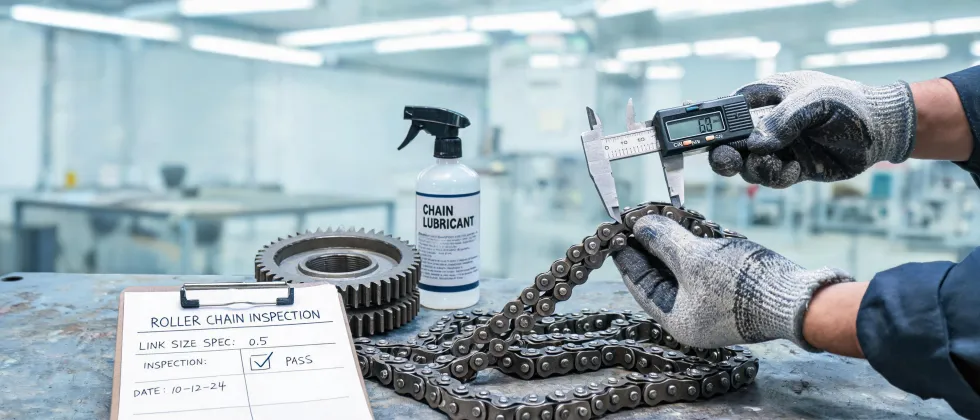
Let me set the scene. It's a Tuesday morning in March 2023, and I'm standing next to a piece of equipment we'd just shut down for a routine bearing inspection. Nothing special. We do these checks quarterly. But this time, the maintenance lead walks over and says something that still makes me wince when I think about it: "The chain's gone. And it took the sprocket with it."
Now, a single chain failure on a medium-speed conveyor line—that's not a catastrophe. It's a headache. Maybe a day of lost production. But what happened next was a cascade of small disasters that ended up costing way more than I ever would have guessed. And it forced me to rethink how I evaluate every power transmission component supplier we work with.
The Setup: A "Smart" Cost Decision
Back in late 2022, I was doing our annual procurement review. We were coming off a tight year, and my boss had made it clear: find savings without sacrificing reliability. So I did what any cost-conscious buyer does—I ran competitive bids on our most frequently ordered items. Roller chain was high on the list.
We'd been buying a well-known brand for years. Solid product, responsive sales rep, decent delivery. But their pricing had crept up. When I put the spec out for quotes—ANSI 60 roller chain, 10-foot lengths, standard carbon steel—I got bids ranging from $18 to $31 per length. The incumbent was at $28. One vendor came in at $21.
"The difference was $7 per length. On a 200-length annual order, that's $1,400 in savings. I thought I'd found a win."
I checked references. Talked to two engineers at other plants who used them. Asked about lead times. Everything looked fine. So I made the switch.
The Break: When Cheap Isn't Cheap
For about four months, everything was fine. The new chain ran smoothly. We saved money. I felt good. Then came that March morning.
The failure analysis took a week. The maintenance team pulled the failed section, inspected the sprocket, looked at wear patterns. Here's what we found: the chain had experienced accelerated pin wear—about 40% faster than what we'd seen with the previous brand. The elongation pushed it past the wear limit before the scheduled inspection. By the time we caught it, the chain had jumped a tooth on the sprocket, which wiped out two sprocket teeth and caused a jam that bent a guide rail.
Total direct costs:
- Replacement chain (rush order): $680
- Replacement sprocket: $220
- Bent rail replacement: $175
- Labor (overtime): $1,120
- Lost production (8 hours): roughly $2,000
That's about $4,200—on a purchase that saved me $1,400 annually. I'd saved 33 cents to spend a dollar.
The Realization: It's Never Just the Unit Price
It took me about 150 orders over 6 years of tracking every invoice in our procurement system to fully understand how hidden costs work. But this failure was the trigger event that actually changed my process.
I went back and looked at the spec we used for the bid. Standard ANSI 60, yes. But I hadn't specified a minimum pin hardness. I hadn't asked about bushing material. I hadn't checked whether the chain was pre-stressed or had controlled elongation during manufacturing. The vendor met the spec, technically. But they met the minimum, not the sweet spot for our application.
That's on me. I was treating chain as a commodity when it's actually a precision component with real engineering variation.
The Vendor Who Told Me "No"
After the failure, I started evaluating vendors differently. One conversation stands out. I called a technical sales engineer at Tsubaki—I'd heard their name come up in a few forums and spec sheets. I explained our application: medium-speed conveyor, 8-hour shifts, standard loads, but the line was critical path. If it goes down, the whole plant slows.
I expected the usual pitch: "Our chain handles that easily." Instead, he asked me five questions I hadn't considered:
- What's your typical chain speed? (Not the max—the actual operating speed.)
- What's the sprocket material and tooth count? (He wanted to check the engagement geometry.)
- How often do you lubricate? (And with what? Most people guess.)
- What's the ambient temperature range? (Seasonal shifts matter.)
- Have you measured elongation on your current chain? (No, I hadn't. Good question.)
Then he said something I won't forget: "Honestly, for your application, our standard RS roller chain is probably fine. But I think you'd see longer service life if you stepped up to the premium series—better pin hardness, tighter tolerance, and we can supply it with a measurement trace if you want to track elongation over time."
"The vendor who told me what I needed—not just what he had—earned my trust for everything else."
He also sent me a link to the Tsubaki chain catalog (available online—pretty thorough) and showed me how to interpret the wear life data for our operating conditions. That catalog alone replaced about three hours of my own research.
The New Procurement Process
Here's what I changed after that experience:
- We always specify a full technical profile, not just ANSI number. Pin hardness, bushing type, pre-stress treatment, and acceptable elongation limits. If a vendor can't provide that data, they're not qualified.
- We calculate TCO for every critical-path component. I built a simple spreadsheet: unit price × annual quantity + expected replacement cost (based on published wear life data) + downtime cost × expected failure frequency. It's not perfect, but it surfaces the trade-offs.
- We ask vendors what they're not good at. This sounds weird, but I've found that vendors who can honestly say "our entry-level chain isn't ideal for high-shock loads—here's who specializes in that" are more credible when they say "our premium chain is the right choice here."
In the two years since, we've standardized on the Tsubaki premium series for our critical lines. The unit price is about 15% higher than what we were paying before the switch. But our chain-related downtime dropped by 80%. We replaced fewer sprockets. Our maintenance team spends less time on emergency repairs. The TCO calculation—which I now run religiously—shows we're actually saving about $3,000 annually on that line alone.
My experience is based on about 15 years of procurement in medium-scale manufacturing, and I've tracked roughly 200 chain orders across three facilities. If you're working with high-speed, high-load, or extreme-environment applications, your requirements will differ. But for standard industrial use, TCO thinking beats unit-price thinking every time.
That March 2023 failure was expensive. But it taught me a lesson no training session could: the real cost of a component isn't on the invoice. It's in the maintenance log, the downtime tracker, and the relationship with a vendor who knows their stuff.
I'm not 100% sure my current process is perfect. But I've run the numbers on enough orders to know it's way better than where I started.