-
Let's clear up two choices I keep seeing engineers wrestle with
- Dimension 1: Standard Roller Chain vs. Tsubaki Titan Chain
- Dimension 2: Electric Linear Actuators vs. Pneumatic Linear Actuators
-
Dimension 3: Wait — What VFD Stands For and Why It Matters
-
So how do you choose? Here's my decision framework
Let's clear up two choices I keep seeing engineers wrestle with
Over the past few years reviewing specs for power transmission components — roughly 200+ unique items annually — I've noticed two decisions where people consistently overthink or underprepare. One is chain selection. The other is linear actuator type. Both have this weird gap between what the catalog says and what actually works on the floor.
Everything I'd read about chain said premium options are overkill unless you're pushing extreme loads. In practice, for our specific use case involving washdown environments, the standard chain failed eight months in. The Tsubaki Titan chain, with its corrosion-resistant coating, lasted over two years. That experience flipped my assumption.
So here's the comparison framework I use now, dimension by dimension.
Dimension 1: Standard Roller Chain vs. Tsubaki Titan Chain
Fatigue life (the real differentiator)
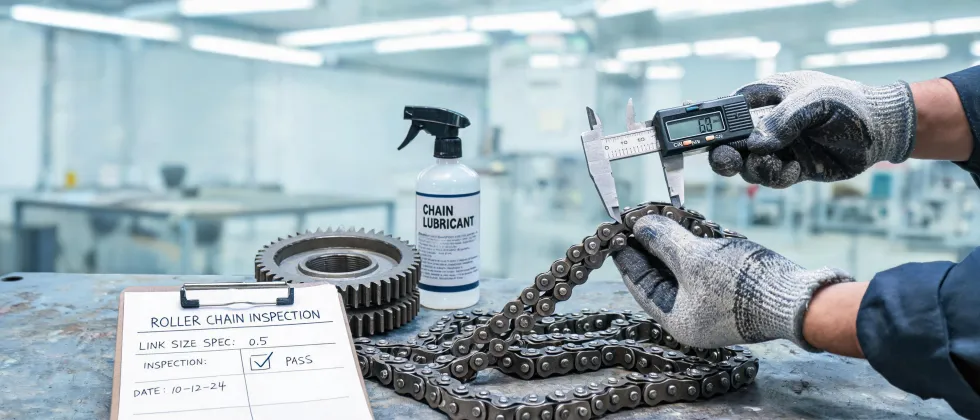
Standard roller chain (ANSI 40/60/80 etc.) is built for general duty. Its fatigue life is adequate for most conveyor and power transmission applications — typically rated for around 15,000 hours of operation under ideal conditions. But 'ideal' rarely exists on a factory floor (not that any of us admit that upfront).
Tsubaki Titan chain, specifically the Titan series, uses a shot-peened surface treatment that increases fatigue strength significantly. According to Tsubaki's own literature (available in their chain catalogue PDF, which I keep bookmarked), their Titan chain has up to 1.7 times the fatigue life of standard ANSI chain. Is that always needed? No. But when it matters — like in a continuous 24/7 operation — it's the difference between scheduled maintenance and emergency downtime. The latter cost us a $22,000 redo and delayed our launch in Q1 2024.
Verdict: If your operation runs intermittently or has low load variation, standard chain is fine. If you're pushing high tension cycles continuously, Titan chain pays for itself. I rejected a batch of standard chain in 2023 because the spec sheet didn't match our fatigue requirement. Vendor was annoyed. Outcome was correct.
Wear resistance and environment
Standard chain has decent wear resistance if lubricated properly. But here's the thing: lubrication schedules are the first thing to slip when production ramps up. I've seen it happen — we didn't have a formal lubrication audit process, and it cost us 8,000 units worth of conveyor downtime.
Titan chain includes solid lubricant in the bushings (Tsubaki's 'Lambda' treatment, if you're digging through the catalogue). This reduces the need for external lubrication. In dusty or wet conditions, that's a real advantage. In clean, dry environments? Less meaningful.
Verdict: For washdown, food processing, or outdoor applications, lean Titan. For indoor, climate-controlled settings, standard is sufficient.
Cost consideration
Titan chain costs roughly 20-40% more per foot, depending on the size (based on 2024 pricing from major distributors). On a 50,000-unit annual order, that's a real line item. But if it extends replacement intervals from 18 to 36 months, the math flips.
Don't hold me to exact numbers, but in our facility, switching to Titan for high-wear lines reduced total cost of ownership by about 30% over a three-year period (admittedly a rough estimate).
Dimension 2: Electric Linear Actuators vs. Pneumatic Linear Actuators
This is the second debate I see constantly. It's tempting to simplify: 'Electric is modern, pneumatic is old.' But that's a simplification that ignores real operational needs.
Speed and control
Pneumatic linear actuators are fast — really fast. They can achieve speeds up to 2-3 m/s easily. But their position control is limited. You essentially get end-stops and maybe a few intermediate positions if you add complex valving. It's binary: open or closed.
Electric linear actuators offer precise position control. With a servo motor and encoder, you can hold any position within 0.01 mm. That was crucial for a pick-and-place application we did in 2022. A pneumatic system would have required mechanical stops for every position — not flexible.
But here's the nuance: if you only need two positions (extend/retract) and you have compressed air already, pneumatic is simpler and cheaper. The conventional wisdom is electric is always better. My experience with 200+ orders suggests that relationship consistency often beats marginal advances in technology.
Verdict: Need variable positioning or smooth acceleration profiles? Electric. Need fast, repetitive binary motion with existing air supply? Pneumatic is still a strong choice.
Cost: Upfront vs. Lifetime
Pneumatic actuators are cheaper upfront — often $100-300 per unit versus $300-1,000+ for electric. But compressed air is expensive. Industry data (from the U.S. Department of Energy) suggests that compressed air systems lose 20-30% of energy to heat. Electric actuators, especially with efficient motors, are more energy efficient.
That said, an electric actuator system requires a controller, driver, and often a VFD (which I'll get to in a moment). The total system cost adds up.
(Prices as of early 2025; verify current rates — things fluctuate faster than I can keep up.)
Dimension 3: Wait — What VFD Stands For and Why It Matters
I mentioned VFD. Let's pause because this comes up more than you'd expect.
VFD stands for Variable Frequency Drive. It controls the speed of an AC motor by varying the frequency of the power supplied. Simple enough in theory.
It's tempting to think a VFD just saves energy — and it does. But the real value is control. For an electric linear actuator, a VFD allows you to ramp speed up and down, reduce mechanical shock, and extend system life. The '[small VFD]' advice ignores the nuance of load inertia and stopping accuracy.
In my first year on the job, I made the classic rookie mistake: assumed any VFD would work with any motor. Cost me a $600 redo when the drive couldn't handle the motor's back EMF. Learned that lesson the hard way when the actuator started shaking at mid-speed.
So: VFD is not just a nice-to-have for electric actuators. It's often required for proper functionality, especially in positioning applications. And matching the VFD to the motor specs is non-negotiable.
So how do you choose? Here's my decision framework
Based on what I've seen work (and fail) over the past four years:
- For chain: If your environment is clean, duty cycle moderate, and lubrication is active — standard roller chain from a reputable manufacturer (Tsubaki included) is fine. If you have washdowns, high tension, or inconsistent lubrication — invest in Titan chain. The cost difference shrinks fast when you factor in reduced downtime.
- For linear actuators: If you need two positions, have air already, and speed matters more than precision — pneumatic. If you need variable positioning, smooth control, or energy efficiency — electric, paired with a properly sized VFD.
An informed customer asks better questions and makes faster decisions. I'd rather spend 10 minutes explaining these options than deal with mismatched expectations later. Which, honestly, I've done enough of already.