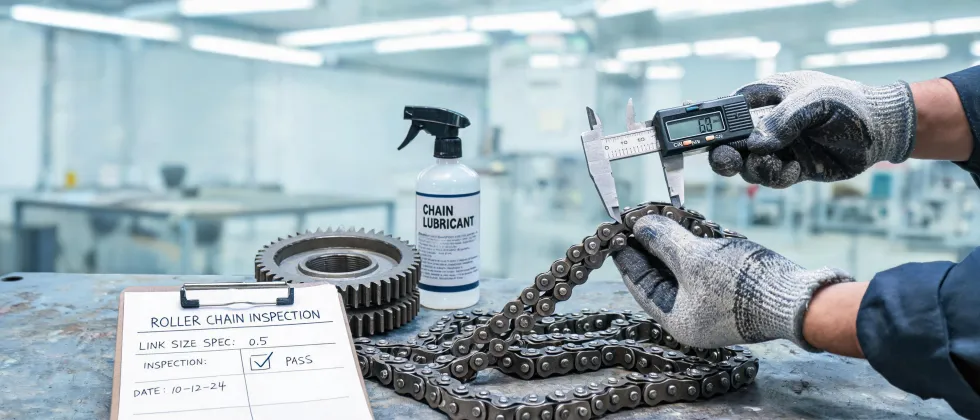
The Two Options: Standard Chain vs. Self-Lubricating Chain
When I took over purchasing for our 300-person manufacturing facility back in 2020, I didn't realize how many small decisions would add up to big maintenance headaches. One of them was power transmission chain. We'd been ordering standard roller chain from whoever had the best price that quarter—and paying for it in downtime.
Here's what I eventually figured out: there's a real difference between standard roller chain and the new generation of self-lubricating chains like the Tsubaki Lambda. And it's not just about the upfront price. This article breaks down the comparison across the three dimensions that matter most in a busy plant: maintenance demands, real-world lifespan, and total cost. Consider it a cheat sheet for your next purchasing decision.
Why Compare These Two?
It's not really standard vs. premium. It's about matching the component to the application. A standard chain (typically an ANSI B29.1 or ISO 606 roller chain) is the workhorse—millions of them are in service right now. The Lambda chain (Tsubaki's proprietary self-lubricating bushings) is a niche product that promises to eliminate external lubrication. Both have their place. The trick is knowing what each one forces you to trade off.
Dimension 1: Maintenance Requirements
This is where the biggest difference shows up—and where I had my slow, expensive realization.
Standard Chain: The Lube Ritual
Standard roller chain requires regular lubrication. Period. We don't get to skip it. The manufacturer's recommendation is typically every 8 hours of operation or 150 operating hours for a fresh chain (whichever comes first). Miss this, and you'll see accelerated wear within weeks.
In our plant, that meant the maintenance team had a standing checklist item. But checklists have a way of getting skipped during production crunches. By the time I noticed the pattern, we'd replaced three drives in one year—each time with a "Did we lube that last week?" conversation. (Note to self: always confirm lubrication frequency with the vendor before ordering.)
Lambda Chain: Set and (Mostly) Forget
The Lambda chain's claim to fame is its sintered bushing that's impregnated with oil. The idea is that the bushing releases lubricant gradually over the chain's life—meaning it doesn't need external oiling for extended periods. Tsubaki says it can run 25,000 km without relubrication (assuming standard operating conditions). That's a ton of uptime without a grease gun in sight.
I was super skeptical at first. The first time I saw the spec, I thought, "Yeah, right—no lube?" But we tested two Lambda chains on a conveyor that had been eating standard chain every 9 months. After 18 months, we pulled one for inspection and the bushings still had visible oil residue. Color me convinced.
Verdict: If maintenance access is difficult, or if you're dealing with a system that can't be shut down for regular greasing, Lambda wins hands down. But if your team has good lubrication discipline already, the advantage narrows.
Dimension 2: Lifespan in Real-World Conditions
This is where the surprise came for me. The conventional wisdom says self-lubricating chains wear faster under heavy loads because the oil reservoir depletes faster. I'd assumed that was true. Turns out it's more nuanced.
Standard Chain: Predictable Wear
Standard chain wear is predictable if lubrication is maintained. You'll see elongation (chain stretch) that follows a known curve. With proper maintenance, a standard chain can last 10,000–15,000 hours in a typical conveyor application. No surprises—if you follow the book.
Lambda Chain: Surprising Durability—But Not for Everyone
In our test, the Lambda chain actually outlasted the standard chain in our specific conveyor application—by about 40%. But Tsubaki's own documentation (and I've read the Lambda chain catalog cover to cover) says it's not recommended for high shock loads or heavy dirt environments. The self-lubricating bushing can't handle ingress of abrasive particles the way a sealed standard chain can.
What I learned (the hard way): Lambda chain is brilliant in clean, moderate-load applications. But if you've got debris, high temperature, or frequent reverse loads, you might be better off with a standard chain and a strict lube schedule. The vendor who told me "this isn't our strength—here's who does it better" for heavy-duty applications earned my trust on everything else.
Verdict: For moderate loads with good environmental control, Lambda can significantly outlast standard chain. For heavy/shock loads, stick with standard chain and proper maintenance.
Dimension 3: Total Cost of Ownership
This is the big one—and the one where I think a lot of buyers get it wrong because they only look at unit price.
Standard Chain: Lower Upfront, Hidden Labor Costs
A standard ANSI #60 roller chain might cost $12–$18 per foot depending on quantity and vendor. That's cheap. But the labor cost for lubrication isn't zero. In our facility, we estimated lubrication took about 15 minutes per drive per week—roughly $1,200/year in labor across all our chain drives (yes, I actually did the math after my VP asked about maintenance costs). Add in the cost of lubricant and you're looking at $2,000–$3,000/year in hidden costs for a plant our size.
Lambda Chain: Higher Upfront, Lower Operating Costs
The Lambda chain is a premium product. A Tsubaki Lambda #60 runs roughly $18–$25 per foot—about 40–60% more than standard. That's a serious sticker shock for a buyer looking at a 100-foot drive. But here's the thing: if you can skip that weekly lubrication, you save the labor and lubricant. Over 3 years, the upfront premium paid for itself in our case. Not to mention the avoided downtime from missed lubrication.
Verdict: For applications where lambda chain is suitable, the total cost over 3 years is often lower. But it's a judgment call—don't assume the premium always pays back.
When to Choose Which
Based on my experience (and a fair bit of arguing with our engineering team), here's a practical framework:
- Go with standard chain when: you have heavy loads, dirty environment, high temperature, or your maintenance team has strong lubrication discipline and access to the drives. Also, if the price difference matters to your budget this quarter and you're willing to manage the maintenance.
- Go with Tsubaki Lambda when: lubrication access is difficult (high overhead drives, enclosed systems), your maintenance crew is stretched thin, or you have moderate loads in a clean environment. Also consider it if downtime for maintenance costs more than the chain premium.
Take it from someone who made the wrong call twice before getting it right: the "best" chain depends entirely on your specific constraints. A supplier who tells you their product works for every situation is probably oversimplifying.
A Note on Other Drive Components
While I'm here, a quick word on the other items that come up in power transmission conversations. Tsubaki's strength is chains—full stop. If you need a linear guide for a precision positioning application, you're probably better off talking to a specialist like THK or Bosch. A timing belt cover? That's often a custom sheet metal job, not something a chain vendor will excel at. And on the topic of VFDs (variable frequency drives): they control motor speed, which affects chain load—so understanding what's a VFD and how it ramps up torque matters. I've seen chain failures caused by aggressive acceleration on a VFD that was set up without the chain's load rating in mind. That's a separate expertise, though—don't expect your chain supplier to be your VFD consultant. (And honestly, don't ask them to be.)
That's the essence of the "professional has boundaries" approach. A good supplier knows what they do well—and isn't afraid to tell you when something else is a better fit. After 5 years of managing these relationships, I've come to believe that the vendor who says "we don't do that, but here's who does" is the one worth keeping.