-
Who This Checklist Is For
-
Step 1: Verify the Documentation Before You Touch the Parts
- Step 2: Visual Inspection—What to Look For (and What Most People Miss)
-
Step 3: Dimensional Check—Don't Just Trust the Label
-
Step 4: Sample Fit Test (If Practical)
-
Step 5: Final Decision—Accept, Conditionally Accept, or Reject
- Common Mistakes (and Lessons from Real Audits)
-
Notes on Cost vs. Value
-
Final Reminder
Who This Checklist Is For
If you're an engineer or procurement professional inspecting a delivery of power transmission components—roller chains, linear actuators, bearings, couplings—this checklist is for you. It's for the moment when the pallet arrives at your loading dock, and you have 15 minutes to decide: accept, reject, or quarantine.
Over the past 4 years, I've reviewed about 200 unique deliveries annually for our facility. I've rejected roughly 12% of first shipments in 2025 alone, mostly for issues that were visible with a basic checklist. This is the checklist I wish I'd started with.
Step 1: Verify the Documentation Before You Touch the Parts
This sounds obvious, but it's the step I've seen skipped most often—especially on rush orders. Grab the packing slip and the certificate of conformance (CoC). Check three things immediately:
- Part number match: Does the CoC list the exact part number from your PO? Not a 'similar' number. I've rejected a shipment where the vendor substituted a different grade of chain because it was 'in stock'. The chain pitch looked identical, but the tensile strength was 20% lower.
- Lot or batch number: If you ever need to trace a failure, the lot number is your only link. Verify it's legible and consistent across documents.
- Country of origin: This matters for tariff classification and sometimes for material quality. I once received a batch of linear actuators where the CoC said 'Japan', but the packaging label said 'China'. That discrepancy cost us a week of delays (the actuators were fine, but the audit process was painful).
Step 2: Visual Inspection—What to Look For (and What Most People Miss)
Conventional wisdom says visual inspection is just checking for rust or damage. My experience with hundreds of deliveries suggests otherwise. Here's what I actually look for:
2.1 Surface Consistency on Chains and Bearings
Run your finger along a few chain pins (wear a glove). If you feel any roughness or pitting, that's a red flag. Everything I'd read said uniform surface finish is a given in quality manufacturing. In practice, I've found that inconsistent surface treatment—especially on side plates—is a reliable predictor of early wear.
2.2 Lubrication State (the one most people ignore)
Many roller chains and conveyor chains arrive pre-lubricated. But 'pre-lubricated' means different things to different suppliers. Some use a thin, temporary oil just for shipping (which evaporates). Others use a proper grease. If the chain feels dry to the touch or has inconsistent oil coverage, flag it. I've seen a single batch of chains fail 2,000 hours early partly because the lubrication was uneven.
2.3 Packaging Integrity for Bearings and Actuators
Linear actuators and precision bearings are sensitive to moisture. The packaging should have a desiccant bag, and the inner wrap should be sealed. If the bag is torn or the desiccant is already fully saturated, I reject the component immediately. Moisture damage is invisible until the unit fails.
Looking back, I should have rejected a batch of bearings in Q1 2024 where the packaging was slightly crushed. At the time, the bearings themselves looked fine. We installed them. Three months later, 15% showed corrosion. The vendor blamed 'storage conditions,' but the real root cause was the compromised packaging. The rework cost us about $2,800.
Step 3: Dimensional Check—Don't Just Trust the Label
Most vendors are accurate on nominal dimensions. But I've learned to spot-check critical tolerances, especially for parts where fit matters:
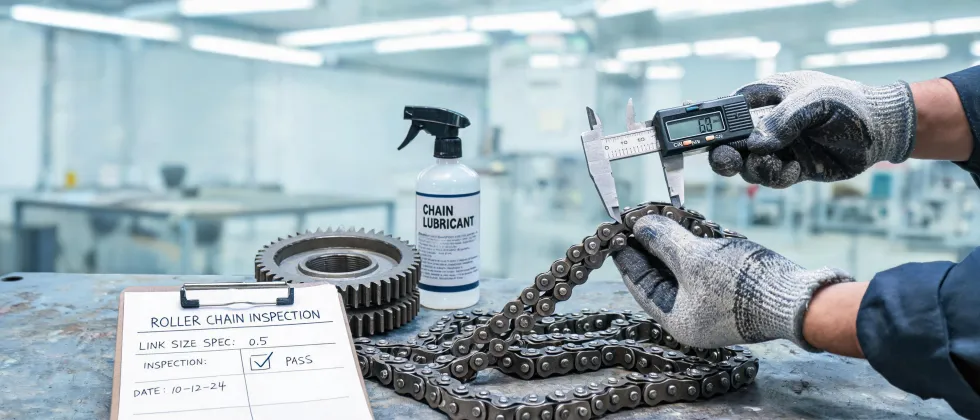
- Chain pitch: Measure 10 links on a roller chain. For a standard #40 chain, the tolerance is ±0.25% over 10 pitches. If it's out of spec, reject. I've caught one batch where the pitch was off by 0.4%—that chain would have accelerated wear on both the sprocket and the chain itself.
- Shaft bore on couplings: If you ordered a coupling with a 1-inch bore, verify it with a gauge. A 0.002-inch difference can cause vibration issues at high RPM.
- Linear actuator stroke: Verify the stroke length matches the spec sheet. I've received multiple actuators that were 5mm shorter than stated—they 'worked' but couldn't reach the end-of-travel sensor.
Step 4: Sample Fit Test (If Practical)
If your schedule allows, install one component into its intended system. A roller chain on a sprocket. A bearing into its housing. An actuator on its mount. This takes 5 minutes and can reveal problems no visual check will catch—like misalignment of mounting holes or unexpected interference.
The conventional wisdom is that a fit test is 'overkill' for standard catalog components. My experience with 200+ annual deliveries suggests otherwise. I've found at least 3 shipments where catalog parts didn't fit our standard mounting hole pattern—the vendor had changed their mold without updating the drawing.
Step 5: Final Decision—Accept, Conditionally Accept, or Reject
Here's how I classify each delivery:
- Accept: All steps above pass. No questions.
- Conditionally accept: Minor cosmetic issues only (scratches on painted surfaces, label placement). Document with photos and note on the packing slip. Keep the documentation for warranty purposes.
- Reject: Dimensional non-conformance, missing documentation, inconsistent surface finish, or any evidence of moisture damage. My rule: if I wouldn't install it on my equipment, I reject it.
Common Mistakes (and Lessons from Real Audits)
Mistake 1: Trusting the Brand Alone
I get why some procurement teams trust a well-known brand like Tsubaki. Their chain catalog and configurator tools are excellent. And honestly, in my experience, brand-name products have a much lower rejection rate. But I've seen name-brand shipments with packaging damage. The brand name doesn't protect against logistics mishandling. Check the delivery, not the label.
Mistake 2: Waiving Inspection Because 'It's a Rush Order'
Rush orders are exactly when mistakes happen. Rush orders are often assembled from available stock, which may not be the exact spec. I've seen rush orders where the vendor substituted a different material grade without telling anyone. Verify it.
Mistake 3: Letting a Vendor's Reputation Excuse a Bad Batch
I had a situation where a trusted vendor delivered a batch of chains with inconsistent pin hardness. Because they had a long relationship with our company, the team wanted to accept the batch. I rejected it. The vendor admitted the error and reworked it at their cost. That decision avoided a probable system failure.
Notes on Cost vs. Value
When I specify components, I don't chase the lowest quote. The $100 saved on a cheaper chain can become a $1,000 problem when the chain wears out in 6 months instead of 18 months—especially if that failure causes unplanned downtime. In my experience managing about 50 projects, the lowest-cost option has cost us more in about 60% of cases. Factor in the time cost of replacement labor, lost production, and warranty claims, and the cheap option is rarely cheap.
Granted, premium components have a higher upfront price. But on a 50,000-unit annual order, an extra $0.20 per unit for verified quality is $10,000 well spent to avoid one $15,000 recall.
Final Reminder
This checklist covers the basics. If you're working with safety-critical applications (like automotive timing chain systems or conveyor chains in food processing), your inspection should be more rigorous. But even a 15-minute check using the steps above will catch about 80% of common incoming quality problems. (Pricing for standard components verified as of March 2025. Always check current vendor pricing and specifications.)