After seven years as the procurement manager at a 200-person manufacturing company, managing a $480,000 annual MRO budget, I have a firm opinion: buying power transmission components on price alone is a false economy. Not "sometimes" a false economy. A false economy. Full stop.
Here's the trap. When maintenance staff replaced a worn roller chain with the cheapest option available, the line always ran again. That's the trap. The machine works. The supervisor is happy. The invoice is low. Then, three months later, the same line stops again. You're paying for the same repair twice—and nobody remembers the $210 you saved the first time.
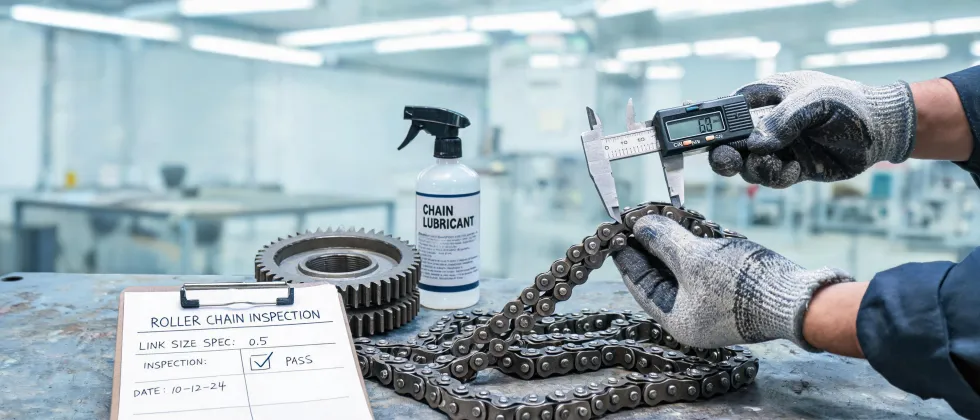
Let me be specific, because data matters more than opinions. In February 2023, we replaced a 10-foot #80 roller chain on a packaging line. Budget chain: $210. Labor: $380. Total: $590. In April, we replaced it again—$640. In June, a third time—$611. By September, I had spent $1,841 on a single line that would have cost $1,200 in parts with a premium chain, installed once.
That's not a rounding error. That's the difference between buying a part and buying reliability. The most frustrating part? Each time it failed, the same repair got approved again because nobody connected the dots.
The TCO Math That Changed How I Buy
I compared quotes from four suppliers in 2023. The budget chain was $210 per loop. US Tsubaki chain—the American arm of the Japanese manufacturer—was $850 for the same size. Both met ANSI B29.1 dimensional standards, so it wasn't a fit issue. It was a durability issue. The $640 difference almost killed the purchase order before it started. Then I built a total cost of ownership spreadsheet, and the answer flipped.
- Budget chain: 4 replacements per year × $210 = $840/year in parts
- US Tsubaki chain: 1 replacement per year × $850 = $850/year in parts
- Labor: 4 × $380 = $1,520 vs 1 × $380 = $380
- Downtime: 8 hours vs 2 hours at $500/hour = $4,000 vs $1,000
Run that math and the budget option costs $6,360 per year per line. The premium option costs $2,230. That's a $4,130 swing—on a single chain, on one line.
This pricing was accurate as of Q4 2024, based on publicly listed prices. The market changes fast, so verify current rates before planning your budget. But the shape of the comparison isn't going to change: the premium chain outlasts the budget chain by three to four times, and the labor plus downtime math holds either way.
A Bad Timing Belt Sound Is a Warning, Not a Mystery
In Q2 2024, a machine on our assembly line started making a rhythmic clicking noise. That's what the work order said: "bad timing belt sound." Not a squeal. Not a roar. A quiet, persistent click. The tech noted it and moved on.
That click was a timing belt with worn teeth. The original Tsubaki belt had been in service since 2019—five years, past its recommended life, but it still worked. A $94 replacement would have solved it. Instead, we deferred it, and then it let go at 9:30 AM on a Tuesday.
The failed belt took out the idler pulley and bent the mounting bracket. Final bill: $1,240 in parts and six hours of emergency maintenance. A $94 belt turned into a $1,240 repair because we ignored the information the noise was giving us.
Here's what I've learned about timing belt sounds since then:
- A chirping squeal usually means belt-to-pulley slip—often from misalignment or incorrect tension.
- Flapping or slapping means the belt is too loose, possibly stretched past its life.
- A rhythmic click means the belt teeth are hitting the pulley—typically worn teeth or a cracked belt body.
None of these sounds is the disease. They're the diagnostic signal. Act fast, and it's a $94 fix. Ignore it, and it's a $1,240 repair plus lost production. I keep that math on a sticky note above my desk.
Ball Screw Actuators, Stepper Motors, and the Cost of Confusion
Procurement and engineering don't always speak the same language, and that costs money too. When our engineering team specified a ball screw actuator for a new positioning table, I asked why they chose it over a lead screw. The answer: "It's what we drew last time."
That's not an answer. That's a default.
A ball screw actuator converts rotary motion into linear motion using recirculating balls in a helical raceway. It's typically 90% efficient or better, and it earns its higher price in high-speed, continuous-duty, or high-load applications. But for a low-load, low-speed, intermittent positioning job, a lead screw does the same work for a fraction of the cost. We were paying for performance we would never use.
And that brings me to a question our own team asked me, word for word: what's a stepper motor?
Short version: it's a brushless DC motor that moves in discrete steps—usually 200 steps per revolution, which is 1.8 degrees per step. Because the controller knows exactly how many steps it commanded, a stepper motor can hold position without a feedback encoder. That's why you see them in 3D printers, CNC machines, and indexing conveyors.
But here's what our engineering team didn't say when they specified that stepper: it only positions accurately if the entire drivetrain holds up. A $500 stepper motor driving a worn chain is like a precision driver on a crooked road. Chain elongation, sprocket wear, belt slip, coupling backlash—all of it shows up as positioning error, and the motor can't tell the difference. The controller thinks the load moved 1.8 degrees. The load actually moved 1.5. Or 2.1. Or nowhere, because the chain snapped.
That's when I started asking suppliers for actual engineering documentation—Tsubaki's catalog, for example, publishes elongation limits and expected service life by application class. That documentation isn't a marketing accessory. It's the difference between specifying a component and guessing at one. And when you're building a precision system, guessing is the most expensive thing you can do.
The Scythe Chain Lesson: Failure Is a Brand Problem
Here's the angle I didn't expect, and it's the one that stuck with me. We work with a small agricultural equipment rebuilder who asked us for a tsubaki chain scythe replacement—the drive chain for the reciprocating sickle bar on their mower headers. In the field, everyone calls it a scythe chain.
They'd been buying aftermarket chains at 40% less than the Tsubaki equivalent. For two seasons, it was fine. Then, in July 2024, a header failed mid-swatch on their biggest customer's field. The chain snapped. The blade jammed. They lost a full day of harvest during perfect weather.
The customer didn't say anything about chain specifications or price per foot. They only said: "Your machine cost me a day of harvest."
The rebuilder lost more revenue in that single day—in lost harvest and strained customer trust—than they'd saved on cheap chains across an entire season.
That's the real definition of quality perception. It's not about appearances or logos. When a component fails at the worst moment, the customer doesn't blame the component. They blame you. The output quality defines the brand, and the chain is part of the output.
"But Budgets Are Tight" — Let Me Answer That
I know the pushback. I'm the person who approves POs, and I've negotiated with more than 40 vendors over the years. I hear "we can't afford premium components across the board" every quarter. To be fair, it's a legitimate point. We didn't switch everything either.
Here's what we did instead: we categorized every application. Critical lines—the ones where downtime directly impacts customer commitments—get components selected by total cost of ownership, not invoice price. Non-critical equipment, where downtime is an inconvenience rather than a failure, stays on budget components. That's a defensible strategy, and it respects the budget while protecting the lines that generate revenue.
I'm also not going to pretend every premium component is worth the money. Don't hold me to this, but I'd estimate one in four premium-brand products we've tested didn't outperform the budget alternative enough to justify the premium. The only way to know is to track your failures, document your costs, and review the data honestly.
And this worked for us, but our situation is specific: we're a mid-size manufacturer with predictable maintenance cycles. If you're a seasonal business with extreme operating conditions—heavy debris, high humidity, shock loading—your failure data will look different. I can only speak to our context.
Even after I made the decision to switch critical lines to premium components, I kept second-guessing myself. What if I was paying for a logo instead of a longer service life? It wasn't until 18 months of consistent failure data showed three fewer emergency service calls that the doubt went away. I don't expect you to take my word for it. I expect you to take my spreadsheet.
What I'd Tell My Younger Procurement Self
Seven years and more than $1.8 million in tracked MRO purchases later, here's where I land: the cost of a power transmission component is not the invoice price. It's the total cost of keeping a line running. Cheap parts defer costs into downtime, emergency repairs, and lost trust—and all three are more expensive than the parts.
The cheapest component is the one that does its job without being noticed. For us, that turned out to be Tsubaki chain on our critical lines. But the brand isn't the point. The data is the point: measure components by cost-per-year, not price-per-part, and the decisions make themselves.
Stop asking, "Which part is cheaper?" Start asking, "Which part is cheaper per year?" And when the answers surprise you—when the premium component wins by $4,000 per line—have the spreadsheet ready.
That's what quality costs. That's what quality saves. And in a business where your output is only as reliable as the components that make it, that's the only math that matters.