I still remember the phone call. Maintenance said we needed an lm8luu linear bearing, and my first question was, "What size is an lm8luu, anyway?" I typed it into our supplier portal and saw "8mm linear bearing." Ordered it. Easy.
Wrong.
The 8 is the bore. The L isn't decoration — it's the long version, almost twice the length of a standard LM8UU. That wrong bearing sat on a shelf for a week while the machine sat idle. The supplier's return policy didn't cover "specified incorrectly." We paid rush freight for the right one.
By the time we were back online, that $12 bearing had cost us about a day of production.
I'm a procurement manager, not an engineer. Over the past six years, I've tracked every order in our system — roughly $180,000 in cumulative spending across chains, bearings, tensioners, couplings, and actuators. I've made expensive mistakes, and I've watched engineers make the same ones. Here's the thing: most of the expensive mistakes had nothing to do with the unit price. They came from not understanding what we were actually buying.
The part number trap
Start with the lm8luu. If you've ever searched "what size is lm8luu linear bearing," you already know the answer needs more context than "8mm." Yes, it's an 8mm-bore linear ball bearing with a 15mm outer diameter. But the L means it's the long version — roughly 45mm long instead of 24mm for the standard LM8UU. I'm not 100% sure of the exact lengths from memory; I pulled the drawing from the manufacturer's catalog in January 2025. The point is, the difference between 24mm and 45mm is the difference between "fits" and "doesn't."
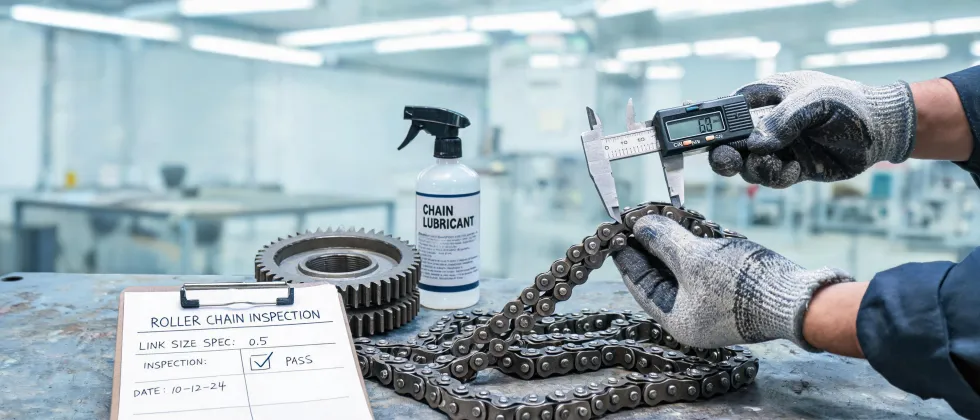
The same logic applies to chain. Roller chain dimensions are standardized — ISO 606 defines the pitch and roller widths so that any 530 chain fits standard 530 sprockets. But the standard stops at dimensions. Material quality, fatigue resistance, and sealing (for O-ring or X-ring chains) are not standardized. For motorcycle chain, ISO 10190 covers dimensions and breakage load, but it doesn't dictate fatigue life. A no-name 530 might be fine on a low-power commuter. It is not the same as a Tsubaki motorcycle chain, even though the pitch is identical.
And that's the trap: when the numbers match, we assume the products match.
The single-part illusion
The second reason components fail isn't the component. It's the system around it.
Take the v belt tensioner we ordered in 2023. An engineer flagged it as "overpriced" and found a cheaper alternative that fit the mount. It fit. The problem? A tensioner's job isn't just to exist. It's to maintain the right belt tension at the right angle with the right preload. The cheaper unit didn't have the same adjustment range, so the belt ran too loose, a driven bearing overheated, and we lost most of a production day to something that was "working fine."
Then there's the Tsubaki chain coupling that wore out after about six months. Look, the coupling wasn't defective — the investigation found shaft misalignment well past spec. The machine's foundation had shifted, and no coupling handles that forever. Replacing it with a cheaper brand wouldn't have changed the root cause either.
The one that really changed my thinking: we spec'd a linear actuator with encoder to replace a pneumatic cylinder. The actuator was correct. The encoder was correct. Nobody checked whether the controller could actually read the encoder fast enough. We spent two days troubleshooting "a bad actuator" that was actually a programming issue wearing a hardware costume.
I could keep going, but here's the pattern: when a part fails or doesn't perform, we blame the part. Very often, the actual problem is a wrong size, a missing spec, or a system mismatch that no part number can fix.
The real cost of being wrong
I don't want to sound dramatic, but I've watched this enough times to get a little preachy.
Our production downtime runs around $2,100 per hour in lost contribution — that's from our 2023 internal analysis, and it's on the low side for most manufacturers. A "small" mistake typically costs us a day.
Do the math on the bearing:
- $12 for the wrong lm8luu bearing
- $85 for rush shipping the correct one
- 8 hours of downtime at roughly $2,100/hour
That's about $17,000 from a $12 purchase. Not typical — but not rare, either.
When I audited our 2023 spending, I found that 14% of our component-related budget overruns came from reordering after spec errors. Not from price increases. Not from vendor mistakes. From us — we literally paid twice, and more, because the first order was specified wrong.
So in Q2 2024 we implemented a simple policy: any order over $500 has to include a manufacturer part number, a drawing reference, or a photo of the existing component. That one rule cut our reorder-related overruns more than any vendor negotiation ever did.
"Your cheapest purchase can become your most expensive one when the spec is wrong."
What I'd recommend (and what I wouldn't)
If you're in a mid-size B2B operation like ours, a few things make our life easier:
- Use manufacturers' engineering resources. Tsubaki chain catalogs, technical guides, and configurators are fairly solid. If you ask their engineers a real question, you get a real answer. That's worth more than any discount.
- Buy the right grade, not the highest grade. A standard Tsubaki chain is plenty for normal conveyor and drive applications. A racing-grade motorcycle chain is overkill for a street bike, and a high-end linear actuator with encoder is overkill if you don't need closed-loop precision. If you don't need the extreme spec, don't pay for it.
- Verify the system, not just the part. A chain coupling is only as good as its alignment. An actuator with encoder is only as good as the controller that reads it. A v belt tensioner is only as good as the belt it's tensioning.
But I'll be honest about limits too. I've only worked with Tsubaki and a few other established brands, so I can't speak to every vendor's catalog. And I wouldn't use a full-line supplier for highly custom adapters, small-batch exotic parts, or anything where a local machine shop is simply faster and cheaper.
Our situation is a mid-size manufacturer with fairly predictable ordering patterns. If you're a race team, a food-processing plant, or a job shop with different requirements, your calculus will be different. But the core lesson applies everywhere I've seen it: the spec matters more than the price.
It took me six years and a $17,000 bearing to understand that. Hopefully it takes you less time — and less money.