"Pick the best chain" is a trap
If you're reading this, you probably want a direct answer: "Buy this exact chain." I get it. When I took over purchasing in 2020, I wanted the same thing. But after five years of managing orders for 400 employees across three locations, I've learned there's no one-size-fits-all recommendation. There's only the right approach for your situation. Honestly, anyone who claims there's a single "best" chain for everything is either guessing or trying to sell you something.
Here's a quick map of what we'll cover:
- Standard roller chain for simple, low-load connections
- Tsubaki chain stretch gauge for when wear monitoring matters
- Ball bearing rollers and conveyor chain for high-friction applications
- When not to use chain at all (timing belts, gear drives, and repair questions)
How we think about it: four different situations
There's no universal answer, so I've broken it down into four common scenarios. Most of your questions will fall into one of these. The key is to figure out which one matches your operation before you order anything.
Scenario 1: You just need a reliable standard roller chain
About 60% of our orders are for standard roller chain. If you're connecting a motor to a gearbox at moderate speed with a steady load, a Tsubaki roller chain in the right size will do the job without any extra monitoring features. You don't need a fancy stretch gauge, and you don't need to overthink it.
What I mean is that the "cheapest" option isn't just about the sticker price—it's about the total cost including your time spent managing issues, the risk of downtime, and the potential need for replacements. In 2024, I compared three brands of ANSI 60 roller chain. One was 20% cheaper, but the pins wore out faster. We replaced it twice in one year. The Tsubaki chain from our regular supplier is still going after 18 months. That's the kind of math finance doesn't see from the price list.
If you're in this scenario, don't let a salesperson upsell you into a premium chain with extra seals or fancy coatings. Just get the correct chain size and couple it with the right sprockets. I usually verify my selection using the Tsubaki catalog tables and then double-check my shaft centers with the tsubaki chain configurator. It takes about ten minutes and eliminates the standard errors like wrong pitch or wrong number of links.
Scenario 2: Downtime is expensive—use a chain stretch gauge
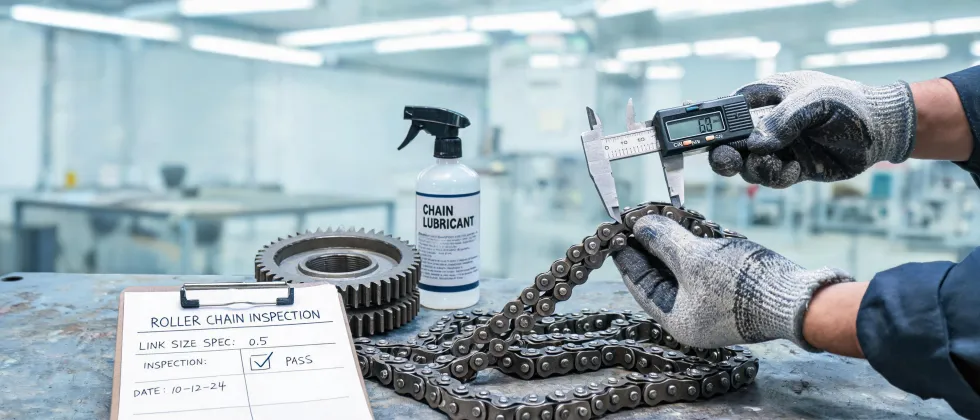
Now, if you're running a critical process line or one that's tough to access, that changes the game. You don't just buy a chain and ignore it. You need to monitor chain elongation before it becomes a catastrophic failure. This is where a tsubaki chain stretch gauge earns its keep.
Why does this matter? Because a broken chain doesn't just stop a machine—it can damage sprockets, shaft keys, even the motor. It's a cascading failure that turns a $40 part into a $4,000 repair. I'll admit I made this mistake. In 2022, I knew I should check stretch on the packaging line every quarter, but I thought "what are the odds?" Well, the odds caught up with me when a chain snapped and shut the line for half a day. Replacement parts, overtime labor, and lost production cost us about $2,400. A $75 gauge would have caught the elongation in ten minutes.
The general guidance from ISO 606 (the standard for short-pitch roller chains) is to replace a chain when elongation reaches 2–3%. You can measure that with the gauge in a few seconds. Actually, in dusty or high-load environments, I'd recommend checking monthly. The gauge is not a luxury; it's basically an insurance policy.
"A broken chain doesn't just stop a machine—it can damage sprockets, shaft keys, even the motor."
Scenario 3: Conveyors and heavy friction loads—ball bearing rollers
Conveyor applications are a different animal. Standard plain-bore rollers can bind when the chain is long or has to push products sideways. If your setup has long conveyor runs or high friction, look for Tsubaki chain with ball bearing rollers. They let the chain roll instead of slide, which reduces wear and energy consumption.
I learned this after a costly mistake. I assumed "same specifications" meant identical results across vendors for a case conveyor. Didn't verify. Turned out the cheaper chain had bushings instead of actual bearing rollers, and it wore out in nine months instead of three years. We paid double in the long run and had to shut down a line for two days to swap it. That's the kind of experience that makes you obsessive about component specs.
When you're ordering this type of chain, use the tsubaki chain configurator to get the exact pitch, width, and attachment spacing. You'll also need to specify the roller type. The configurator forces you to think about things like pin orientation, side clearance, and temperature—details you might miss on a paper purchase order. It's especially useful if you're not an engineer, because it walks you through the logic step by step.
Scenario 4: When you might want alternatives (timing belts, gear drives)
I'm a chain guy, but I'll be honest: there are cases where chain isn't the best answer. If you have a high-speed, low-torque application that needs no lubrication and minimal noise, a timing belt might be better. Just remember that timing belt repair isn't exotic—it usually involves replacing a worn belt and rechecking tension. The mistake I see is treating a belt like a chain: you can't run it until it stretches and "seats in." Belts either grip or they slip. If you're asking about timing belt repair, the real issue is scheduling the replacement before it snaps, not after.
And what about gear drives? People sometimes ask, "what happened to pete jackson gear drives?" That's more of an automotive performance niche. In industrial power transmission, gear drives are still around, but they're overkill for most small machines and significantly more expensive to maintain. The point: don't switch technologies just for novelty. Stay with chain unless a specific constraint—speed, hygiene, noise—forces you out.
I'm not going to tell you that belts or gears are useless. That would be dishonest. But for 80% of the applications we handle, a well-chosen chain will outperform the alternatives on cost per hour of operation. If you do decide to switch, at least keep the old chain and sprockets for a while. I've seen too many "technology upgrades" that had to be rolled back because the belt drive couldn't handle the load spikes.
How to know which scenario you fall into
If you're still unsure, here's a quick self-assessment:
- Is your load steady and moderate? Then Scenario 1 is your default. Standard roller chain is fine.
- Is downtime very expensive or is the line hard to access? Buy a stretch gauge and treat it as a monitoring point (Scenario 2).
- Do you have long conveyor runs or sliding contact? Invest in ball bearing rollers and use the configurator (Scenario 3).
- Are you tempted to replace chain with a belt or gear? Only if you have speed, noise, or lubrication constraints that chain can't meet. In that case, research timing belt repair and gear drive costs before switching (Scenario 4).
The most frustrating part of chain purchasing is that the same issues keep coming back—mis-specified parts, premature wear, and surprise failures. You'd think written specs would prevent misunderstandings, but interpretation varies wildly. That's why I lean on the tsubaki chain configurator and the tsubaki chain stretch gauge. They remove guesswork and give you a defensible basis for buying decisions. When my CFO asks why I ordered a slightly more expensive chain, I can point to the elongation data, not just a hunch.
The bottom line
I can't tell you exactly which Tsubaki chain to buy—your application, budget, and availability dictate that. But I can tell you that you don't need to be an engineer to make good decisions. You just need to sort yourself into one of these scenarios: standard, monitored, conveyor-specific, or alternative-drive. Then use the free tools (especially the configurator) and verify the critical dimensions.
Take it from someone who has eaten the cost of a cheap chain and paid the price of an untimely failure. Get the right baseline, measure when it counts, and don't fall for the "best" recommendation that ignores your situation. Trust me on this one.
Note: Matching the right chain is half the battle. You also need to check that your sprockets match, your shaft alignment is within spec, and your lubrication schedule is real. The Tsubaki catalog covers all that in a couple of pages—it's worth the read.