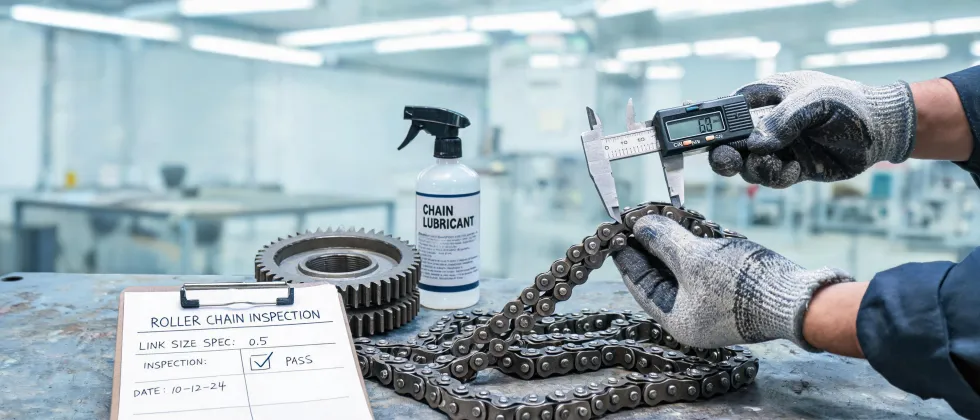
I review chain specifications almost every day. Roller chain, conveyor chain, leaf chain—if it moves product through a facility, I've probably had to verify its specs at some point. In Q1 2024, my team audited about 60 unique chain orders and rejected roughly 12% of first deliveries. Some had dimensional variations out of tolerance. Some had the wrong pin heat treatment. One was stamped with the correct part number but had the wrong pitch. (That one was scary.)
The most common call I get, though, isn't about spec mismatches. It's a maintenance manager saying their conveyor chain keeps wearing out. Maybe it's stretching. Maybe the pins are seizing. Maybe the rollers are breaking. The response is almost always the same: order a new chain—preferably the cheapest one that fits, because this is the third time this year.
And I understand the impulse. Every hour the conveyor is down, production takes a hit. The fastest fix feels like the best fix.
But here's what I've learned after 6 years and roughly 500 of these reviews: the chain is rarely the actual problem.
The chain is the messenger, not the culprit
I didn't always think this way. For the first few years, I treated chain failures like everyone else: inspect the failed part, check for manufacturing defects, and if there were none, assume the application was just hard on chains.
It took a specific incident in March 2022 to change my thinking. A food processing plant kept snapping their conveyor chain—three times in four months. They'd already upgraded to "heavy-duty" replacements and blamed the chain quality. The frustrated purchasing manager was ready to switch brands entirely.
When the failed chains arrived at my bench, I noticed something. All three had broken at the connecting link, and the fracture surfaces showed the classic signs of repeated impact loading. The chain wasn't defective. It had been subjected to shock loads it was never designed to absorb.
The real culprit was the VFD. A variable frequency drive (in plain terms, the controller that ramps the motor up and down) had been programmed with a 1.5-second acceleration ramp. For a loaded conveyor, that's a violent jerk every time the line starts. The start-up torque spiked high enough to approach the chain's ultimate tensile strength, start after start.
The fix wasn't a different chain. It was reprogramming the VFD to a 6-second acceleration ramp. The exact same chain spec—the one they were ready to abandon—ran for 14 months without a single failure.
That incident rewired how I look at every "chain failure" report. Now I ask different questions first:
- Sprocket condition. Worn teeth don't mesh properly with a new chain, and the result is accelerated wear on pins and bushings within weeks.
- Alignment. If shafts aren't parallel or sprockets aren't in the same plane, the chain runs at an angle, rubbing side plates and dying long before its rated life.
- Drive parameters. If there's a VFD, what are the acceleration and deceleration times? What's the load demand at start-up?
- Selection. Is the chain actually rated for the working load? This sounds basic, but you'd be surprised how often size is guessed instead of calculated.
The v belt guide mindset, and the timing belt trap
The same logic applies to belt drives. In fact, I'd argue the misconception is worse there.
Every decent v belt guide—and there are plenty, from manufacturers and industrial suppliers—tells you belt drives need matched sets. Profile, length, number of belts, all matched to the pulley spec. But what most guides don't emphasize enough: if the pulleys are worn or the shafts are misaligned, a new belt will fail just as fast as the old one.
I once audited an assembly line where new V-belts were wearing out every six weeks. The team blamed the belt brand and upgraded to a premium one. Same outcome, higher expense. The actual issue was pulley groove wear—the contact angle had changed, so no belt was going to run true. (Should mention: we caught it after I insisted on a simple groove gauge check. Thirty seconds of measurement.)
Replacing a timing belt is the same story, with higher stakes. It's one of those jobs people dread, partly because of the labor, partly because a mistake means catastrophic mechanical failure. I remember an engine shop that replaced a timing belt three times on the same vehicle before someone measured crankshaft pulley runout. The pulley was wobbling significantly—I want to say around 2 mm, but don't quote me on the exact figure. Each replacement was fine on its own. None addressed the root cause.
Here's the rule I give when anyone asks about replacing a drive component, chain or belt: the replacement is necessary, but it's not sufficient. Verify the system around it first. Otherwise you're paying full cost for a temporary fix.
What premature failure actually costs you
Let me run some numbers, because "don't buy cheap" sounds like vendor talk. I'd rather show you the math.
Say a chain replacement on a packaging line takes two hours. Two techs at $35/hour = $140 in labor. The line produces about $1,200 of output per hour, so downtime costs roughly $2,400. Add the component: a decent conveyor chain runs around $220 per length. Total repair cost: $2,760.
Now, a generic chain might save you $60. Your cost of repair drops to $2,700—looks better. But if that generic chain fails at 80% of the expected life, you repeat the cycle sooner. That's another $2,700. And if it jams, damages product, or injures someone? The cost jumps by an order of magnitude. Not a risk I'd classify as worth $60.
We ran a comparison in 2023 to check this exact assumption. We took a name-brand chain (not ours—a well-known global brand) and a generic "compatible" version of the same nominal spec. Under a tensile verification test per ISO 606, the generic version failed at roughly 84% of the specified minimum breaking load. Visually, they were nearly identical. The generic had a slightly undersized pin diameter and marginally softer steel.
On paper, the generic saved $60 per length. At a partner facility, it caused two jam-ups and a full production halt. The total cost was over $6,000 in lost product and overtime. The $60 savings became a $6,000 expense.
(Pricing as of early 2025 and specific to our facility—verify current rates. But the structure of the math holds: downtime dominates everything else in the calculation.)
What to do instead: measure, verify, then replace
If you're dealing with repeated chain failures, slow down and measure before ordering anything.
Verify the specification, not just the part number. Pitch, width, and tensile rating matter more than the number stamped on the side plate. Check against the manufacturer's catalog or an applicable standard—ISO 606 covers roller chain, and conveyor chain has its own reference guidelines. If you're unsure where to start, most established manufacturers offer selection tools. Tsubaki's chain catalog and configurator, for example, translate application data (load, speed, sprocket teeth, center distance) into a concrete chain spec. Use them.
Inspect the drive train. Sprockets, shaft alignment, bearing condition, mounting bolts. A few minutes of measurement beats a month of trial-and-error replacements.
Review start and stop settings. If the system runs through a VFD, check acceleration and deceleration ramps against the actual load. In most facilities, the VFD is the cheapest component to adjust and the least likely to get checked.
Ask the question behind the question. When a chain fails, the emergency purchase order is the last step, not the first. The first step is understanding why it failed. That requires a system mindset, not just a parts mindset.
When I implemented this verification protocol in 2022, our warranty-related rejections dropped by roughly 34% within a year. Not a perfectly controlled study—we changed process and training at the same time. The direction was clear.
A final thought
I get the pressure. Maintenance teams are overworked, budgets are tight, and production waits for no one. Replacing a chain or belt is the pragmatic move, and sometimes it's the right one.
But when the same component fails repeatedly, the answer isn't a cheaper version of the same part. It's understanding why the part fails.
The chain tells the truth. It wears, stretches, and breaks at the exact point of stress. Read it carefully—and check what's around it—and you'll find the real problem. I've been reading them for years now. They've never lied to me.