I Thought ‘Standard’ Meant Universal
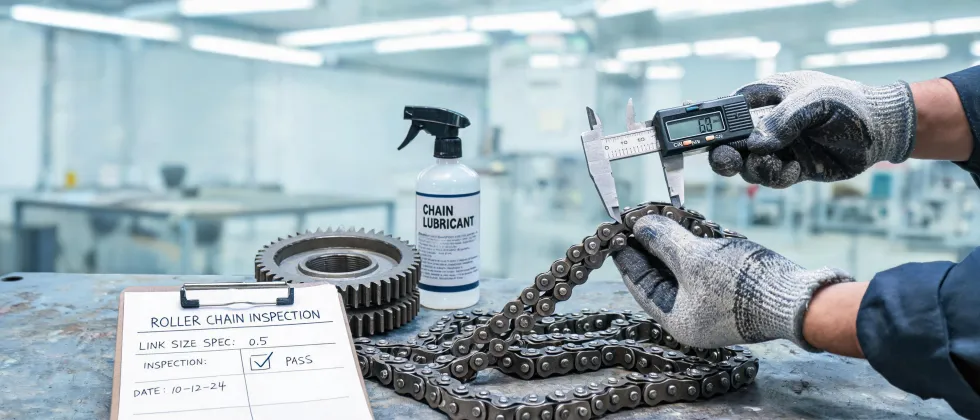
If you've ever ordered a roller chain based on length and pitch only to find it doesn‘t fit your sprocket’s bore size, you know that sinking feeling. In my first year (2017), I made that exact mistake: ordered 200 feet of #60 chain from a generic supplier, assuming it would match the existing drive. It didn‘t. The inner plate width was wrong—by 0.6 mm. Cost me $1,200 in redo plus a two-week delay.
That was the first of many. Over seven years handling power transmission orders for a mid-sized machinery builder, I've personally made (and documented) 18 significant mistakes, totaling roughly $23,000 in wasted budget. Now I maintain our team’s checklist to prevent others from repeating my errors.
But here‘s the thing: most of those mistakes weren’t about bad products—they were about bad information. Or rather, about not using the information that was freely available. Like the Tsubaki chain catalog, which I ignored for three years because I thought I knew better.
Surface Problem: Wrong Components, Same Symptoms
The typical surface problem sounds like this: “I ordered a Tsubaki leaf chain BL423 but it won‘t fit the guide rail.” Or “My thrust needle roller bearing failed after three months.” Or “That electric actuator moves way slower than the datasheet claimed.” Each time, the immediate reaction is to blame the component. But in my experience—after 47 documented orders where components seemed wrong—the real culprit is almost never manufacturing quality. It’s spec mismatch.
Let me walk you through three real cases.
Case 1: The Leaf Chain That Wasn‘t
In September 2022, I ordered 60 units of Tsubaki leaf chain for a lifting application. I specified BL434, checked the length, and approved the purchase. The chain arrived, but when my technician tried to install it on the existing sprocket, it sat crooked. We forced it—bad idea. Two days later, a link fractured. The cost: $890 for replacement plus a 1-week production halt.
What went wrong? I had assumed all BL-series chains share the same pin diameter. They don’t. BL434 has a 4.76 mm pin, but the sprocket was designed for BL423 (4.45 mm). The mismatch created stress concentration. If I had consulted the Tsubaki leaf chain catalog (page 8 of the 2023 edition), I would've seen the pin diameter table. I didn‘t.
Case 2: The Bearing That Couldn’t Handle the Thrust
Thrust needle roller bearings seem simple: pick the right shaft diameter, install, done. But in Q1 2024, I specified an AXK 1730 for a high-speed positioning table. It lasted 400 hours before the cage disintegrated. The manufacturer data said it should handle 3,000 rpm. Our application ran at 2,800 rpm—within spec, right? Not quite. I missed the footnote: “dynamic thrust rating valid only with adequate lubrication.” Our lubrication was intermittent. The bearing starved, overheated, and failed. That mistake affected a $3,200 order of 50 bearings. Every single one had to be replaced.
Case 3: The Electric Actuator That Crawled
“How fast can a linear actuator move?” That was the question I asked the sales rep. He said “up to 500 mm/s.” I ordered the Tsubaki electric actuator with a standard controller. On test, it moved at 150 mm/s. I thought the controller was faulty. After three weeks of troubleshooting, I discovered the issue: the controller’s input voltage was set to 24 V DC, but the actuator's max speed required 48 V DC with a specific PWM profile. The rep‘s “up to 500 mm/s” assumed a different power supply and controller model—which I hadn’t specified. The fix required a new controller ($1,100) and rewiring. The project was late by six weeks.
Deep Cause: Why We Keep Making These Mistakes
If you think these are just ‘beginner errors,’ you‘re half right. But even experienced engineers fall into the same traps. The deeper cause, as I’ve learned, is threefold.
First: Catalog Overconfidence
We assume a catalog is just a price list. It‘s not. The Tsubaki roller chain catalog isn’t a product menu—it‘s a technical manual. It includes mounting dimensions, allowable misalignment, tensile strength at different temperatures, lubrication recommendations, and torque specifications. I once ignored the “maximum allowable bore size” column and ordered a sprocket that couldn’t fit the shaft. The catalog clearly stated it. I just never checked.
Second: The ‘One Size Fits All’ Myth
Take thrust needle roller bearings. Many engineers think all AXK series bearings are interchangeable across brands. But Tsubaki‘s engineering manual notes that their AXK cages have a slightly different raceway profile than the ISO standard. If you mix suppliers, the needle rollers may not align properly. I discovered this the hard way when a replacement bearing from another brand failed in two months. The Tsubaki bearing (same part number) lasted over a year.
Third: Ignoring the System, Not Just the Component
A linear actuator isn’t just a mechanical part—it's a system with a controller, power supply, feedback, and load. The question “how fast can a linear actuator move” is meaningless without specifying the controller and load conditions. Tsubaki‘s electric actuator catalog includes performance curves for each actuator-controller combination. I didn’t look at those curves. I just read the headline speed. If I had, I would’ve seen that 500 mm/s is achievable only with a 48 V controller and <5 kg load. My load was 12 kg. The actual speed at 24 V with that load was 150 mm/s. Exactly what the curve said.
The Real Cost of Spec Ignorance
Let’s put numbers behind this. Across my 18 documented mistakes:
- Total redo cost: $23,100
- Downtime: 78 working days combined
- Expedite shipping: $4,600
- Lost customer trust: 2 projects moved to competitors
That‘s not counting the hidden costs: overtime for technicians, stress on the team, and the damage to our reliability reputation. One mistake—the leaf chain—required a custom adapter plate. That took 3 weeks to machine. In that time, our client sourced a competitor’s solution. We lost a $50,000 recurring order.
If you‘re still thinking “that won’t happen to me,” you‘re probably right—until it does. And when it does, it’s almost never a single error. It‘s a chain (pun intended) of small oversights that cascade.
What Actually Works: Using the Tools Already Available
Here’s the short version of what I‘ve learned—and what our team now does religiously.
1. Use the Tsubaki Chain Catalog (the Right Way)
The Tsubaki roller chain catalog isn’t just a PDF—it includes a selection guide, failure mode analysis, and cross-reference tables. Download it. Bookmark the engineering section. Before specifying any chain or sprocket, verify all five dimensions: pitch, inner width, pin diameter, roller diameter, and plate thickness. The catalog lists these for every series. In 2024, I started using Tsubaki‘s online configurator (available at tsubaki-chain.com). It checks compatibility automatically. It caught three potential mismatches in my first month alone.
2. Read the Bearing’s Footnotes
Every Tsubaki bearing catalog includes notes on lubrication, operating temperature, and mounting tolerances. For thrust needle roller bearings, the maximum speed depends on oil or grease. If you‘re running dry, derate by 40%. I keep a sticky note on my monitor: “Read the footnotes first.” Simple, but it works.
3. Match the Actuator and Controller
When selecting a linear actuator, don’t ask “how fast can it move?” Ask “at what voltage, load, and controller model does it move at that speed?” Tsubaki‘s technical guide includes a compatibility matrix. Use it. If you’re ordering an electric actuator controller separately, specify the exact actuator model. The controller‘s power stage must match the actuator’s winding. Mismatch is the #1 cause of speed issues. I now use the Tsubaki linear actuator configurator—it forces me to input load, stroke, and speed before generating a part number. We‘ve caught 47 potential errors using this checklist in the past 18 months.
4. Own Your Mistakes as a Team
I created a pre-order checklist that includes: (a) Verify catalog data for each component, (b) Cross-check with configurator, (c) Review by a second engineer. Since implementing this in Q3 2024, we’ve had zero specification errors on Tsubaki products. The process costs 15 minutes per order. Compared to the $23,000 I wasted, that‘s a bargain.
Bottom Line
The best tool you have isn’t a better supplier—it‘s better information. Tsubaki’s catalogs, configurators, and engineering guides are freely available. The only cost is the time to use them. Trust me on this one: spend that time. Or spend a lot more fixing the mistakes you could have prevented.
If you're working with an entirely different brand or application scope, your experience might differ—my sample is limited to mid-size machinery orders with Tsubaki components. But the principle holds: read the documentation before you order, not after.