The phone rang at 2:47 PM on a Thursday. The line lead from Assembly 2 didn't bother with hello.
"Line's down. The timing belt shredded."
Six years of managing procurement for a mid-sized manufacturing plant in Starkville, and I still felt that cold hit in my stomach. Another breakdown. Another round of angry calls. Another invoice I'd have to explain to the CFO.
This is the story of how one belt failure changed everything about the way we buy power transmission components. And what it taught me about quality, reputation, and the real price of being cheap.
How We Ended Up with a Cheap-Belt Policy
Let me back up a little.
When I took over the parts budget in 2019, I inherited a policy that sounded perfectly sensible: "Lowest quote wins." It looked great in quarterly reports. The previous procurement guy had been promoted on the strength of it. And honestly, it took me two years to understand how wrong it was.
Cheap timing belts don't fail dramatically, you know? They crack slowly. They stretch. They squeal in the mornings. Then one day, they just let go.
In the two years before that Thursday, we replaced eleven belts across three machines. Eleven. I logged every one of them in our cost tracking system — a detail that turned out to be crucial later.
For context, I'm the person who documents everything around here. $180,000 in annual parts spend, every order logged by vendor, every replacement categorized by cause. I've negotiated with 20+ suppliers, built a TCO spreadsheet that my colleagues joke is "the only Excel file that matters," and I had still let that belt failure happen.
The Two-Hour Decision
When the line stopped, two things became clear immediately. First, we didn't have a spare. Second, the machine used a metric belt that none of our local Starkville distributors stocked.
Had I been doing my job properly, I would have known that. But the specs had been set before my time, and nobody had ever questioned them. Not the maintenance team. Not engineering. Not me.
I had two hours to decide before the next shift started. Normally I'd compare quotes from three vendors and build a proper comparison. There was no time.
Option A was overnight freight from Memphis at a 50% rush surcharge. Option B was a local fabricator who could splice something together — great people, but the "as close as we can get" part scared me. Option C was telling the plant manager we'd be down for 48 hours. That wasn't an option.
In hindsight, I should have pushed back on the timeline. But with the production manager standing over my shoulder and the cost of downtime running around $4,200 per hour, I made the call with incomplete information. I paid for speed.
The rush delivery cost us $340 over standard freight. The line restarted at 6:30 PM. Everyone went home exhausted, and I drove home thinking that was the end of it.
It wasn't. The replacement belt snapped 23 days later. Same machine, same shredding noise, same cold feeling in my stomach.
The Research Weekend
That weekend, I did what I should have done years earlier. I sat down with a notebook, disconnected the news, and researched power transmission basics like a student cramming for an exam.
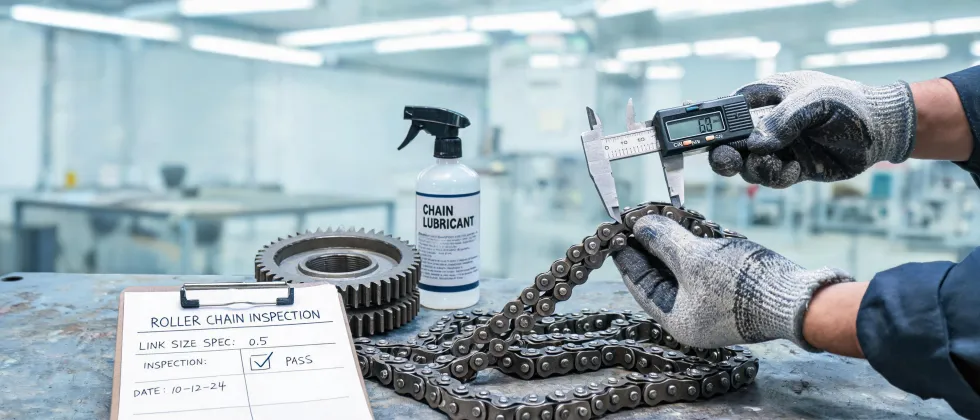
First stop: the Tsubaki chain catalogue PDF. I'd seen it cited in engineering forums for years — the actual download from tsubaki-chain.com. It wasn't a sales brochure masked as a spec sheet. It had load ratings, elongation limits, corrosion resistance tables, lubrication intervals. Real numbers. The kind you can print out, hand to a maintenance tech, and say, "follow this."
I also pulled up a proper V-belt guide — the kind that breaks down cross-section types (A, B, C, 3V, 5V), sheave diameters, tensioning methods, and alignment tolerances. Turns out, we were running three different belt sizes across two machines that did essentially the same job. Of course we were. Nobody had ever standardized anything.
And then I found the Tsubaki Neptune chain series.
We have a washdown station in our food-grade processing area. Standard roller chain could not handle the moisture and caustic wash chemicals. We'd been replacing rusted chain every six months, blaming the environment, and moving on. Neptune chain is purpose-built for that application — corrosion-resistant coatings, stainless steel pins, designed specifically for repeated sanitized washdowns. According to the catalog's own test data, it lasts several times longer than standard chain in those exact conditions.
The worst part? I'd approved every one of those rusted-chain replacement orders. Each one felt necessary at the time. None of them was the right answer.
The Rabbit Hole: What Happened to Pete Jackson Gear Drives?
At some point during that research weekend, I fell into a rabbit hole. I remembered watching my older brother rebuild an old V8 in our dad's garage back in the 90s. He replaced the timing chain with a Pete Jackson gear drive — a kit of machined gears that replaced the chain and sprockets entirely.
So I typed it into the search bar: what happened to Pete Jackson gear drives?
For anyone who hasn't been down this particular road: Pete Jackson gear drives replace a timing chain with a gear-to-gear setup. No chain to stretch. No belt to snap. No tensioner to fail. In effect, a permanent mechanical link. Hot rodders loved them in the 1980s — the whine they produced became almost a status symbol.
The company still exists, and the gear drive is still sold for specific applications, mostly in racing and classic car restoration. But it never became mainstream. Why?
Chain and belt technology improved. Modern timing chains last 200,000+ miles with proper maintenance. Gear drives are noisy and unforgiving if the engine front end isn't perfectly aligned — a much lower tolerance than a chain setup. And with overhead-cam designs taking over, the timing chain became a more elegantly simple solution.
But here's what I took from it: sometimes the smartest maintenance decision isn't a cheaper version of the same failed component. It's a fundamentally different approach. Pete Jackson didn't try to make a cheaper chain. He built a different mechanism. And for certain applications, that's exactly the kind of thinking that saves you money in the long run.
What I Changed
By Monday morning, I had a list. Here's what we actually did:
- Standardized belt sizes across all equipment. Any new machine must use one of two standard cross-sections. No more exotic sizes that no distributor stocks within a hundred miles.
- Switched the washdown line to Tsubaki Neptune chain. Standard roller chain in the dry sections. Neptune in the washdown zones. No debate.
- Published a proactive replacement schedule. Based on the wear limits in the Tsubaki catalogue — not on "it seems to be running okay."
- Rewrote the procurement policy. Three quotes minimum, but TCO — total cost of ownership — is the deciding factor. Sticker price is for beginners.
The initial spend was uncomfortable. In the first quarter, we spent about 12% more on power transmission components than in the same quarter the year before. The CFO raised an eyebrow. I showed her the spreadsheet.
The Results Fewer Breakdowns, Better Reputation
By the end of that year, unplanned downtime was down 40%. We were replacing parts proactively instead of reactively, and the difference shows up all over our numbers.
What surprised me — and I mean genuinely surprised me — was how our customers noticed.
Our on-time delivery rate improved from 87% to 96% in one year. The number of "equipment issues" mentioned in customer feedback dropped by half. One major account, the one that had been threatening to leave after our late-delivery streak in 2023, re-signed. Their purchasing manager told our sales rep that it "felt like we finally had our act together."
If you ask me, that's the part most people miss. The $50 difference on a chain — or the $340 rush fee on a belt — doesn't just appear in your maintenance budget. It shows up in your reputation. When your equipment runs reliably, customers see a company they can trust. When it doesn't, they see a company that's slipping.
The output of a production line is the product, sure. But the output of procurement is the confidence your customer has in your delivery date.
Lessons for Anyone Managing Power Transmission
If you're in a similar position — managing chains, belts, drives, and maintenance budgets — here's what I'd tell my 2019 self:
The catalogue is free. Use it. Whether it's the Tsubaki chain catalogue PDF or a solid V-belt guide, the engineering data is out there. Ignorance isn't a budget line item, but it acts like one.
Think about the application, not the part. Washdown, high heat, abrasive dust, food-grade lubricants — standard components are built for standard environments. Specialty products like Neptune chain exist because the real world isn't generic. Paying for them is not an indulgence. It's arithmetic.
Plan for failure even when things are fine. The rush fee wasn't the cost of the replacement belt. It was the cost of my not planning. I paid it because I had to. I'd rather pay for reliability on my own terms.
If a component keeps failing, question the component itself. Not the vendor. Not the price. The mechanism. Pete Jackson built a gear drive because he was sick of replacing timing chains. That's the right instinct.
One honest caveat: the numbers I've shared hold up as of my records through 2024 and early 2025. The market changes fast, and rush shipping premiums in particular seem to climb every year. Verify current pricing before you build your own spreadsheet.
And if you're reading this because you searched for "Starkville timing belt replacement" after your own 2:47 PM phone call — I feel for you. Call a proper industrial supplier, not a general parts store. Ask what they actually stock before you ask the price.
Then download that catalogue.
Not after the breakdown. Now.