-
Start with the scenario, not the product
-
Scenario 1: You just need chain. Use the configurator and move on.
-
Scenario 2: You need compact linear motion. Consider a zip chain actuator.
-
Scenario 3: You need precision. That's ball screw territory.
-
Scenario 4: You're asking 'What's a VFD?' The question tells me you may not need one.
-
How to decide which scenario you're in
Ask five engineers how to spec a motion component and you'll get five different answers. That's not because they don't know what they're doing. It's because the right answer depends on your application.
It took me three years and roughly 300 purchase orders to understand that the best component is context-dependent. I'm a procurement manager at a 180-person packaging company, and I manage a $460,000 annual MRO budget. I've made the mistake of buying something that looked good on paper and then watching it fail in service. That's why I now start every project by asking what scenario I'm in.
Here's the thing: motion components are basically a series of trade-offs. The Tsubaki chain configurator, a Tsubaki zip chain actuator, a miniature linear actuator, a ball screw actuator, and a VFD all serve different jobs.
Start with the scenario, not the product
Before you look at a parts list, write down what the machine is supposed to do. I use four buckets:
- You are replacing an existing chain and the mechanical design is already fixed.
- You need to add linear motion in a small envelope.
- You need exact positioning and repeatability.
- You are thinking about changing motor speed and someone mentioned a VFD.
Most projects fall into one of these. A few fall into two. If yours falls into two, start with the constraint that is harder to fix later.
Scenario 1: You just need chain. Use the configurator and move on.
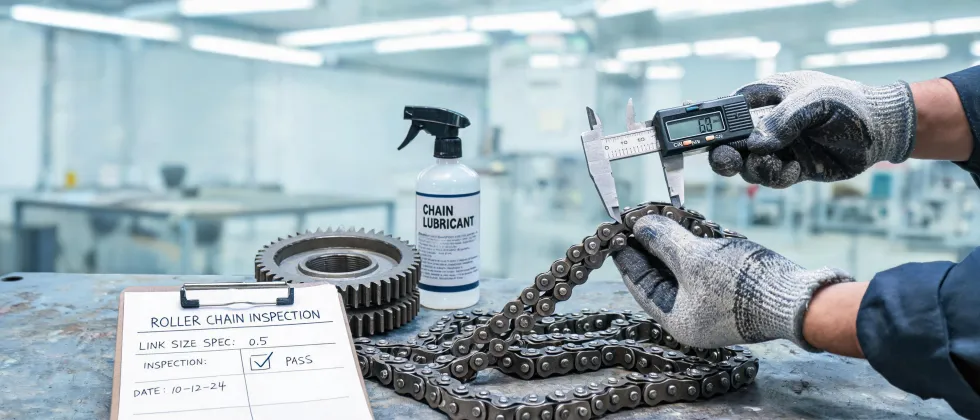
If the machine has been working and you're replacing worn chain, there is no need to redesign anything. Measure the chain number, or read it off the old chain, and use the Tsubaki chain configurator to narrow down the replacement.
For roller chain, the pitch, width, and roller dimensions follow standards like ISO 606:2015 and ANSI/ASME B29.1. The configurator handles the matching so you don't have to. My advice: don't spend engineering hours on a custom chain when a standard one will do. As of January 2025, a custom chain quote can easily run three to four times the price of a standard equivalent.
In 2023, I audited our chain inventory and found 240 line items. Only 16 of them were actually unique sizes. We now use the configurator before we buy anything, and our inventory count is down to 34 SKUs. That's the kind of win that doesn't show up on a spec sheet.
Scenario 2: You need compact linear motion. Consider a zip chain actuator.
If you need to push, lift, or position something in a tight envelope, a Tsubaki zip chain actuator might be the non-obvious answer. It works by zipping a chain into a rigid column and unzipping it as it retracts. That gives you a long stroke without extending a screw or rod outside the machine footprint.
I still kick myself for initially specifying a ball screw actuator on a lifting station. It was the obvious choice from my past experience. Then our engineer showed me that the ball screw would stick out 30 inches behind the machine. The zip chain actuator fit inside the frame. It was not the option I expected, but it was the right one.
Don't compare zip chain actuators to ball screws by first cost alone. A ball screw can be more precise, but a zip chain actuator can win on space and installation time. It also avoids some of the alignment headaches that come with long screws. In my experience, the TCO comparison came out nearly even; the space savings were the deciding factor.
If your motion is up-and-down or in-and-out and the envelope is tight, get a quote for a zip chain actuator before you default to a cylinder or a ball screw.
Scenario 3: You need precision. That's ball screw territory.
Precision is a spectrum. If you need to stop at the same position, day after day, and hold that position under load, a ball screw actuator is the workhorse. It has the stiffness and repeatability that a simple miniature linear actuator may not.
But don't overbuy. A miniature linear actuator can be the right call when the load is light and the stroke is short. We use a miniature linear actuator on a divert gate in our packaging line. It cost about 40% less than the ball screw version and installation took half a day instead of a day and a half. Good enough for that application.
On the other hand, we specified a ball screw actuator for a camera positioning table. The miniature option was not consistent enough. The ball screw held tolerance on every cycle, and the extra precision paid for itself immediately by eliminating scrap.
Bottom line: define the tolerance you actually need. Microns are expensive. Millimeters might be fine.
Scenario 4: You're asking 'What's a VFD?' The question tells me you may not need one.
A VFD, or variable frequency drive, controls the speed of an AC motor by changing the frequency and voltage of the power supplied to it. It is not a motion component in the same way a chain or actuator is. It's an add-on to the motor.
Honestly, if your motor runs at a constant speed and that speed works, a VFD is optional. I've never fully understood why some sales reps push a VFD on every proposal. My best guess is it pads the quote. But the real cost isn't just the drive; it's the panel space, wiring, commissioning, and potential harmonics issues.
Ballpark pricing as of January 2025: $400 to $2,000 per unit, depending on horsepower and enclosure. Verify current pricing with your distributor before you budget. If you need adjustable speed, soft starts, or energy savings on fan and pump loads, a VFD is worth the money. If you don't, skip it.
One of my biggest regrets was buying a VFD for a conveyor that had been running fine at one speed for years. It sat in storage for nine months before we transferred it to another project. Don't buy a solution before you've named the problem.
How to decide which scenario you're in
If you're still on the fence, ask yourself these questions:
- Is the machine already built and the chain is just worn out? Start with the Tsubaki chain configurator.
- Do you need linear movement where space is the constraint? Get a zip chain actuator quote.
- Does the motion need repeatable positioning? Use a ball screw actuator.
- Is the load light and stroke short? A miniature linear actuator may be the low-cost winner.
- Is the motor already there and you just want speed control? Then, and only then, look at a VFD.
The industry has changed a lot since 2020. Digital configurators and electric actuators have made it easier to find the right component and keep costs down. But the fundamentals haven't changed: understand your load, duty cycle, environment, and total cost.
Period. That's it. Simple.
If you're a procurement person like me, your job is to make trade-offs with your eyes open. Use the tools, get the quotes, and buy for the whole life of the machine, not just the invoice. That's how you keep the plants running and the CFO happy.