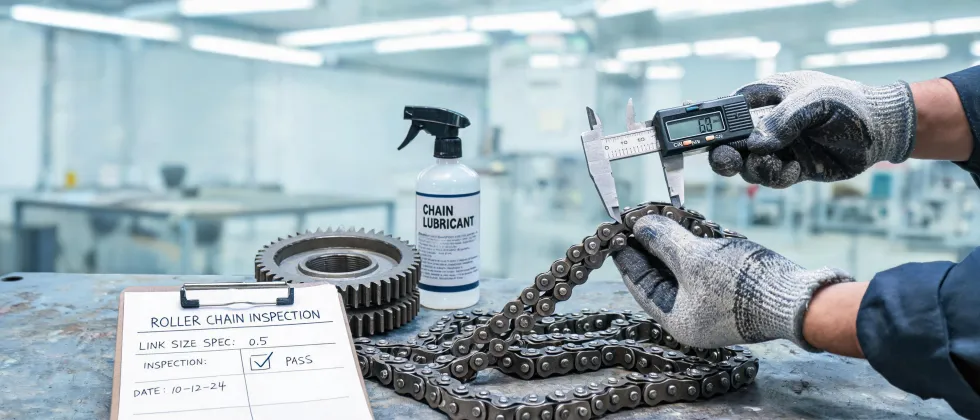
I still remember the morning the production line went silent. A roller chain snapped on the main conveyor—nothing dramatic, just a broken link. But that one failure shut us down for 4 hours, cost $12,000 in lost output, and triggered a $1,500 emergency replacement order. The chain that failed? It was the cheapest option we could find.
Over the past 6 years managing procurement for a 200-person manufacturing company, I've audited every invoice and tracked every failure. What I learned is that the price tag on a part is almost never the real cost. And the decisions that save you $50 on paper often bleed money through hidden leaks—wrong specs, short service life, unexpected downtime.
The Problem You Think You Have
Most engineers and buyers come to me with the same complaint: 'These chains can't handle our load. They keep stretching or breaking.' Their instinct is to blame the manufacturer or look for a more expensive brand. But after digging into 200+ orders over 6 years, I found the real issue runs deeper.
The assumption is that a chain is a chain—buy the right size, it'll work. The reality is that selection mistakes cost more than product failures. We once ordered what looked like the correct roller chain pitch and width. The link plates were identical. But the pin hardness, clearances, and material composition were slightly off for our application. That 'close enough' choice gave us 18 months of life instead of the expected 5 years.
This is where the cheap option traps you. You think you're saving 20% upfront. But if you have to replace it twice as often, plus cover labor and downtime, your total cost is actually double.
The Deeper Causes: What Nobody Talks About
1. Skipping the Configurator Step
I fell into this trap myself early on. We needed a special attachment for a leaf chain application. I flipped through a printed catalog, guessed at the attachment code, and placed the order. It fit—barely. But within 3 months the attachments started cracking. We ended up buying a new chain with the correct spec from Tsubaki's chain configurator—and that chain is still running 4 years later. The configurator (available on tsubaki-chain.com) forces you to input load, speed, environment, and expected life. It eliminates the guesswork that leads to premature failure.
A lot of procurement folks avoid online configurators because they think they know the specs. Plus, they're in a hurry. But skipping it is like ordering a custom suit by guessing your size—you'll get something wearable, but it won't fit right.
2. Ignoring Timing Belt Replacement Intervals
Here's a classic: engineers know that timing belts need periodic replacement, but they treat it like an oil change—do it when the manual says. What they miss is that the interval itself is a cost variable. A cheap belt with a 2,000-hour life costs less upfront than a quality belt rated for 6,000 hours. But the cheaper belt means 3 times more changeouts, each with labor cost, production losses, and the risk of a failure between changes. I've calculated that for one of our machines, switching to a premium belt cost $75 more per belt, but saved $420 per year in labor and downtime. The total cost difference: $345 saved annually per machine (circa 2022 pricing).
3. Not Understanding What You're Buying (When 'What's a Ball Bearing?' Actually Matters)
It sounds basic, but I've seen buyers order a deep groove ball bearing for a linear application that needed a cross roller bearing. The result was sloppy motion, vibration, and accelerated wear. If you're asking 'what's a ball bearing?' or 'what's a cross roller bearing?' that's fine—but don't assume they are interchangeable because they both have rolling elements. The cost of a mistake here isn't just the bearing price. It's the damage to the entire assembly.
I've learned to always verify the bearing type against the manufacturer's recommendation. For linear motion with high rigidity, a cross roller bearing is often the right choice. A standard radial ball bearing may cost half as much, but it will fail 3-4 times faster under high moment loads.
The Real Cost: A $50 Saving That Cost $5,000
Let me give you a specific example from our records. In Q3 2023, I compared two quotes for a conveyor upgrade. Vendor A offered a complete set of roller chains, sprockets, and bearings for $8,500. Vendor B quoted $7,950—a $550 savings upfront. I almost went with B until I calculated the TCO.
- Vendor B had a 2-week lead time (which meant we had to pay for 2 weeks of temporary manual handling: $1,200).
- The chain was standard carbon steel—no coating for our humid environment. Estimated rust-related replacement every 18 months vs. 48 months for vendor A's coated chain.
- They charged $150 for setup fees that vendor A included.
- Their warranty covered only 12 months; vendor A covered 36.
When I ran the numbers over a 5-year life, vendor B's 'cheaper' solution cost $13,400 more. That $550 initial saving turned into a $5,000-plus loss after including downtime risk and replacement frequency.
People think expensive vendors deliver better quality. Actually, vendors who deliver quality can charge more. The causation runs the other way. But the real lesson is: never compare line-item prices without adding up every cost over the expected life.
(I should note: my data comes from about 200 orders in a mid-size manufacturing environment. If you're in ultra-light assembly or heavy mining, your experience might differ. But the framework holds.)
The Solution: Build a TCO Checklist
Here's the short version—because after reading all that analysis, you don't need me to spell out every step. You need a checkable list:
- Use the manufacturer's configurator. For Tsubaki chains, go to tsubaki-chain.com and use their chain configurator. It will generate a spec that matches your exact load, speed, and environment.
- Ask for replacement intervals on timing belts. Don't just compare unit prices. Divide the price by expected hours of life, then add labor per changeout.
- Know your bearing types. If you're not sure what a ball bearing vs. a cross roller bearing is, look it up before buying. A wrong bearing can destroy the housing.
- Write down every hidden charge: shipping, setup, minimum order quantities, warranty exclusions, expedited delivery if the part fails early.
I've been burned enough times that I now insist on a TCO spreadsheet before any purchase over $1,000. It takes 15 minutes to fill out, and it has saved us about $40,000 over the last 3 years.
Bottom line: the cheapest part in the catalog is rarely the cheapest part you'll ever buy. Take the time to understand what you're actually paying for—and use the tools the manufacturer built (like the Tsubaki chain configurator) to get the spec right the first time. Your production line—and your budget—will thank you.