I've been managing procurement for a mid-sized automation company for about six years now. Over that time, I've audited roughly $180,000 in cumulative spending across drive components—chains, couplings, actuators, bearings. And if there's one thing I've learned, it's that there's no single 'best' power transmission component. The right choice depends entirely on your specific application, budget constraints, and tolerance for downtime.
This guide breaks down the decision into three common scenarios. Find yours, and you'll have a clear path forward.
Three Common Scenarios (And Which One You're In)
Before we dive into specifics, let's map out the landscape. Most of the decisions I've dealt with fall into one of three categories:
- Scenario A: Standard, High-Volume Production — You need reliable, repeatable performance. Downtime is costly. Think conveyor lines, packaging equipment, or assembly lines.
- Scenario B: High-Fatigue or Special Environment — The application involves heavy loads, high speeds, washdown, or extreme temperatures. Standard parts won't cut it.
- Scenario C: Cost-Sensitive or Prototype — Budget is the primary constraint. You're building a proof-of-concept, a low-volume run, or a product where margins are razor-thin.
Scenario A: Standard, High-Volume Production
If you're in this scenario, your priority is predictability. You need components that perform to spec, every time, for a predictable lifespan. This is where a broad, established product portfolio like the one from tsubaki-chain really shines.
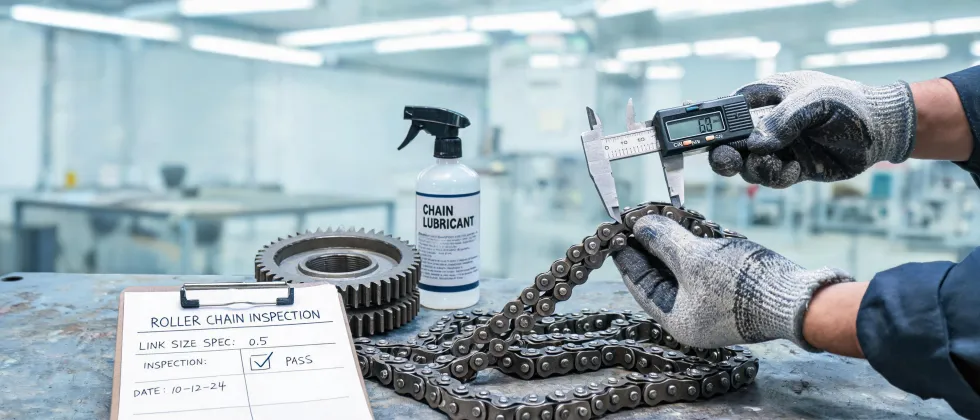
For a standard roller conveyor, I've found that a tsubaki roller chain catalog is often the best starting point. The standardization means you can get replacements fast (this was back in 2023 when we had a chain snap on a Friday afternoon—we had a replacement by Monday morning). The total cost of ownership isn't always the cheapest, but the predictability of lifespan and the availability of spares make it a no-brainer for high-volume lines.
The key insight: When I compared costs across three vendors for a standard double-pitch chain, the lowest initial quote was 18% cheaper. But after factoring in the cost of two emergency shutdowns over two years, the cheaper option cost us 12% more in total. The conventional wisdom is to always go with the lowest upfront cost. My experience with 200+ orders suggests that relationship consistency and component reliability often beat marginal cost savings.
What About Gear Couplings?
For standard motor-to-gearbox connections, a good quality gear coupling is usually the right answer. They handle misalignment well and are incredibly durable. I've had gear couplings last 8+ years in a clean environment with proper lubrication.
One thing I learned the hard way: I knew I should spec a coupling with a service factor of at least 1.5 for a high-torque application, but thought 'what are the odds?' Well, the odds caught up with me when we sheared a coupling at 3 AM. That was a $600 mistake in lost production time for a $90 part. (Surprise, surprise.) Always check the service factor.
Scenario B: High-Fatigue or Special Environment
This is where standard solutions break down. I'm talking about things like high-speed indexing, food-grade washdown, or extreme heat/cold. In these cases, off-the-shelf components from a general catalog will fail prematurely.
Here's the counterintuitive part: The best solution isn't always a 'heavy-duty' version of the standard part. For a high-speed indexing application, I spent weeks going back and forth between a beefed-up roller chain and a specialty timing belt. The numbers said the chain would work—the load capacity was there. But my gut said the added weight and inertia would cause problems. Went with my gut and chose the belt. Turns out the belt's lower mass and zero-backlash characteristic were exactly what we needed.
For these environments, look for products specifically engineered for the challenge. For linear motion, a linear actuator kit designed for washdown will have sealed bearings and stainless steel components. A standard actuator won't last a month in a wet environment. The vendor who said 'this isn't our strength—here's who does it better' earned my trust for everything else.
What's a Stepper Motor? (And When Does It Matter?)
I get this question a lot. A stepper motor is a brushless DC motor that divides a full rotation into a number of equal steps. It's used for precise positioning. But more importantly for this discussion: it's a classic example of 'not every solution fits every problem.'
For precise, low-speed positioning, a stepper is ideal. For high-speed or high-torque applications, a servo motor is usually better. Don't let anyone tell you a stepper can handle anything—it can't. It's a specialist tool. And that's fine. I'd rather work with a specialist who knows their limits than a generalist who overpromises.
Scenario C: Cost-Sensitive or Prototype
When budget is king, you need to be ruthless about what you're actually paying for. Total cost of ownership (TCO) includes: base product price, shipping, potential rush fees, and—most importantly—the cost of a failure.
In a prototype, failure is expected. So you can often get away with a cheaper component. I've used generic roller chain from a local supplier for a proof-of-concept machine. It worked fine for the three months we needed it. The key is knowing when that risk is acceptable.
For production, even low-volume, the math changes. A failure can cost you a customer relationship. Over the past six years of tracking every invoice, I've found that about 65% of our 'budget overruns' came from using cheap components that failed too early. We implemented a 'minimum spec' policy and cut overruns by about 30%.
A Practical Framework for Decision-Making
I built a simple cost calculator after getting burned on hidden fees twice. Here's the question it always starts with:
What's the cost of an unplanned failure?
- If it's under $500: A budget component might be acceptable for short-term use.
- If it's between $500 and $5000: You need a reliable, established component from a brand like tsubaki-chain. The catalog is your friend.
- If it's over $5000: You need a specialist solution. Call an engineer, not a salesperson.
This isn't a perfect system, but it has worked for me for years. It helped me choose the right gear coupling for a critical pump drive and the right linear actuator kit for a new assembly line.
How to Figure Out Which Scenario You're In
It took me about three years and roughly 150 orders to understand that the 'best' component is highly context-dependent. Here's a quick checklist to help you decide:
- What is the primary cost of failure? (Production downtime, safety, product quality?)
- How long do you need the component to last? (Months, years, or decades?)
- What is the operating environment? (Clean, dirty, wet, hot?)
- What is your team's maintenance capability? (Can they lubricate and adjust, or do they need 'fit and forget'?)
Answer these four questions honestly, and you'll know whether you're in Scenario A, B, or C. Then, use the guidance above to make your choice. It's not a perfect system—no system is—but it's better than guessing or relying on a sales pitch.
Bottom line: A broad product portfolio like tsubaki-chain's is fantastic for Scenario A. For B, look for specialized engineering. For C, be disciplined about TCO. The key is knowing which scenario you're actually in. That's the real skill.