-
There’s no "best" component for every job—here’s how to find yours
-
Scenario A: High-speed, continuous production (24/7 lines)
-
Scenario B: Variable-speed or heavy shock load applications
-
Scenario C: High precision, low-speed positioning
-
Scenario D: Budget-sensitive, lower duty applications
-
How to figure out which scenario you’re in
There’s no "best" component for every job—here’s how to find yours
I've been managing procurement for a mid-size assembly plant for over six years now. When I first started, I thought every power transmission decision came down to a simple spec sheet comparison. Pick the highest rated part within budget, done.
Turns out, that approach cost us about $4,200 in rework and emergency orders in my first year alone. The problem? There’s no one-size-fits-all answer for something like “which chain should I use” or “what’s the right coupling for our pump.” Your situation changes everything.
What I’ve learned is that optimizing for total cost of ownership (TCO) usually means matching the component to your specific operating environment—not just the machine specs. Below, I’ll break down four common scenarios: each one calls for a different approach to chains, tensioners, couplings, and linear actuators.
Scenario A: High-speed, continuous production (24/7 lines)
Your priority: Reliability above all else. Downtime here costs $1,000+ per hour.
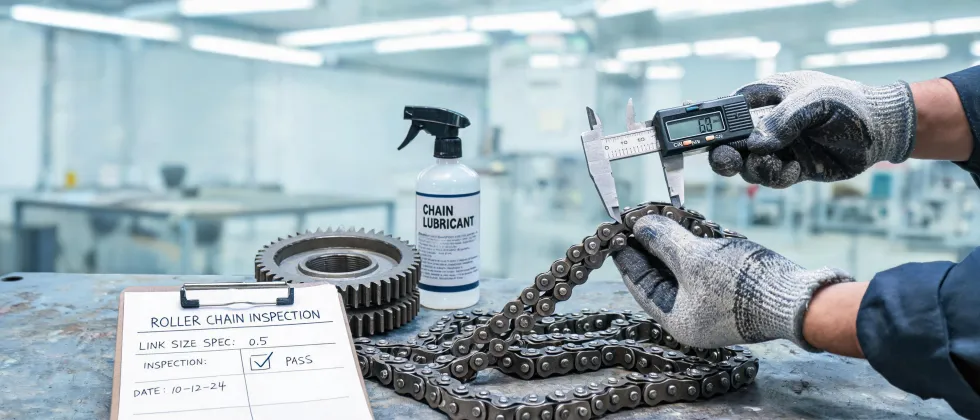
For this environment, I’d go with a premium roller chain from a known manufacturer. A Tsubaki chain, for instance, often includes shot-peened rollers and a pre-lubrication treatment that extends service life under constant load. The upfront cost is higher—maybe 20-30% more than a standard chain—but I’ve tracked the math: our replacement interval went from 8 months to 14 months, saving roughly $1,400 per line per year in parts and labor.
When I compared our 2024 orders side by side—Tsubaki vs. a budget alternative—I got the insight I needed: the premium chain cost 23% more per unit but we replaced it 43% less often. That’s a pure TCO win.
Same thinking applies to v belt tensioners. For a line that runs around the clock, I spec a manual tensioner with a locking mechanism—not an auto-tensioner. The auto type can creep over time, creating micro-slip that wears belts faster. We tested both on a packaging line in Q3 2024. The manual unit held tension for 11 months without adjustment; the auto needed re-tensioning at 6 months (and belt wear was 18% higher).
One caution: I’m not a design engineer, so I can’t speak to dynamic load calculations. What I can tell you from a procurement perspective is to verify that tensioner’s spring constant matches your OEM spec. I once saved $80 buying an “compatible” tensioner—ended up spending $400 on a rush reorder when it couldn’t hold the correct force.
Scenario B: Variable-speed or heavy shock load applications
Your priority: Absorb vibration and misalignment without failure.
Here’s where the market splits: you can go with a jaw-style coupling (low cost, decent damping) or a gear coupling (higher cost, higher torque density). I’d actually recommend a flexible coupling like a Fernco-type (technically an elastomeric connector) for many pump and compressor setups, but only after doing the torque math.
For our main compressor drive, we had a serious misalignment issue—about 0.012 inches offset. The original gear coupling transmitted noise and vibration straight to the bearing housing. We switched to an elastomeric style (similar in principle to a Fernco flexible coupling) at about 40% less cost than a new gear coupling. Side effect: our bearing replacements dropped from twice a year to once in 18 months. That’s about $600 per year in avoided bearing cost and downtime.
But—and this is the part that surprised me—if your application involves regular reversals or clutching, stick with the gear type. I tested an elastomeric coupling on a reversing conveyor once. Lasted 3 months before the rubber tore. The gear coupling cost 2x but ran for 4+ years.
Scenario C: High precision, low-speed positioning
Your priority: Accuracy and repeatability. Speed is secondary.
When our R&D lab needed a precision lifting stage for a test fixture, we looked at both ball screw and belt-driven linear actuators. The engineers initially recommended a ball screw: excellent positioning accuracy, high load capacity.
But here’s the cost controller in me: the ball screw actuator (with servo motor) was quoted at $3,200. The belt-driven alternative: $1,100. For a lab application with 50 mm travel and 2 kg load, the required repeatability was 0.5 mm. The belt-driven unit’s spec sheet claimed 0.1 mm repeatability. We tested it—ran 200 cycles—and it held 0.08 to 0.12 mm. Well within spec. Saved $2,100 for one-off lab equipment that sees maybe 50 cycles a month.
Quick reality check: how fast can a linear actuator move in this scenario? For a belt-driven unit, top speed often exceeds 2 m/s, but we only needed 200 mm/s. Plenty of headroom. For ball screws, speed is limited by critical RPM (screw whipping), which can be complex to calculate—so if speed is important, I’d ask the manufacturer for a duty cycle recommendation.
Scenario D: Budget-sensitive, lower duty applications
Your priority: Get the job done with minimum spend, but not at the cost of safety.
This is where I’d recommend the “good enough” tier—but with a framework for knowing when that’s actually acceptable. For a light conveyor moving boxes at a distribution center (8 hours/day, 5 days/week), a standard roller chain from a mid-tier brand is fine. You don’t need Tsubaki-level pre-stressing for that duty.
I compared quotes for a $4,200 annual contract for conveyor chains in 2023. Vendor A (Tsubaki) quoted $2.40/pitch. Vendor B (budget) quoted $1.55/pitch. I almost went with B until I calculated TCO: B charged $0.25/pitch for joining links (Tsubaki includes them), $0.10/pitch for shipping (bulk vs bulk). Total with Tsubaki: $2.40 inclusive. Total with B: $1.55 + $0.25 + $0.10 = $1.90/pitch. Still cheaper—but only 21% less, not 35%. Given the reliability difference, we split the order: 60% Tsubaki for critical lines, 40% budget for low-risk sections. That hybrid saved us $680 in 2024 with zero failures on either side.
What about v belt tensioners here? A simple spring-loaded idler at $12 works fine. You don’t need a $45 heavy-duty unit if the belt runs at 500 RPM and only powers a small blower.
How to figure out which scenario you’re in
Here’s the simple decision framework I now use:
- If your line runs 24/7 or downtime costs >$500/hour → Scenario A. Premium chain, manual locking tensioners, no shortcuts on couplings. TCO math almost always favors higher-quality components here.
- If your equipment experiences shock loads or misalignment → Scenario B. Consider elastomeric couplings for moderate demands, but verify torque and misalignment tolerance before switching from a gear coupling.
- If you need precise positioning at low speeds → Scenario C. Don’t default to a ball screw actuator. Test whether a belt-driven unit (or a simple lead screw) can meet your repeatability spec. The savings can be 50-60%.
- If your application runs less than 8 hours/day, is low load, or is non-critical → Scenario D. Budget components can work, but structure your split: buy premium for the 20% of critical points, budget for the rest. That 80/20 rule has saved me about $1,200 per year.
One final thought from my experience: the component that works for your neighbor’s plant may be the wrong choice for yours. I’ve learned to ignore generalizations like “always buy premium” or “just get the cheapest.” The truth is in the details of your specific duty cycle, environment, and downtime cost. When I started auditing our actual failure data instead of following industry buzz, our total transmission maintenance spend dropped about 14% per year.
Prices referenced are from 2024 quotes in the U.S. industrial market; verify current rates with your distributor. Component life and reliability data are based on our own internal tracking and will vary by operating conditions.