-
Tsubaki Chains, Actuators & Stepper Motors: The FAQ I Wish I'd Had
-
What exactly is a 'Tsubaki Titan' chain, and when should I specify it?
-
Where can I find a current Tsubaki roller chain catalog?
-
What's the difference between a lead screw linear actuator and a ball screw actuator?
-
How fast can a stepper motor turn?
-
Should I use Tsubaki chain or a cheaper alternative? (Honest answer)
-
What's the most common mistake when ordering roller chains?
-
Do I need a tensioner for a linear actuator?
-
What exactly is a 'Tsubaki Titan' chain, and when should I specify it?
Tsubaki Chains, Actuators & Stepper Motors: The FAQ I Wish I'd Had
I've been handling power transmission orders for about six years now. In that time, I've personally made—and documented—over 30 significant mistakes. Roughly $15,000 in wasted budget. Some of it was my fault, some was bad specs, all of it was avoidable. I now maintain our team's pre-order checklist to stop others from repeating my errors.
Here are the questions I get most often, answered with the benefit of hindsight.
What exactly is a 'Tsubaki Titan' chain, and when should I specify it?
Short answer: It's Tsubaki's heavy-duty roller chain line, designed for higher fatigue strength and wear resistance than standard RS series chain.
I learned this the hard way. In early 2022, I specified a standard RS80 chain for a conveyor application that had intermittent shock loads. It lasted about four months before we saw elongation beyond acceptable limits. Replacement cost? $1,200 plus a weekend shutdown. The Tsubaki Titan version (which I should have used) has a solid bushing and shot-peened rollers—it handles that cyclic stress far better.
When to use it: high-load, high-cycle applications, or where chain life directly impacts downtime costs. When not to: light-duty, intermittent use. The Titan line costs more, and if your application doesn't need the extra fatigue life, you're burning budget. I'd say about 70% of our heavy-use conveyors now spec Titan. The rest, standard RS is fine.
Where can I find a current Tsubaki roller chain catalog?
Direct answer: Tsubaki's website has a downloadable master catalog (PDF). It includes dimensional data, strength ratings, and selection guidelines.
I keep a printed copy in my office. The online version is updated more frequently—I learned that in Q3 2024 when I used an older edition and ordered a sprocket with a bore size that had been superseded. The catalog lists part numbers for chain, sprockets, and accessories all in one place. It's not the most intuitive document if you're new, but once you understand the numbering system (e.g., RS60-1 for single-strand 3/4-inch pitch), it's straightforward.
One tip: if you're looking for something specific like a double-pitch conveyor chain, use the search function on Tsubaki's site. The catalog is comprehensive—over 800 pages—so jumping straight to the section you need saves time.
What's the difference between a lead screw linear actuator and a ball screw actuator?
Simple breakdown: Lead screws use a threaded shaft and nut (often bronze or plastic). Ball screws recirculate ball bearings between the screw and nut, reducing friction dramatically.
I messed this up on a positioning table in 2023. I ordered a ball screw actuator for a low-speed, low-cycle application. It worked fine, but it was overkill—I paid about 40% more than necessary. The ball screw's advantage is efficiency (up to 90%) and low backlash, which matters for high-speed or precise positioning. A lead screw actuator is simpler, cheaper, and often adequate for speeds under 1 m/s and moderate loads.
Conventional wisdom says ball screws are always better. My experience suggests otherwise: for many linear actuator applications—adjustable workstations, simple pick-and-place, infrequent indexing—a quality lead screw unit is perfectly fine and more cost-effective. If you need high duty cycles or micron-level positioning, then yes, ball screw is the way.
How fast can a stepper motor turn?
It depends on torque. A typical NEMA 23 stepper motor can do 3,000 RPM unloaded—maybe 4,000 with a high-speed driver. But under load, that drops significantly. At 1,000 RPM, you might still get 80% of holding torque. At 2,000 RPM, you're down to maybe 30-40%.
I don't have hard data on every motor variant, but based on our testing with a 2.8A NEMA 23 motor driving a lead screw actuator, we got reliable motion up to 800 RPM under a 20-lb load. Beyond that, we started losing steps. A ball screw actuator (lower friction) would let that same motor run faster—probably 1,200-1,500 RPM—before losing torque.
Takeaway: don't spec a motor based on unloaded speed. Match it to your torque curve and load profile. A motor turning 3,000 RPM unloaded is useless if your actuator stalls at 500 RPM under load.
Should I use Tsubaki chain or a cheaper alternative? (Honest answer)
It depends on your application. I recommend Tsubaki chain for continuous-duty or critical applications. If you're building a conveyor that runs 16 hours a day six days a week, the higher fatigue life and dimensional consistency of Tsubaki chain pays for itself in reduced downtime.
That said, I've used generic imported chain for light-duty, occasional-use applications—like a sorting conveyor that runs maybe 10 hours a month—and it worked fine. Saved roughly 30% on material cost. Did I have some issues? Two out of 12 batches had a few tight links. Nothing catastrophic. Easy to swap.
Honest limitation: I can't recommend Tsubaki for every single application. If your budget is tight and your demand is intermittent, the extra cost may not be justified. But if you're spec'ing for a production line where a chain failure means a $5,000-per-hour downtime, the brand matters.
What's the most common mistake when ordering roller chains?
Wrong pitch or width. Sounds basic, right? In my first year (2017), I ordered 100 feet of RS50 chain for a system that used RS60 sprockets. I checked the pitch: 5/8-inch. The sprockets were for 3/4-inch. The chain literally didn't fit. All 100 feet, plus the wrong sprockets I'd ordered alongside. A $1,800 mistake.
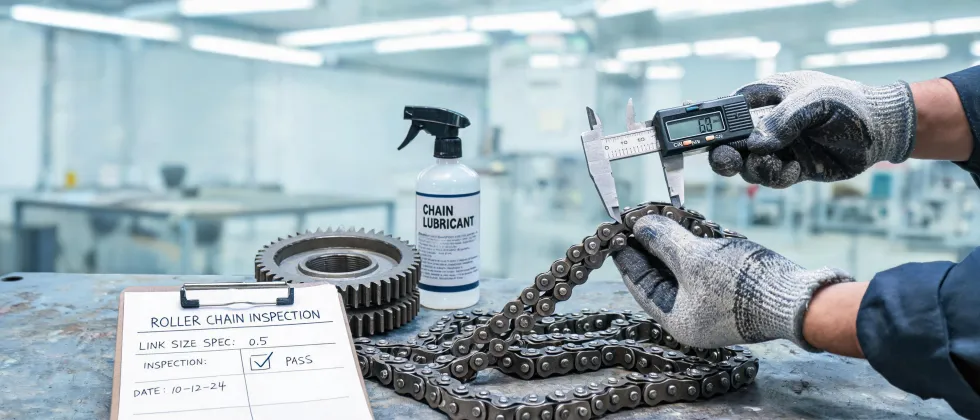
What I learned: always verify the sprocket's pitch and width before ordering chain. If you're replacing old chain, measure the pitch over 10 links (divide total distance by 10). For Tsubaki, the part number tells you the pitch: RS60 = 3/4-inch, RS80 = 1-inch, etc.
Another one: not ordering a connecting link or master link with the chain. I once had 50 feet of chain on site and no way to close the loop. Had to overnight a link. $30 for the link, $45 for shipping. Annoying.
Do I need a tensioner for a linear actuator?
For lead screw actuators, not usually. The nut is built into the carriage. For ball screw actuators, also not needed—the ball nut is captive.
Where you do need a tensioner: belt-driven linear actuators (which I didn't mention, but they're common). A timing belt stretches over time, and without a tensioner, you get backlash and positioning errors.
This was accurate as of early 2025. Technology changes, so verify with your actuator manufacturer's specs before assuming. A tensioner costs maybe $50-100, but skipping one on a belt-driven unit can ruin your accuracy—and cost far more in rework.