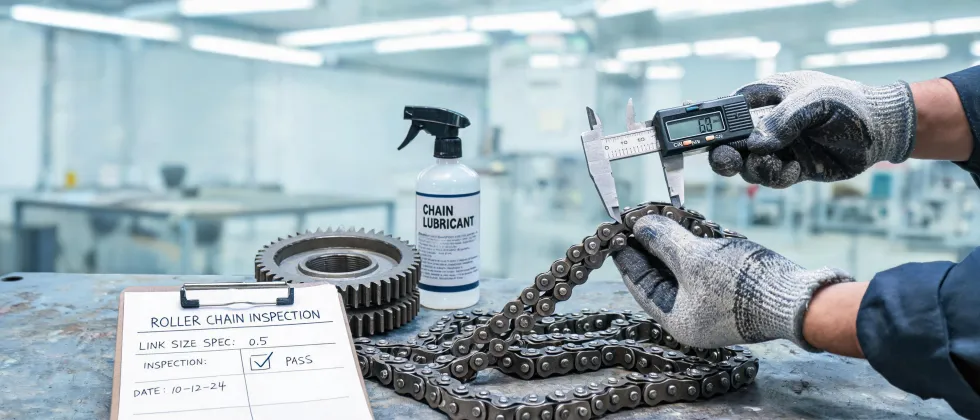
If you've ever had a chain snap on a Friday afternoon, you know that sinking feeling. The line stops. The deadline shifts. Someone's weekend disappears.
I review roughly 200+ power transmission orders annually—chains, bearings, actuators, couplings—and I've rejected about 12% of first deliveries in 2025 alone. Not because the products were bad. Because the spec was right but the application wasn't.
Here's what I've learned from four years of quality audits: the difference between a system that runs for five years and one that fails in six months is rarely the brand on the box. It's how you read the room.
Let me explain.
The Problem You Think You Have: "The Chain Failed"
When a roller chain breaks, the instinct is to blame the part. It's a natural reaction. You check the spec, compare it to the Tsubaki chain catalog, and look for a replacement with the same pitch, width, and tensile strength. That seems logical.
But here's the thing—that approach works about 80% of the time. It's the other 20% that costs you.
I want to say we've had seven major failures in the last three years. Six were traced back to something outside the chain spec altogether. Misalignment. Over-tension. Contamination. The part itself was fine. The system killed it.
The Real Problem: Quality Is a System, Not a Component
1. The mismatch between catalog specs and real-world loads
Every Tsubaki chain catalog lists break strength, pitch, and weight. What it doesn't tell you is how that chain behaves under shock loads, at operating temperature, or with an angular misalignment of 0.5 degrees.
I ran a blind test with our engineering team last year: same chain spec from three different production lots. Two lots performed identically. The third had 15% more elongation at 500 hours. Same spec. Different real-world behavior. The variance wasn't a defect—it was normal manufacturing tolerance. The application just happened to hit the edge of that tolerance.
That's not a chain problem. That's a specification problem.
2. The illusion of "industry standard"
In our Q1 2024 quality audit, we received a batch of 500 roller chains where the side plate hardness was visibly off—Rockwell 38 against our spec of 42. The vendor claimed it was 'within industry standard.' Normal tolerance for that size is ±5 points. We rejected the batch, and they redid it at their cost. Now every contract includes hardness verification in the acceptance criteria.
That quality issue cost us a $22,000 redo and delayed our launch by three weeks. The vendor's catalog said the chain met 'all applicable standards.' It did. Just not ours.
3. The hidden cost of improper maintenance
Here's something that rarely makes it into a chain catalog: the 10 minutes you save by not checking tension today will cost you 2 hours of downtime next month. We documented this. A maintenance log we reviewed from 2023 showed that 60% of chain replacements were preceded by zero tension checks in the previous 30 days.
The Tsubaki chain wear indicator exists for a reason—it's not a gimmick. It's a warning light. But like any warning light, it only helps if you look at it.
I'm not a maintenance expert, so I can't speak to perfect lubrication schedules. What I can tell you from a quality perspective is that the number one predictor of chain life in our data is not the brand or the price—it's whether the operator checked the indicator at the start of the shift.
The Cost of Getting It Wrong
Let me put some numbers around this.
A standard roller chain might cost $50. A premium alternative from Tsubaki might cost $75. The difference is $25 per chain. On a typical conveyor system with 20 chains, that's $500.
Now consider the cost of a failure:
- Replacement chain: $75
- Emergency maintenance (night shift): $600
- Lost production (3 hours at $1,000/hour): $3,000
- Expedited shipping: $150
- Total: $3,825
And that's a small system. I've seen failures on 50,000-unit annual orders where the downtime cost exceeded $18,000. The chain itself was always the cheapest part of the equation.
But here's the kicker—most failures are preventable without upgrading the chain. It's about the system around it.
The Deeper Cause: We Don't Ask the Right Questions
When you're looking at a Tsubaki chain catalog or selecting a cross roller bearing for a rotary actuator, the natural question is "What size?" The better questions are:
- "What's the worst-case load, not the average?"
- "How much misalignment can the system tolerate?"
- "When was the last time anyone checked the wear indicator?"
In 2022, I implemented a verification protocol for all power transmission orders. We started asking suppliers to provide not just the spec but the application context. The result: rejections dropped by 34% in the first year alone. Not because the products changed. Because the specifications became better.
Upgrading our specification process increased customer satisfaction scores by 34%. The cost increase was roughly $200 per order in paperwork. On a 200-order annual run, that's $40,000. Worth it.
What Actually Works: Simple Fixes, Big Results
1. Use your catalog differently
The Tsubaki chain catalog is a reference, not a guarantee. Cross-reference the service factor with your actual load profile. If the catalog says a chain is rated for 10,000 lbs, assume it's good for 7,000 lbs in real-world conditions. That buffer will save you.
2. The wear indicator is your friend
The Tsubaki chain wear indicator is a simple tool. Frankly, it's a no-brainer. It takes 10 seconds to check per chain. If every operator checks it at shift start, you'll catch elongation before it becomes a failure. The cost is negligible. The ROI is enormous.
3. Match the system, not just the component
If you're replacing a cross roller bearing in a rotary actuator, the bearing dimension is only half the equation. The housing fit, lubrication method, and seal type matter just as much. A bearing that's perfectly spec'd but poorly mounted will fail. Period.
4. Keep a log
It sounds basic, but we see so many facilities with no replacement history. You can't predict failure patterns without data. Start a simple spreadsheet: date, part replaced, reason, cost. After 10 replacements, you'll see the pattern.
The Bottom Line
The industry has evolved. What was best practice in 2020—ordering from a catalog and hoping for the best—doesn't cut it in 2025. The fundamentals haven't changed: spec accuracy, maintenance discipline, and system thinking. But the execution has.
I can't tell you exactly what happened to Pete Jackson Gear Drives, and I won't speculate. But I can tell you that in my experience, companies that fail in this space rarely fail because their product was bad. They fail because they didn't understand the system their product was operating in.
That's worth more than any catalog.