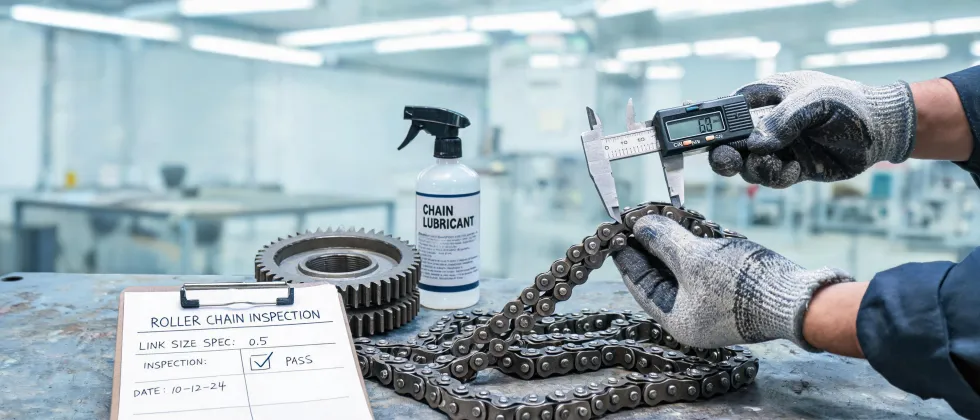
Here's a situation I run into a lot: A maintenance engineer is designing a simple linear drive. They need a chain for tension, a couple of bearings for the idlers, a timing belt to sync things, and a stepper motor to power the whole thing. So they order the chain from their usual supplier, grab some bearings from a big-box distributor, find a timing belt kit on Amazon, and pick up a stepper motor from an electronics surplus store.
Look, I get it. It seems efficient. You're price-shopping each component individually. But after four years of reviewing orders (note to self: I really should compile our rejection stats), I've seen this approach cause a lot of headaches. So let's compare two approaches: the mix-and-match approach vs. the tsubaki-chain integrated approach.
The Framework: What We're Comparing
We're comparing a drive system built from five generic or unbranded components vs. one built from Tsubaki components (tsubaki-chain roller chain, precision roller bearings, a timing belt kit from their power transmission line, and a stepper motor). The comparison isn't about which is 'better' in a vacuum. It's about which approach makes more sense when you factor in time, risk, and rework.
Here are the three dimensions we'll look at:
- Product quality & consistency
- Technical support & documentation
- Long-term cost & preventive maintenance
Dimension 1: Product Quality & Consistency
The Generic Mix: A Gamble
I don't have hard data on the industry-wide failure rate of generic components, but based on our orders, my sense is that quality issues affect about 8-12% of first deliveries from unbranded suppliers. Things like inconsistent hardness on chain pins, loose tolerances on bearing races, or belt misalignment.
For example, last year we got a batch of 'precision' bearings from a new supplier. The spec sheet said they met ABEC-1 tolerance. When we measured them (circa Q2 2024), the inner race diameter was off by 0.003 inches on about 15% of the parts. Normal tolerance is 0.0005 inches. The vendor claimed it was 'within industry standard.' We rejected the batch. That cost us a week of delays.
The Tsubaki Approach: Consistency
Tsubaki-chain products, on the other hand, come with traceable QC documentation. I've specified their tsubaki lambda chain for a conveyor system where we needed consistent elongation over 10,000 hours. The data we got back from their technical team was inline with the spec sheet. That's the difference: consistency.
Verdict: Generic gives you a price advantage, but it's a gamble. Tsubaki gives you consistency. Simple.
Dimension 2: Technical Support & Documentation
The Generic Mix: You're On Your Own
When you buy a generic bearing, you get a box and an invoice. When you buy a generic stepper motor, you get a datasheet with some cryptic Chinese characters. If something goes wrong, you're troubleshooting by yourself.
I went back and forth on ordering a timing belt kit from a generic supplier and Tsubaki for about two weeks. The price difference was about 30% in favor of the generic. But then I thought about what happens if the belt slips. With generic, I'd have to measure the pitch, find a cross-reference, and guess at the material spec. With Tsubaki, I could call their support and get a replacement within 24 hours.
The Tsubaki Approach: Resources at Your Fingertips
Tsubaki has a full catalog, an online configurator (for tsubaki-chain and precision roller bearings), and application guides. For their tsubaki zip chain lifter, they provide installation manuals with torque specs. For their linear actuators, they provide load-life calculations.
Verdict: Generic leaves you with no safety net. Tsubaki provides a technical buttress. If your application is critical, the difference is huge.
Dimension 3: Long-Term Cost & Preventive Maintenance
The Generic Mix: The Hidden Rework
Here's the thing about the mix-and-match approach: it looks cheap on the invoice, but rework is where the cost hides. I once inherited a system where someone had mixed a generic chain with a generic sprocket and a generic motor. The chain wore out in 6 months. The sprocket had worn teeth. The motor bearings were shot. The total cost to replace everything? About $4,500. The cost to replace them with Tsubaki components from the start? About $3,200. The rework also cost us a week of downtime. (Mental note: track this case study better.)
In hindsight, I should have pushed back on the original spec. But with the project timeline, I didn't have the data to argue.
The Tsubaki Approach: Designed to Work Together
When you use a tsubaki-chain with a Tsubaki sprocket and a Tsubaki precision roller bearing, they're designed to work together. The chain pitch matches the sprocket tooth profile. The bearing fits the shaft tolerance. The tsubaki lambda chain has a specific lubrication requirement that matches their maintenance recommendations. It's about the system working as a system, not as a collection of parts.
Verdict: The cheapest invoice doesn't mean the cheapest system. Preventive ordering beats corrective replacement. 5 minutes of verification beats 5 days of correction.
Selection Guide: When to Use What
When to buy from Tsubaki (or a similar integrated supplier)
- Critical applications where downtime costs more than the parts. That's basically any production line.
- When you need technical support for sizing or troubleshooting.
- When you're building a standard system that you'll need to maintain for years. Interchangeability matters.
- For components like timing belt kits and precision roller bearings where tolerance stack-up can ruin the whole system.
When generic or mix-and-match makes sense
- Prototyping where you don't care about longevity.
- Non-critical, low-load applications like a simple jig in a workshop.
- When you have in-house engineering capacity to do the cross-referencing and troubleshooting yourself.
- For commodity items like standard bolts or low-speed bearings where failure is inconvenient but not disastrous.
Final Thought
Between you and me, I still mix-and-match for my home projects. But for anything that goes into a customer's production line, I go with a reputable brand. The peace of mind alone is worth about a 20% premium. The rework savings are worth the other 80%.
So when you're specifying that next drive system, ask yourself: what's the cost of getting it wrong?