When a Lower Price Isn't the Better Deal
In 2023, I was tasked with sourcing replacement parts for a conveyor line in our plant. I got two quotes: one for a Tsubaki roller chain (the spec called for ANSI #60) and another for a Columbus timing belt replacement that seemed to fit just as well. The timing belt was roughly $150 cheaper upfront. A no-brainer, right? Not so fast.
I'm an office administrator for a mid-sized manufacturing company—about 200 employees across two facilities. I manage around $400k in annual MRO spend, and power transmission components are a significant chunk. Over the years, I've learned that the cheapest upfront option often costs more in the long run. This article compares two procurement mindsets: unit-price thinking versus total-cost-of-ownership (TCO) thinking. By the end, you'll see why TCO matters even for "commodity" parts like chains and belts.
Dimension 1: Upfront Costs – The Trap of the Sticker Price
Unit-price thinking says: pick the lowest quoted price. For our conveyor project, the Columbus timing belt was $480 installed (including a tensioner). The Tsubaki roller chain kit (chain + master link + a chain breaker tool) was $630. A $150 difference—$630 vs $480.
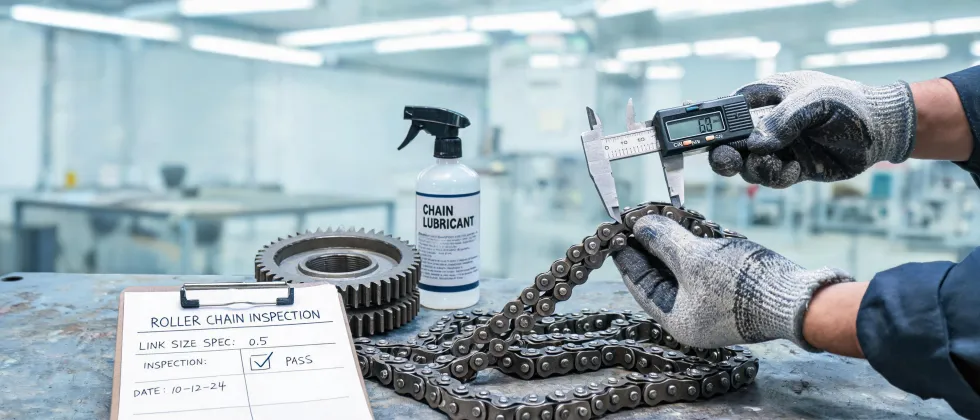
But TCO thinking asks: what else is included? The chain kit included a tsubaki chain breaker, a tool specifically designed for installing roller chain. Without it, we'd have to buy or rent a chain breaker separately—another $40–60. More importantly, the chain is rated for 10,000 hours of operation under our load, while the timing belt manufacturer recommended replacement at 6,000 hours. So over a 3-year period, we'd likely replace the belt once more than the chain. That's an extra $480 for the second belt, plus downtime.
This was accurate as of Q4 2023. Pricing changes fast—verify current rates before budgeting.
Dimension 2: Hidden Costs – Installation, Tools, and Maintenance
It's tempting to think that a simple belt swap is faster than installing chain. But in our case, the timing belt required a special tensioning tool and realignment checks that took an extra hour. The roller chain, using the Tsubaki chain breaker, was quicker—about 45 minutes once the team got the hang of it.
Think about a heavy duty linear actuator for positioning tasks. If you buy a cheap actuator, you might save $200 initially, but if it fails after 18 months, you pay for a replacement plus labor. A Tsubaki linear actuator (which we use in one of our packaging stations) came with a 2-year warranty and local support—no shipping delays. The TCO calculation made it the better buy, even though the sticker was higher.
People often assume that maintenance costs are roughly the same across brands. Actually, quality manufacturing reduces frequency. The tsubaki roller chain we installed required lubrication only every 200 hours; the cheaper chain we tried earlier needed it every 80 hours. Over a year, that's 3× the maintenance labor—a hidden cost many overlook.
My experience is based on about 60 component upgrades over four years. Your mileage may differ if you're in a lighter-duty application.
Dimension 3: Risk and Opportunity – What If Things Go Wrong?
If you're wondering what's a servo motor—it's a precise rotary actuator used for motion control. But for linear motion, many people look at a heavy duty linear actuator instead. The risk dimension in TCO: what happens when a component fails? A servo motor failure might stop an entire assembly line for hours. The cost of downtime far exceeds the component price.
In our conveyor project, the Columbus timing belt had a lead time of 2 weeks from the distributor. The Tsubaki chain, on the other hand, was stocked locally—I could get it overnight. That reduced our risk of extended downtime. Plus, the chain's modular nature meant we could replace individual links instead of the whole assembly when a single link wore out. That's a real TCO advantage.
The bottom line: unit-price thinking ignores consequences. If a cheap part fails and costs you 3 hours of production (say $500/hour), the real cost skyrockets.
When to Use Each Approach – A Practical Guide
So when should you think TCO vs. just compare prices? Here's my rule of thumb:
- Use TCO thinking when: the component is critical, the application is continuous, or failure causes significant downtime. This includes nearly all power transmission parts—chains, belts, bearings, linear actuators.
- Unit-price thinking might work for: non-critical single-use items, or when you have so many vendors that evaluation costs outweigh savings. But even then, I'd run a quick TCO estimate.
In my department, I now require a TCO analysis for any purchase over $500. It's saved us roughly $8,000 per year in hidden costs. Our operations manager appreciates the reduced breakdowns, and finance likes the predictable spend.
Final thought: Whether you're comparing a Tsubaki roller chain with a timing belt replacement, or evaluating a heavy duty linear actuator vs. a servo-driven alternative, remember that price is just the beginning. The real cost is in installation, maintenance, and reliability. Make the TCO call.